




With the help of a simple diagram, show the location of four taste receptors in human beings.
Answer
 Verified
509.1k+ views
Hint: Taste receptors are a type of protein on the tongue that recognize taste stimuli of various foods. It functions as the initial component in the process of sensing and differentiating ingested material. Taste stimuli can be categorized into at least five classes namely sweet, salty, sour, bitter, and umami (the savoury taste). These taste receptors are expressed on the apical membranes of taste receptor cells which extend into the oral cavity.
Complete explanation:
The diagram below shows different taste receptors in the human tongue.
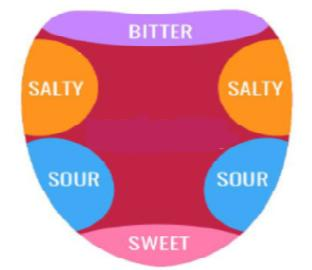
Bitter taste receptors: There are approximately \[25\] bitter receptors present in the human tongue. In humans the gene responsible for encoding this ability is the \[TAS2R\] gene family. The bitter taste receptor is encoded on chromosomes \[7\] and \[12\]. They are made up of alpha subunits of G-protein coupled receptors.
Sweet taste receptors: The sweet receptors are expressed in taste cells located in the taste buds of the tongue. They sense sweet substances in the oral cavity and transmit the signals to adjacent neurons. The receptors are heterodimer of two G protein coupled receptors called \[T1R2\] and \[T1R3\]. It has been found that the sweet receptors are also expressed in gastrointestinal tract, pancreatic \[\beta \]-cells and glucose responding neurons in the brain.
Salty taste receptors: The simplest receptor present in the mouth is the salt receptor. Saltiness is a taste produced by the presence of sodium ions. The salt taste is sensed by a sodium channel in the taste cell wall which allows sodium ions to enter the cell. This channel is known as an epithelial sodium channel (ENaC). The entered sodium ions open the voltage dependent calcium channels ultimately leading to neurotransmitter release.
Sour taste receptors: Sour taste receptors detect acidity. They are detected by a small set of cells that are distributed throughout the taste buds called Type III taste receptor cells. The sour substances are rich in $H^+$ ions and can enter type III taste cells through a proton channel. This will be followed by signal release to the brain.
Note:
The tongue can also sense other sensations which are not included in the basic tastes. These are detected by the somatosensory system. Some of them are pungency, coolness, astringency and metallicness. In humans, taste perception starts to fade around \[50\] years due to loss of tongue papillae and decrease in saliva production.
Complete explanation:
The diagram below shows different taste receptors in the human tongue.
Bitter taste receptors: There are approximately \[25\] bitter receptors present in the human tongue. In humans the gene responsible for encoding this ability is the \[TAS2R\] gene family. The bitter taste receptor is encoded on chromosomes \[7\] and \[12\]. They are made up of alpha subunits of G-protein coupled receptors.
Sweet taste receptors: The sweet receptors are expressed in taste cells located in the taste buds of the tongue. They sense sweet substances in the oral cavity and transmit the signals to adjacent neurons. The receptors are heterodimer of two G protein coupled receptors called \[T1R2\] and \[T1R3\]. It has been found that the sweet receptors are also expressed in gastrointestinal tract, pancreatic \[\beta \]-cells and glucose responding neurons in the brain.
Salty taste receptors: The simplest receptor present in the mouth is the salt receptor. Saltiness is a taste produced by the presence of sodium ions. The salt taste is sensed by a sodium channel in the taste cell wall which allows sodium ions to enter the cell. This channel is known as an epithelial sodium channel (ENaC). The entered sodium ions open the voltage dependent calcium channels ultimately leading to neurotransmitter release.
Sour taste receptors: Sour taste receptors detect acidity. They are detected by a small set of cells that are distributed throughout the taste buds called Type III taste receptor cells. The sour substances are rich in $H^+$ ions and can enter type III taste cells through a proton channel. This will be followed by signal release to the brain.
Note:
The tongue can also sense other sensations which are not included in the basic tastes. These are detected by the somatosensory system. Some of them are pungency, coolness, astringency and metallicness. In humans, taste perception starts to fade around \[50\] years due to loss of tongue papillae and decrease in saliva production.
Recently Updated Pages
Master Class 10 Computer Science: Engaging Questions & Answers for Success

Master Class 10 General Knowledge: Engaging Questions & Answers for Success
Master Class 10 English: Engaging Questions & Answers for Success
Master Class 10 Social Science: Engaging Questions & Answers for Success
Master Class 10 Maths: Engaging Questions & Answers for Success
Master Class 10 Science: Engaging Questions & Answers for Success
Trending doubts
What is the median of the first 10 natural numbers class 10 maths CBSE
Which women's tennis player has 24 Grand Slam singles titles?
Who is the Brand Ambassador of Incredible India?
Why is there a time difference of about 5 hours between class 10 social science CBSE
Write a letter to the principal requesting him to grant class 10 english CBSE
State and prove converse of BPT Basic Proportionality class 10 maths CBSE