




With the help of a ray diagram, state what is meant by refraction of light. State Snell’s law for refraction of light and also express it mathematically.
Answer
 Verified
588.6k+ views
Hint:Refraction of light is a natural phenomenon in which a ray of light changes its direction at the interface of two different mediums, when it passes from one medium into another medium. The refraction of light is understood by Snell’s law.
Complete step by step answer:
Refraction of light is a natural phenomenon in which a ray of light changes its direction at the interface of two different mediums, when it passes from one medium into another medium.This can be understood from the figure given below.
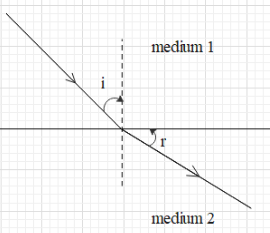
The ray of light is initially travelling in medium 1. Then it encounters medium 2. When the light ray meets the interface of medium 1 and medium 2, it changes its direction. As a result, the light ray appears to be bending at the interface. This bending of light rays is called refraction. The refraction of light is understood by Snell’s law. According to Snell’s law, the ratio of the sine of the angle of incidence (i) and the angle of refraction (r) is equal to the ratio of the speeds of the light ray in both the mediums.
Mathematically, the Snell’s law can be expressed as $\dfrac{\sin i}{\sin r}=\dfrac{{{v}_{i}}}{{{v}_{r}}}$ ….. (i).
Here, ${{v}_{i}}$ is speed of the light in the medium in which it is incident and ${{v}_{r}}$ is speed of the light in the medium in which the light enters after refraction.
In the above figure, ${{v}_{i}}$ is in medium 1 and ${{v}_{r}}$ is in medium 2. The refractive index of a medium is given as $\mu =\dfrac{v}{c}$, where v is the speed of light in the medium and c is the speed of light in vacuum. Therefore, we can write that
${{\mu }_{i}}=\dfrac{{{v}_{i}}}{c}$ and ${{\mu }_{r}}=\dfrac{{{v}_{r}}}{c}$
Then,
${{v}_{i}}=\dfrac{c}{{{\mu }_{i}}}$ and ${{v}_{r}}=\dfrac{c}{{{\mu }_{r}}}$
Substitute these values in (i).
$\Rightarrow \dfrac{\sin i}{\sin r}=\dfrac{\dfrac{c}{{{\mu }_{i}}}}{\dfrac{c}{{{\mu }_{r}}}}$
$\Rightarrow \dfrac{\sin i}{\sin r}=\dfrac{{{\mu }_{r}}}{{{\mu }_{i}}}$.
$\therefore {{\mu }_{i}}\sin i={{\mu }_{r}}\sin r$.
Snell's law is used in this form, most of the time.
Note:Refraction of light is one of the most commonly observed phenomena, but other waves like sound waves and water waves also experience refraction. Refraction makes it possible for us to have optical instruments such as magnifying glasses, lenses and prisms. It is also because of the refraction of light that we are able to focus light on to our retina.
Complete step by step answer:
Refraction of light is a natural phenomenon in which a ray of light changes its direction at the interface of two different mediums, when it passes from one medium into another medium.This can be understood from the figure given below.
The ray of light is initially travelling in medium 1. Then it encounters medium 2. When the light ray meets the interface of medium 1 and medium 2, it changes its direction. As a result, the light ray appears to be bending at the interface. This bending of light rays is called refraction. The refraction of light is understood by Snell’s law. According to Snell’s law, the ratio of the sine of the angle of incidence (i) and the angle of refraction (r) is equal to the ratio of the speeds of the light ray in both the mediums.
Mathematically, the Snell’s law can be expressed as $\dfrac{\sin i}{\sin r}=\dfrac{{{v}_{i}}}{{{v}_{r}}}$ ….. (i).
Here, ${{v}_{i}}$ is speed of the light in the medium in which it is incident and ${{v}_{r}}$ is speed of the light in the medium in which the light enters after refraction.
In the above figure, ${{v}_{i}}$ is in medium 1 and ${{v}_{r}}$ is in medium 2. The refractive index of a medium is given as $\mu =\dfrac{v}{c}$, where v is the speed of light in the medium and c is the speed of light in vacuum. Therefore, we can write that
${{\mu }_{i}}=\dfrac{{{v}_{i}}}{c}$ and ${{\mu }_{r}}=\dfrac{{{v}_{r}}}{c}$
Then,
${{v}_{i}}=\dfrac{c}{{{\mu }_{i}}}$ and ${{v}_{r}}=\dfrac{c}{{{\mu }_{r}}}$
Substitute these values in (i).
$\Rightarrow \dfrac{\sin i}{\sin r}=\dfrac{\dfrac{c}{{{\mu }_{i}}}}{\dfrac{c}{{{\mu }_{r}}}}$
$\Rightarrow \dfrac{\sin i}{\sin r}=\dfrac{{{\mu }_{r}}}{{{\mu }_{i}}}$.
$\therefore {{\mu }_{i}}\sin i={{\mu }_{r}}\sin r$.
Snell's law is used in this form, most of the time.
Note:Refraction of light is one of the most commonly observed phenomena, but other waves like sound waves and water waves also experience refraction. Refraction makes it possible for us to have optical instruments such as magnifying glasses, lenses and prisms. It is also because of the refraction of light that we are able to focus light on to our retina.
Recently Updated Pages
Master Class 12 Business Studies: Engaging Questions & Answers for Success

Master Class 12 Biology: Engaging Questions & Answers for Success
Master Class 12 Chemistry: Engaging Questions & Answers for Success
Class 12 Question and Answer - Your Ultimate Solutions Guide
Master Class 11 Social Science: Engaging Questions & Answers for Success
Master Class 11 English: Engaging Questions & Answers for Success
Trending doubts
Which are the Top 10 Largest Countries of the World?
Draw a labelled sketch of the human eye class 12 physics CBSE
Name the crygenes that control cotton bollworm and class 12 biology CBSE
Differentiate between homogeneous and heterogeneous class 12 chemistry CBSE
Ribosomal RNA is actively synthesised in A Nucleoplasm class 12 biology CBSE
How many molecules of ATP and NADPH are required information class 12 biology CBSE