




With four bases the number of possible triplet codons is
(A) 24
(B) 32
(C) 48
(D) 64
Answer
 Verified
600.3k+ views
Hint:In order to produce proteins inside a cell, it follows two processes, namely transcription and translation. Transcription involves conversion of DNA into mRNA and translation involves conversion of mRNA into protein. Any change in the nucleic acid sequence results in change in amino acid sequence. To understand this, genetic code is important.
Complete answer:
Codon is defined as a sequence of three nucleotides which together form a unit of genetic code. Nucleotide is made up of a ribose sugar, phosphate group and nitrogenous bases. Genetic codon is triplet in nature. Understanding and interpreting genetic codon was a tough job, which involved scientists of various streams. George Gamow, a physicist stated that since there are only four bases, namely adenine, guanine, cytosine and thymine and if they need to code for 20 amino acids, the codon should be triplet in nature.
Permutation combination of 43 , provides 64 codons. It has generated more codons than required.
4 represents the number of nitrogenous bases and 3 assumes that the codon is triplet
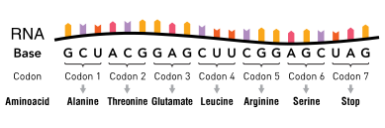
Taking into consideration,
>If the codon is singlet in nature, only 4 codons will be generated.
>If the codon is doublet in nature, only 16 codons will be generated.
>In both the above cases, the number of codons generated are way less than the number of amino acids.
>According to George Gamow and the rule of permutation combination, the base number represents the number of bases and the superscript number represents the nature of codon.
>When four bases are provided, the number of possible triplet codons will be 64 $(4 \times 4 \times 4)$.
Therefore, the correct answer is option (D).
Note: Understanding the rule of permutation combination is necessary in answering these types of questions. Moreover, the proof for genetic codon is triplet in nature was provided by Har Gobind Khorana, Marshall Nirenberg and Severo Ochoa.
Complete answer:
Codon is defined as a sequence of three nucleotides which together form a unit of genetic code. Nucleotide is made up of a ribose sugar, phosphate group and nitrogenous bases. Genetic codon is triplet in nature. Understanding and interpreting genetic codon was a tough job, which involved scientists of various streams. George Gamow, a physicist stated that since there are only four bases, namely adenine, guanine, cytosine and thymine and if they need to code for 20 amino acids, the codon should be triplet in nature.
Permutation combination of 43 , provides 64 codons. It has generated more codons than required.
4 represents the number of nitrogenous bases and 3 assumes that the codon is triplet
Taking into consideration,
>If the codon is singlet in nature, only 4 codons will be generated.
>If the codon is doublet in nature, only 16 codons will be generated.
>In both the above cases, the number of codons generated are way less than the number of amino acids.
>According to George Gamow and the rule of permutation combination, the base number represents the number of bases and the superscript number represents the nature of codon.
>When four bases are provided, the number of possible triplet codons will be 64 $(4 \times 4 \times 4)$.
Therefore, the correct answer is option (D).
Note: Understanding the rule of permutation combination is necessary in answering these types of questions. Moreover, the proof for genetic codon is triplet in nature was provided by Har Gobind Khorana, Marshall Nirenberg and Severo Ochoa.
Recently Updated Pages
Master Class 12 Economics: Engaging Questions & Answers for Success

Master Class 12 English: Engaging Questions & Answers for Success
Master Class 12 Social Science: Engaging Questions & Answers for Success
Master Class 12 Maths: Engaging Questions & Answers for Success
Master Class 12 Physics: Engaging Questions & Answers for Success
Master Class 11 Social Science: Engaging Questions & Answers for Success
Trending doubts
1 ton equals to A 100 kg B 1000 kg C 10 kg D 10000 class 11 physics CBSE
Draw a diagram of nephron and explain its structur class 11 biology CBSE
DNA is not present in A Nucleus B Mitochondria C Chloroplast class 11 biology CBSE
Proton was discovered by A Thomson B Rutherford C Chadwick class 11 chemistry CBSE
Mention the important general characters of Urocho class 11 biology CBSE
Define pneumatic bones class 11 biology CBSE