




Witch’s broom of legumes is due to
(a)Mycoplasma
(b)Bacterium
(c)Fungus
(d)Virus
Answer
 Verified
591.6k+ views
Hint: This is a genus of bacteria that lack a cell wall around their cell membranes. This characteristic makes them naturally resistant to any type of antibiotics that target cell wall synthesis (like the beta-lactam antibiotics). They can be parasitic or saprotrophic.
Complete answer:
Witch-broom disease is a type of disease caused by stress or Mycoplasma. In this, the structure of the plant is modified due to some deformity. In this, there's a dense mass of shoots from one point. This results in a structure resembling a broom.
Additional Information:
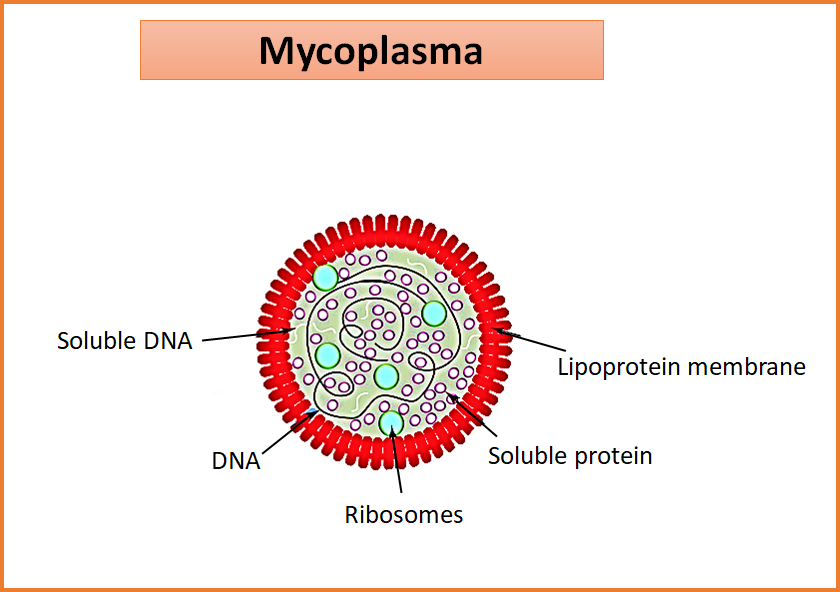
Mycoplasma was earlier known as the PPLO or Pleuropneumonia like organisms. They represent the fungus-like form of branching filaments. The size of PPLO ranges from 0.1-0.3 micrometers. Thus, it is the smallest living cell. The general characteristics of PPLO are-
-They are devoid of a rigid cell wall which makes it highly pleomorphic. They possess a triple-layered cell membrane which is rich in cholesterol and other lipids.
-They are so small that they even pass through bacterial filters.
-They are generally parasitic or saprophytic.
-Due to the absence of a cell wall, they are resistant to certain antibiotics like penicillin.
-They can be inhibited by antiseptic solutions like cetrimide and chlorhexidine.
-They have been observed to cause atypical pneumonia, urethritis, pelvic inflammatory disease, etc.
-They differ from viruses in containing both RNA and DNA and can reproduce in cell-free media.
-They generally reproduce by binary fission or budding.
So, the correct answer is ‘Mycoplasma.’
Note: Mycoplasma was first isolated from bovine pleuropneumonia by Nocard and Roux in 1898. They are Gram-negative organisms but generally stained by the Giemsa stain. It is the smallest living cell while viruses are the smallest structures present on this earth. All mycoplasma except Acholeplasma, require sterols for their growth.
Complete answer:
Witch-broom disease is a type of disease caused by stress or Mycoplasma. In this, the structure of the plant is modified due to some deformity. In this, there's a dense mass of shoots from one point. This results in a structure resembling a broom.
Additional Information:
Mycoplasma was earlier known as the PPLO or Pleuropneumonia like organisms. They represent the fungus-like form of branching filaments. The size of PPLO ranges from 0.1-0.3 micrometers. Thus, it is the smallest living cell. The general characteristics of PPLO are-
-They are devoid of a rigid cell wall which makes it highly pleomorphic. They possess a triple-layered cell membrane which is rich in cholesterol and other lipids.
-They are so small that they even pass through bacterial filters.
-They are generally parasitic or saprophytic.
-Due to the absence of a cell wall, they are resistant to certain antibiotics like penicillin.
-They can be inhibited by antiseptic solutions like cetrimide and chlorhexidine.
-They have been observed to cause atypical pneumonia, urethritis, pelvic inflammatory disease, etc.
-They differ from viruses in containing both RNA and DNA and can reproduce in cell-free media.
-They generally reproduce by binary fission or budding.
So, the correct answer is ‘Mycoplasma.’
Note: Mycoplasma was first isolated from bovine pleuropneumonia by Nocard and Roux in 1898. They are Gram-negative organisms but generally stained by the Giemsa stain. It is the smallest living cell while viruses are the smallest structures present on this earth. All mycoplasma except Acholeplasma, require sterols for their growth.
Recently Updated Pages
Basicity of sulphurous acid and sulphuric acid are

Master Class 11 Business Studies: Engaging Questions & Answers for Success
Master Class 11 Computer Science: Engaging Questions & Answers for Success
Master Class 11 Economics: Engaging Questions & Answers for Success
Master Class 11 Social Science: Engaging Questions & Answers for Success
Master Class 11 English: Engaging Questions & Answers for Success
Trending doubts
One Metric ton is equal to kg A 10000 B 1000 C 100 class 11 physics CBSE
The largest wind power cluster is located in the state class 11 social science CBSE
Explain zero factorial class 11 maths CBSE
State and prove Bernoullis theorem class 11 physics CBSE
What steps did the French revolutionaries take to create class 11 social science CBSE
Which among the following are examples of coming together class 11 social science CBSE