




Why is Primase Needed?
Answer
 Verified
543.9k+ views
Hint: As we already know that genes are nothing but small sequences of DNA, deoxyribonucleic acid compact in long strands of DNA. Many strands of DNA form chromosomes and they are tightly packed with proteins inside a cell. Genes contain all the information which is being carried out from generation to generation. Primase is an enzyme which synthesizes RNA primer for DNA replication and the nucleotides get attached to new nucleotides for extending strands.
Complete answer:
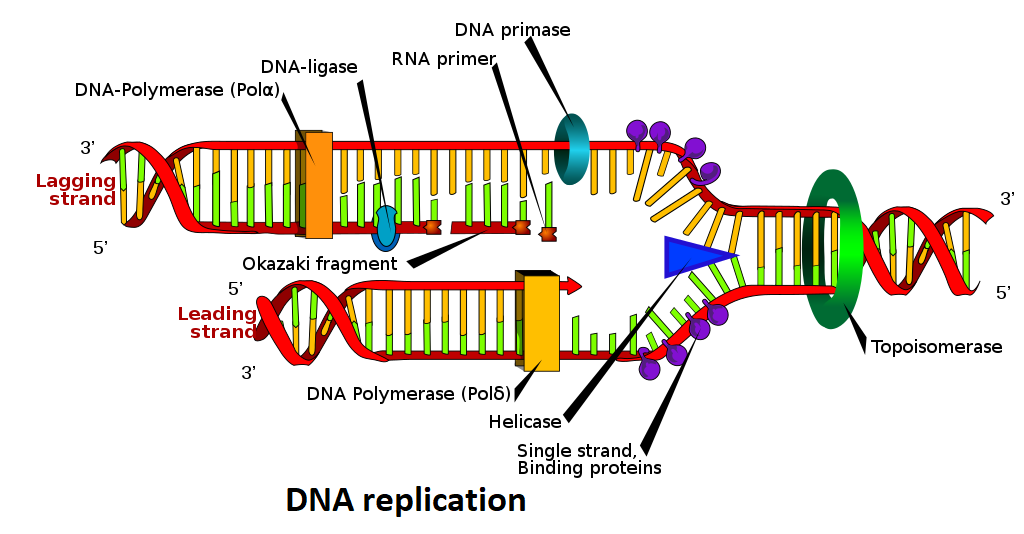
Primase is needed as it is required for the formation of RNA primers which are further required for DNA polymerisation. DNA replication is a term used for the process in which two separated strands of DNA emerge from a single parent DNA molecule. Replication models are of three types- Conservative, Semi-Conservative and dispersive. Conservative replication can be defined as a helix or strand entirely evolved from old DNA and the other helix is evolved from new DNA. Conservative mode is totally the combination of one old and one new DNA strand.
Primer is synthesized to fit into the initiating strand from DNA synthesis and repeatedly on the lagging strand to initiate Okazaki fragments. In the lagging strand the primase plays an important role. Primase synthesizes primers which code for the RNA as well as DNA polymerase.
DNA primases show continual activity at the replication fork. Primers are ribonucleoside rings from four to fifteen nucleotides long. If primase is not present the replication process won’t start. DNA polymerase cannot start the process as they can only add nucleotides.
Note:
Hence, DNA is a complex structure carrying different piles of genes in a compact globule structure. DNA is inherited from one generation to another generation by sexual reproduction. As organisms, especially mammals undergo sexual reproduction and offspring are born having sex chromosomes and genes from both their parents.
Complete answer:
Primase is needed as it is required for the formation of RNA primers which are further required for DNA polymerisation. DNA replication is a term used for the process in which two separated strands of DNA emerge from a single parent DNA molecule. Replication models are of three types- Conservative, Semi-Conservative and dispersive. Conservative replication can be defined as a helix or strand entirely evolved from old DNA and the other helix is evolved from new DNA. Conservative mode is totally the combination of one old and one new DNA strand.
Primer is synthesized to fit into the initiating strand from DNA synthesis and repeatedly on the lagging strand to initiate Okazaki fragments. In the lagging strand the primase plays an important role. Primase synthesizes primers which code for the RNA as well as DNA polymerase.
DNA primases show continual activity at the replication fork. Primers are ribonucleoside rings from four to fifteen nucleotides long. If primase is not present the replication process won’t start. DNA polymerase cannot start the process as they can only add nucleotides.
Note:
Hence, DNA is a complex structure carrying different piles of genes in a compact globule structure. DNA is inherited from one generation to another generation by sexual reproduction. As organisms, especially mammals undergo sexual reproduction and offspring are born having sex chromosomes and genes from both their parents.
Recently Updated Pages
Basicity of sulphurous acid and sulphuric acid are

Master Class 12 Economics: Engaging Questions & Answers for Success
Master Class 12 Biology: Engaging Questions & Answers for Success
Master Class 11 English: Engaging Questions & Answers for Success
Master Class 11 Physics: Engaging Questions & Answers for Success
Master Class 11 Computer Science: Engaging Questions & Answers for Success
Trending doubts
Which are the Top 10 Largest Countries of the World?
Lipids are insoluble in water because they are A Neutral class 12 biology CBSE
The electric field due to a uniformly charged nonconducting class 12 physics CBSE
Suicide bags of cells are aEndoplasmic reticulum bLysosome class 12 biology CBSE
Consider three charges q1 q2 q3 q at the vertices of class 12 physics CBSE
Drive an expression for the electric field due to an class 12 physics CBSE