




Why is an atom neutral?
Answer
 Verified
641.4k+ views
Hint: An atom is composed of neutrons, protons and electrons in such a composition such that the atom develops no charge at all. These are all subatomic particles visible at microscopic level as they are very small.
Complete answer:
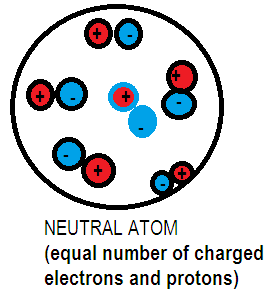
Neutrons are neutral in nature, that is they don’t have a charge of their own and its mass is slightly greater than proton. Protons are positively charged subatomic particles. Each proton has a charge of $1.602 \times {10^{ - 19}}$ C. Electrons are negatively charged sub atomic particles with a charge of $1.602 \times {10^{ - 19}}$C. On observing we come to know that the charge on proton is equivalent to the charge on electron they differ only in their magnitude. Every atom has an equal number of electrons and protons hence the amount of positive charged protons nullifies the amount of negatively charged electrons hence results in no overall charge on the atom.
Additional Information: Many atomic models have been proposed in the past such as Dalton’s invisible atom is composed of subatomic particles carrying positive and negative charges. Different atomic models were proposed to explain the distribution of the charge particles in an atom. Although some of these models were not able to explain the stability of atoms.
Note: Atoms are neutral as long as the numbers of charged protons are equal to the number of charged electrons which will balance all the negative charges to all the positive charges.
Complete answer:
Neutrons are neutral in nature, that is they don’t have a charge of their own and its mass is slightly greater than proton. Protons are positively charged subatomic particles. Each proton has a charge of $1.602 \times {10^{ - 19}}$ C. Electrons are negatively charged sub atomic particles with a charge of $1.602 \times {10^{ - 19}}$C. On observing we come to know that the charge on proton is equivalent to the charge on electron they differ only in their magnitude. Every atom has an equal number of electrons and protons hence the amount of positive charged protons nullifies the amount of negatively charged electrons hence results in no overall charge on the atom.
Additional Information: Many atomic models have been proposed in the past such as Dalton’s invisible atom is composed of subatomic particles carrying positive and negative charges. Different atomic models were proposed to explain the distribution of the charge particles in an atom. Although some of these models were not able to explain the stability of atoms.
Note: Atoms are neutral as long as the numbers of charged protons are equal to the number of charged electrons which will balance all the negative charges to all the positive charges.
Recently Updated Pages
Lysosomes are known as suicidal bags of cell why class 11 biology CBSE

Father s age is three times the sum of the ages of-class-11-maths-CBSE
Give a comparative account of the classes of kingdom class 11 biology CBSE
The ceiling of a long hall is 25m high What is the class 11 physics CBSE
Name the Largest and the Smallest Cell in the Human Body ?
Draw a welllabelled diagram of a plant cell class 11 biology CBSE
Trending doubts
Find the value of the expression given below sin 30circ class 11 maths CBSE
One Metric ton is equal to kg A 10000 B 1000 C 100 class 11 physics CBSE
Two of the body parts which do not appear in MRI are class 11 biology CBSE
10 examples of friction in our daily life
Proton was discovered by A Thomson B Rutherford C Chadwick class 11 chemistry CBSE
10 examples of diffusion in everyday life