




Who discovered Amoeba?
Answer
 Verified
611.7k+ views
Hint: It was discovered by a German naturalist, painter, and entomologist in the year 1755. He was born on 30 March 1705. It is eukaryotes whose bodies most often consist of a single cell. Their cytoplasm and cellular contents are encased inside a cell membrane.
Complete answer:
Rosel von Rosenhof discovered amoeba in 1755. It is found in freshwater. Types of pseudopodia are lobopodia. A contractile vacuole is present for osmoregulation. The mitochondria are frequently observed aggregated around the contractile vacuole. The cytoplasm is differentiated into endosperm and ectoplasm. The body is covered by plasmalemma. Nutrition is holozoic. Sexual reproduction is not known.
Additional information: Characteristics of amoeba
- Amoeba a unicellular organism found in stagnant water.
- The size of the amoeba is 0.25.
- They move with the help of a finger- like projection called pseudopodia.
- Cytoplasm is of two types, the external portion is ectoplast and the inward portion is called endoplast.
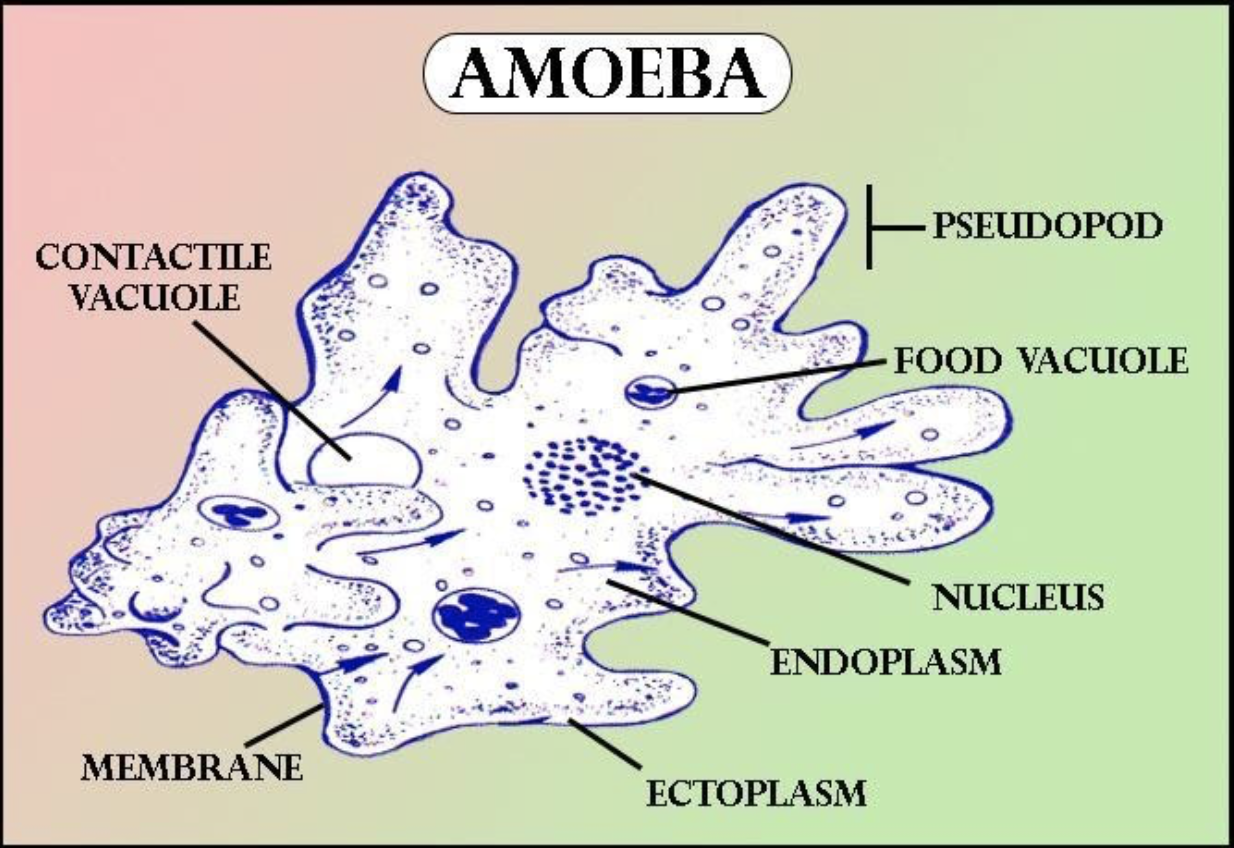
- Amoebae are eukaryotes whose bodies regularly comprise a single cell.
- The cells of amoebae, similar to those of different eukaryotes, have certain characteristic features.
- Within a cell membrane, their cytoplasm and cellular contents are enclosed.
- Their DNA is bundled into a central cellular compartment called the nucleus. Every amoeba contains a little mass of jellylike cytoplasm, which is differentiated into a thin outer plasma membrane, a layer of stiff, clear ectoplasm just inside the plasma membrane, and a central granular endoplasm.
- People generally become infected from warm freshwater lakes and rivers.
Note: An amoeba, Balamuthia mandrillaris, can cause the brain infection granulomatous amoebic encephalitis (GAE). Balamuthia infections are uncommon however are regularly fatal. According to the CDC report the death rate from infection to be 89 percent. At the earlier stage, symptoms that occur include headaches, nausea, and low- grade fever, which turns to more severe ones like the weight loss, partial paralysis, and speech difficulties.
Complete answer:
Rosel von Rosenhof discovered amoeba in 1755. It is found in freshwater. Types of pseudopodia are lobopodia. A contractile vacuole is present for osmoregulation. The mitochondria are frequently observed aggregated around the contractile vacuole. The cytoplasm is differentiated into endosperm and ectoplasm. The body is covered by plasmalemma. Nutrition is holozoic. Sexual reproduction is not known.
Additional information: Characteristics of amoeba
- Amoeba a unicellular organism found in stagnant water.
- The size of the amoeba is 0.25.
- They move with the help of a finger- like projection called pseudopodia.
- Cytoplasm is of two types, the external portion is ectoplast and the inward portion is called endoplast.
- Amoebae are eukaryotes whose bodies regularly comprise a single cell.
- The cells of amoebae, similar to those of different eukaryotes, have certain characteristic features.
- Within a cell membrane, their cytoplasm and cellular contents are enclosed.
- Their DNA is bundled into a central cellular compartment called the nucleus. Every amoeba contains a little mass of jellylike cytoplasm, which is differentiated into a thin outer plasma membrane, a layer of stiff, clear ectoplasm just inside the plasma membrane, and a central granular endoplasm.
- People generally become infected from warm freshwater lakes and rivers.
Note: An amoeba, Balamuthia mandrillaris, can cause the brain infection granulomatous amoebic encephalitis (GAE). Balamuthia infections are uncommon however are regularly fatal. According to the CDC report the death rate from infection to be 89 percent. At the earlier stage, symptoms that occur include headaches, nausea, and low- grade fever, which turns to more severe ones like the weight loss, partial paralysis, and speech difficulties.
Recently Updated Pages
Master Class 11 English: Engaging Questions & Answers for Success

Master Class 11 Social Science: Engaging Questions & Answers for Success
Master Class 11 Maths: Engaging Questions & Answers for Success
Master Class 11 Biology: Engaging Questions & Answers for Success
Master Class 11 Physics: Engaging Questions & Answers for Success
Master Class 11 Chemistry: Engaging Questions & Answers for Success
Trending doubts
One Metric ton is equal to kg A 10000 B 1000 C 100 class 11 physics CBSE
Difference Between Prokaryotic Cells and Eukaryotic Cells
1 ton equals to A 100 kg B 1000 kg C 10 kg D 10000 class 11 physics CBSE
Find the value of the expression given below sin 30circ class 11 maths CBSE
Two of the body parts which do not appear in MRI are class 11 biology CBSE
What are hard magnetic materials class 11 physics CBSE