




Which whole number doesn’t have a successor?
Answer
 Verified
554.1k+ views
Hint: Whole number is a type of Integer. Integers can be positive, negative or zero. The whole numbers are the positive integers from \[0\] to infinity that are used in the number system. The complete set of natural numbers along with \[0\] are called whole numbers.
Complete step-by-step answer:
Whole numbers are numbers that have no fractions and are made up of positive integers and zero.
It is denoted by the symbol \[W\]. It is an infinite set. The set denotation of whole number is as follows:
\[W = \{ 0,1,2,3,4,5,...\} \]
For example – Number of children in a school is a set of whole numbers. Similarly, vehicles parked in a parking lot are a set of whole numbers.
Addition, Subtraction, Multiplication and Division operations can be carried out on whole numbers.
Some of the results of mathematical operators on whole number is given below:
When two whole numbers are added or multiplied, the result is a whole number.
Subtracting two whole numbers can or may not produce whole numbers, i.e., it can be an integer.
Furthermore, in some cases, dividing two whole numbers yields a fraction.
From the definition, we can conclude that:
There is no visible end to the set of whole numbers. It ends at infinity (\[\infty \]).
Therefore, there is no whole number which doesn’t have a successor. However, \[0\]is the whole number which cannot have any predecessor since it is the starting point itself.
Note: Whole numbers are present on the number line. As a result, they're just real numbers i.e. a subset of Real numbers. All whole numbers are real numbers, but not all real numbers are whole numbers.
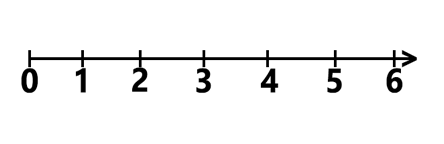
It is shown on number line as follows:
Complete step-by-step answer:
Whole numbers are numbers that have no fractions and are made up of positive integers and zero.
It is denoted by the symbol \[W\]. It is an infinite set. The set denotation of whole number is as follows:
\[W = \{ 0,1,2,3,4,5,...\} \]
For example – Number of children in a school is a set of whole numbers. Similarly, vehicles parked in a parking lot are a set of whole numbers.
Addition, Subtraction, Multiplication and Division operations can be carried out on whole numbers.
Some of the results of mathematical operators on whole number is given below:
When two whole numbers are added or multiplied, the result is a whole number.
Subtracting two whole numbers can or may not produce whole numbers, i.e., it can be an integer.
Furthermore, in some cases, dividing two whole numbers yields a fraction.
From the definition, we can conclude that:
There is no visible end to the set of whole numbers. It ends at infinity (\[\infty \]).
Therefore, there is no whole number which doesn’t have a successor. However, \[0\]is the whole number which cannot have any predecessor since it is the starting point itself.
Note: Whole numbers are present on the number line. As a result, they're just real numbers i.e. a subset of Real numbers. All whole numbers are real numbers, but not all real numbers are whole numbers.
It is shown on number line as follows:

Recently Updated Pages
Master Class 6 English: Engaging Questions & Answers for Success

Master Class 6 Maths: Engaging Questions & Answers for Success
Master Class 6 Science: Engaging Questions & Answers for Success
Master Class 6 Social Science: Engaging Questions & Answers for Success
Class 6 Question and Answer - Your Ultimate Solutions Guide
Master Class 9 General Knowledge: Engaging Questions & Answers for Success
Trending doubts
Give 10 examples for herbs , shrubs , climbers , creepers
How many millions make a billion class 6 maths CBSE
Why is the Earth called a unique planet class 6 social science CBSE
What are the main physical divisions of India class 6 social science CBSE
The planet nearest to earth is A Mercury B Venus C class 6 social science CBSE
Why is democracy considered as the best form of go class 6 social science CBSE