




Which type of plastids helps in photosynthesis? Draw its diagram.
Answer
 Verified
597k+ views
Hint: The plastids which carry out green colour pigment chlorophyll in its cellular structure is capable of photosynthesis. Plastids Can be Seen in the Cells of a plant tissue they are considered as cellular membrane organelles, this organelle in the plant is responsible for further sufficient storage or processing of the food pigmentation.
Complete answer:
Plastids are supported by protective layers which are outer layer or inner layer
There are many types of plastics out of which the plastid which contains green pigment chlorophyll is called as chloroplast plastids without any pigments are called as leucoplast and there are few plastids with different colour pigments other than green pigments in them it is called as chromoplast.
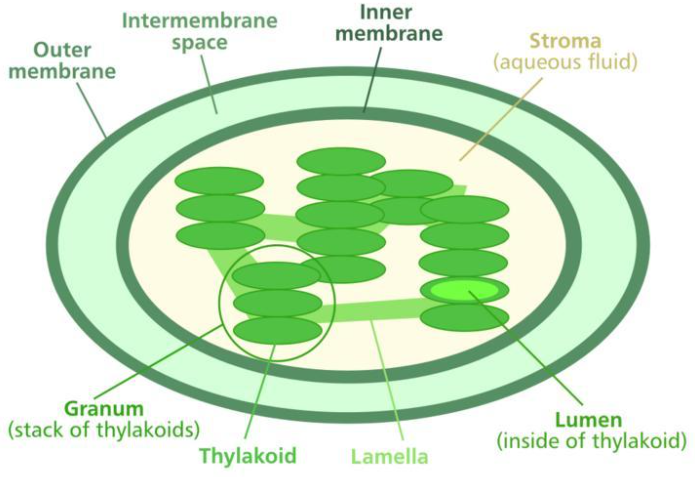
Plastids contain disc-shaped coin-like structures filled inside which are called as granum; these grana are connected as stoma lamella. The chloroplast is a green coloured plastid which is responsible for photosynthesis; it is covered by a double-layer along with a thylakoid membrane; the inner layer is called a thylakoid membrane.
This thylakoid membrane helps in the synthesis of lipids and the membrane condense itself to form small spherical mass call does quantasomes they play a major role in photosynthetic reactions
Note: In chloroplast, most of the enzymatic reactions take place in the thylakoid membrane and the thylakoid membrane in the chloroplast is crucial during the photosynthesis for taking in the light and further proper transport of the electron. They are the major site with large storage of starch and the plastids usually contain their DNA and ribosome and pigments. Quantasomes consist of approximately equal amounts of lipids and proteins and contain chlorophyll, carotenoids and other components of the photosynthetic apparatus.
Complete answer:
Plastids are supported by protective layers which are outer layer or inner layer
There are many types of plastics out of which the plastid which contains green pigment chlorophyll is called as chloroplast plastids without any pigments are called as leucoplast and there are few plastids with different colour pigments other than green pigments in them it is called as chromoplast.
Plastids contain disc-shaped coin-like structures filled inside which are called as granum; these grana are connected as stoma lamella. The chloroplast is a green coloured plastid which is responsible for photosynthesis; it is covered by a double-layer along with a thylakoid membrane; the inner layer is called a thylakoid membrane.
This thylakoid membrane helps in the synthesis of lipids and the membrane condense itself to form small spherical mass call does quantasomes they play a major role in photosynthetic reactions
Note: In chloroplast, most of the enzymatic reactions take place in the thylakoid membrane and the thylakoid membrane in the chloroplast is crucial during the photosynthesis for taking in the light and further proper transport of the electron. They are the major site with large storage of starch and the plastids usually contain their DNA and ribosome and pigments. Quantasomes consist of approximately equal amounts of lipids and proteins and contain chlorophyll, carotenoids and other components of the photosynthetic apparatus.
Recently Updated Pages
Master Class 11 English: Engaging Questions & Answers for Success

Master Class 11 Social Science: Engaging Questions & Answers for Success
Master Class 11 Maths: Engaging Questions & Answers for Success
Master Class 11 Chemistry: Engaging Questions & Answers for Success
Master Class 11 Biology: Engaging Questions & Answers for Success
Master Class 11 Physics: Engaging Questions & Answers for Success
Trending doubts
One Metric ton is equal to kg A 10000 B 1000 C 100 class 11 physics CBSE
Difference Between Prokaryotic Cells and Eukaryotic Cells
Find the value of the expression given below sin 30circ class 11 maths CBSE
1 ton equals to A 100 kg B 1000 kg C 10 kg D 10000 class 11 physics CBSE
Two of the body parts which do not appear in MRI are class 11 biology CBSE
What are hard magnetic materials class 11 physics CBSE