




Which rule determines the direction of force experienced by a current carrying straight conductor placed in a magnetic field which is perpendicular to it?
$\left( a \right)$ Maxwell right hand grip rule
$\left( b \right)$ Fleming’s left hand rule
\[\left( c \right)\] Fleming’s right hand rule
$\left( d \right)$ None of the above
Answer
 Verified
664.5k+ views
Hint: In this question think of the rule in which the middle finger points in the direction of current, thumb is for the direction of force and the index finger is in the direction of magnetic field. The rule that follows these protocols will give the right answer to this problem statement.
Complete step-by-step answer:
Fleming’s left hand rule –
Whenever a current carrying conductor is placed in a magnetic field, it experiences a force due to the magnetic field. The direction of force acting on the conductor can be found using Fleming's Left Hand Rule. The middle finger points in the direction of the current, thumb points in the direction of force and index finger points in the direction of magnetic field as shown in the figure.
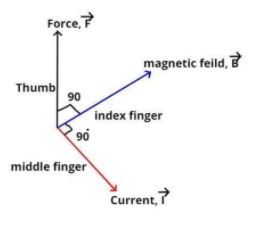
All the lines are at right angles (i.e. at ${90^o}$) to each other as shown in the figure.
So we find out the direction of force due to magnetic induction.
So when the direction of the current is in the positive direction of the x-axis so according to Fleming’s right hand rule the direction of the magnetic field is in the positive direction of y-axis.
And if the direction of the current is in the positive direction of the y-axis so according to Fleming’s right hand rule the direction of the magnetic field is in the positive direction of x-axis.
And if the direction of the current is in the positive direction of the z-axis so according to Fleming’s right hand rule the direction of the magnetic field is in the positive direction of the y-axis.
So this is the required answer.
Hence option (B) is the right answer.
Note:There is a great bit of confusion regarding Fleming's left-hand rule and Fleming’s right hand rule, right hand rule is used to show the direction of induced current when a conductor is placed in a magnetic field. Moreover it can also be used to determine the direction of current in generator winding.
Complete step-by-step answer:
Fleming’s left hand rule –
Whenever a current carrying conductor is placed in a magnetic field, it experiences a force due to the magnetic field. The direction of force acting on the conductor can be found using Fleming's Left Hand Rule. The middle finger points in the direction of the current, thumb points in the direction of force and index finger points in the direction of magnetic field as shown in the figure.
All the lines are at right angles (i.e. at ${90^o}$) to each other as shown in the figure.
So we find out the direction of force due to magnetic induction.
So when the direction of the current is in the positive direction of the x-axis so according to Fleming’s right hand rule the direction of the magnetic field is in the positive direction of y-axis.
And if the direction of the current is in the positive direction of the y-axis so according to Fleming’s right hand rule the direction of the magnetic field is in the positive direction of x-axis.
And if the direction of the current is in the positive direction of the z-axis so according to Fleming’s right hand rule the direction of the magnetic field is in the positive direction of the y-axis.
So this is the required answer.
Hence option (B) is the right answer.
Note:There is a great bit of confusion regarding Fleming's left-hand rule and Fleming’s right hand rule, right hand rule is used to show the direction of induced current when a conductor is placed in a magnetic field. Moreover it can also be used to determine the direction of current in generator winding.
Recently Updated Pages
A Paragraph on Pollution in about 100-150 Words

What is BLO What is the full form of BLO class 8 social science CBSE
10 examples of friction in our daily life
Draw a diagram of nephron and explain its structur class 11 biology CBSE
Write structures of the following compounds i 2 Chloro3methylpentane class 11 chemistry CBSE
XIX+XXX A 49 B 51 C 55 D 44 class 5 maths CBSE
Trending doubts
Explain the Treaty of Vienna of 1815 class 10 social science CBSE
1 GB equals how many MB?
10 examples of evaporation in daily life with explanations
What is the full form of POSCO class 10 social science CBSE
Which is the hottest planet in the Solar system A Earth class 10 social science CBSE
Name any four life processes in living things class 10 biology CBSE