




Which produces a coherent source?
Answer
 Verified
571.8k+ views
Hint: The coherent source is a source that produces waves having constant phase difference and a single frequency. There are different methods of producing the coherent source, they are Young’s double slit arrangement, Lloyd’s single mirror method, Newton’s rings and Michelson’s interferometer.
Complete answer:
The characteristics of the coherent source are: the waves have a constant phase difference and a single frequency.
The methods of producing coherent sources: Division of the wave front and the Division of the amplitude.
Division of wave front: The wave front is divided into 2 or more parts with the help of lenses, prism and mirrors. The common methods are Young’s double slit arrangement and Lloyd’s single mirror method.
Division of amplitude: The amplitude of the incoming beam is divided into 2 or more parts by the partial reflection with the help of lenses, prism and mirrors. The common methods are Newton’s rings and Michelson’s interferometer.
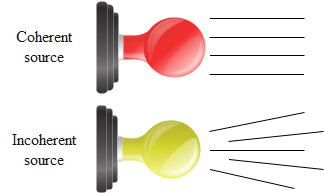
The laser light and the sound waves produce coherent waves (the waves with the same frequency and the phase) so are the coherent sources.
\[\therefore \]The laser light and the sound waves are the coherent sources.
Additional information: The method of producing coherent source: Old method: The light from the monochromatic source is allowed to pass through a narrow slit followed by the two narrow slits present on the screen. The waves coming out of the second round of narrow slits will always be in phase, as the waves originate from the same wave front.New method: The laser is used as a coherent source.
Note:
The coherent source produces in-phase (constant) and the stable interference (single frequency) of light. An example of the coherent source is laser light. The incoherent source produces out of phase (variable) and unstable interference (multiple frequencies) of light. An example of an incoherent source is sunlight.
Complete answer:
The characteristics of the coherent source are: the waves have a constant phase difference and a single frequency.
The methods of producing coherent sources: Division of the wave front and the Division of the amplitude.
Division of wave front: The wave front is divided into 2 or more parts with the help of lenses, prism and mirrors. The common methods are Young’s double slit arrangement and Lloyd’s single mirror method.
Division of amplitude: The amplitude of the incoming beam is divided into 2 or more parts by the partial reflection with the help of lenses, prism and mirrors. The common methods are Newton’s rings and Michelson’s interferometer.
The laser light and the sound waves produce coherent waves (the waves with the same frequency and the phase) so are the coherent sources.
\[\therefore \]The laser light and the sound waves are the coherent sources.
Additional information: The method of producing coherent source: Old method: The light from the monochromatic source is allowed to pass through a narrow slit followed by the two narrow slits present on the screen. The waves coming out of the second round of narrow slits will always be in phase, as the waves originate from the same wave front.New method: The laser is used as a coherent source.
Note:
The coherent source produces in-phase (constant) and the stable interference (single frequency) of light. An example of the coherent source is laser light. The incoherent source produces out of phase (variable) and unstable interference (multiple frequencies) of light. An example of an incoherent source is sunlight.
Recently Updated Pages
Master Class 12 Economics: Engaging Questions & Answers for Success

Master Class 12 English: Engaging Questions & Answers for Success
Master Class 12 Social Science: Engaging Questions & Answers for Success
Master Class 12 Maths: Engaging Questions & Answers for Success
Master Class 12 Physics: Engaging Questions & Answers for Success
Master Class 9 General Knowledge: Engaging Questions & Answers for Success
Trending doubts
Explain the Treaty of Vienna of 1815 class 10 social science CBSE
Who Won 36 Oscar Awards? Record Holder Revealed
Why is it 530 pm in india when it is 1200 afternoon class 10 social science CBSE
Make a sketch of the human nerve cell What function class 10 biology CBSE
What is the full form of POSCO class 10 social science CBSE
Define Potential, Developed, Stock and Reserved resources