




Which part of the gastrointestinal tract is lined with villi, which is specialized for absorption?
Answer
 Verified
588.9k+ views
Hint: Small intestine is one of the longest processes taking place in the human body. The process of digestion involves several steps as well as the organs and this process starts from the mouth and ends at the anus. The track is also referred to as the alimentary canal. The organs involved in the alimentary canal are the mouth, esophagus, stomach, small intestine, and large intestine.
Complete answer:
The small intestine is the most important part of the alimentary canal for the digestion and absorption of food.
It has three regions: a U-shaped duodenum, a long coiled middle portion jejunum, and a highly coiled ileum.
The innermost layer lining the lumen of the alimentary tract is that the mucosa. Inside the stomach, this layer forms irregular folds (rugae) and Inside the intestine, the little finger-like foldings called villi.
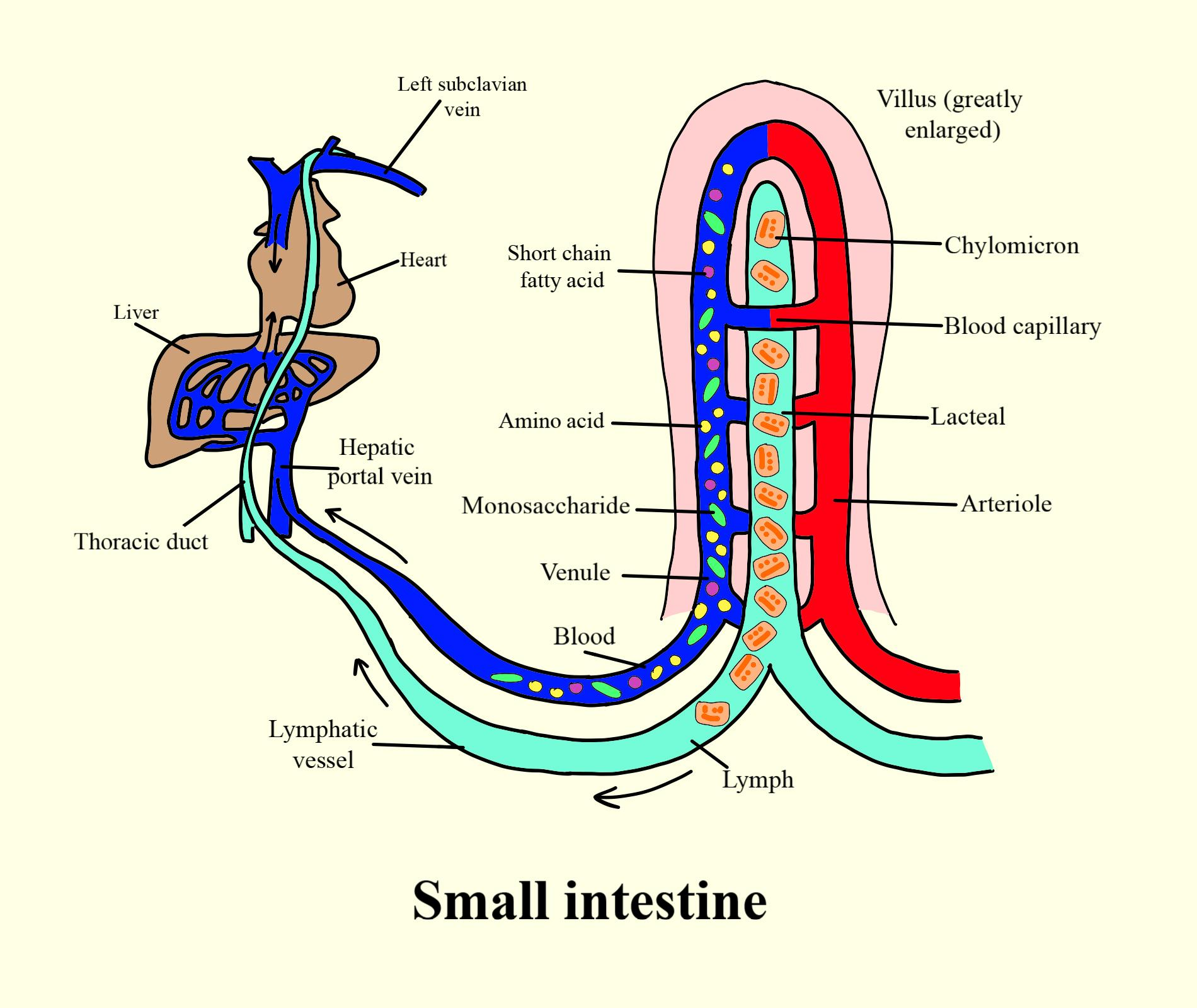
Villi are transverse folds of the intestinal wall that increase the surface area of absorption.
(c)Villi possess blood capillaries and lacteals (lymph vessels) for quick transport of absorbed
Villi are transverse folds of the intestinal wall that increase the surface area of absorption.
It possesses blood capillaries and lacteals (lymph vessels) for quick transport of absorbed.
For more absorption, these modifications increase the surface area. The lacteal is when villi are furnished with a network of capillaries and an outsized lymphatic vessel.
It transports lipid molecules. To the different parts of the body, the wall of the intestine is surrounded by the blood vessels which assimilates the food molecules.
Additional information:
Absorption of food by the small intestine
The digested food is absorbed into the blood within the physical body by the tiny intestine. With the help of the walls of the small intestine, the digested food passes and then into our bloodstream. Here the digested food is weakened into vitamins, minerals, proteins, carbohydrates, and fats.
The enzyme present in the small intestine
Trypsin: Trypsin is a pancreatic enzyme. In the small intestine, trypsin plays an important role. For the digestion of protein, trypsin is an enzyme that helps. In the intestine, the enzyme breaks down into proteins and continues the method of digestion that began within the stomach.
So the correct answer to the above question is ‘Small intestine’.
Note:
The animals which feed on plants, leaves, fruits, and other natural products for their food are called herbivores. Example: cow, goat, etc. Carnivore animals are fed on other animals for their food. Example: Lion, Cat, etc. Herbivores feed only on plants hence they need a longer small intestine to digest the cellulose present in plants. Carnivores feed on other animals and the food gets digested easily as compared to herbivores. Then hence small intestine in herbivores longer than in carnivores.
Complete answer:
The small intestine is the most important part of the alimentary canal for the digestion and absorption of food.
It has three regions: a U-shaped duodenum, a long coiled middle portion jejunum, and a highly coiled ileum.
The innermost layer lining the lumen of the alimentary tract is that the mucosa. Inside the stomach, this layer forms irregular folds (rugae) and Inside the intestine, the little finger-like foldings called villi.
Villi are transverse folds of the intestinal wall that increase the surface area of absorption.
(c)Villi possess blood capillaries and lacteals (lymph vessels) for quick transport of absorbed
Villi are transverse folds of the intestinal wall that increase the surface area of absorption.
It possesses blood capillaries and lacteals (lymph vessels) for quick transport of absorbed.
For more absorption, these modifications increase the surface area. The lacteal is when villi are furnished with a network of capillaries and an outsized lymphatic vessel.
It transports lipid molecules. To the different parts of the body, the wall of the intestine is surrounded by the blood vessels which assimilates the food molecules.
Additional information:
Absorption of food by the small intestine
The digested food is absorbed into the blood within the physical body by the tiny intestine. With the help of the walls of the small intestine, the digested food passes and then into our bloodstream. Here the digested food is weakened into vitamins, minerals, proteins, carbohydrates, and fats.
The enzyme present in the small intestine
Trypsin: Trypsin is a pancreatic enzyme. In the small intestine, trypsin plays an important role. For the digestion of protein, trypsin is an enzyme that helps. In the intestine, the enzyme breaks down into proteins and continues the method of digestion that began within the stomach.
So the correct answer to the above question is ‘Small intestine’.
Note:
The animals which feed on plants, leaves, fruits, and other natural products for their food are called herbivores. Example: cow, goat, etc. Carnivore animals are fed on other animals for their food. Example: Lion, Cat, etc. Herbivores feed only on plants hence they need a longer small intestine to digest the cellulose present in plants. Carnivores feed on other animals and the food gets digested easily as compared to herbivores. Then hence small intestine in herbivores longer than in carnivores.
Recently Updated Pages
Basicity of sulphurous acid and sulphuric acid are

Master Class 11 English: Engaging Questions & Answers for Success
Master Class 11 Physics: Engaging Questions & Answers for Success
Master Class 11 Computer Science: Engaging Questions & Answers for Success
Master Class 11 Chemistry: Engaging Questions & Answers for Success
Master Class 11 Social Science: Engaging Questions & Answers for Success
Trending doubts
Difference Between Prokaryotic Cells and Eukaryotic Cells
Two of the body parts which do not appear in MRI are class 11 biology CBSE
One Metric ton is equal to kg A 10000 B 1000 C 100 class 11 physics CBSE
10 examples of friction in our daily life
Draw a diagram of nephron and explain its structur class 11 biology CBSE
What will happen if the mucus is not secreted by the class 11 biology CBSE