




Which part of our body helps us in maintaining body balance? Answer briefly.
Answer
 Verified
612k+ views
Hint: The balancing of our body is related to the internal part of the ear. The static and dynamic balances are maintained whenever the head is tilted or displaced. Depending on the information received by the brain from the muscle, joints, eyes, and the vestibular organ of the eye the balance of the body is maintained.
Complete answer: The region of the inner ear called vestibule contains the utricle and the saccule. Each of them contains a macula that detects the linear acceleration. The function of the macula of saccule is to detect the vertical linear acceleration as it is placed in a nearly vertical position. The horizontal acceleration is detected by the macula of the utricle and is placed in a horizontal position. The perception of linear acceleration in any direction along the vestibular nerve is allowed by the coordinated sensory perception of acceleration both vertically and horizontally. The sensory organ of rotation called the crista ampullaris is found in the ampulla of each semicircular canal in the internal ear. In response to the change in the position of the head, the hair cells present in the macula and crista bends. This induces an impulse in the afferent nerve fibres which are associated with the hair cells of macula and crista. These impulses generated are analyzed by the cerebellum of the brain which is transmitted to the brain through the vestibular branch of the auditory nerve. The data collected is processed in the cerebellum and coordinates the muscle movement in sync with the cortex and thus an impulse is sent to the muscle for adjusting accordingly.
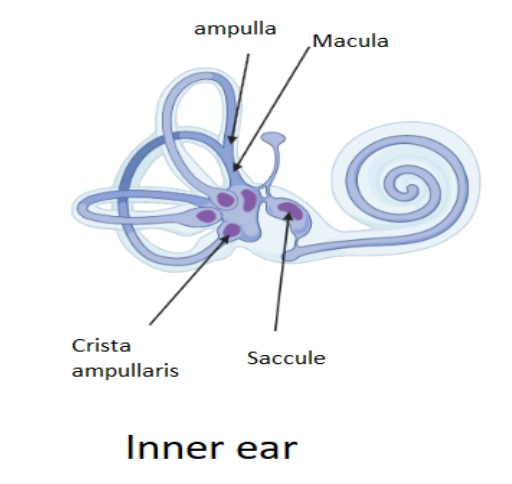
So, the part of the body responsible for maintaining the body balance is the macula and cristae of the inner ear.
Note: As the information about acceleration is provided by both utricle macula and saccule macula, damage to these organs leads to the imbalance of the body. Damage to the semicircular canal can lose a sense of balance. Severe damage of the semicircular canal also results in loss of hearing
Complete answer: The region of the inner ear called vestibule contains the utricle and the saccule. Each of them contains a macula that detects the linear acceleration. The function of the macula of saccule is to detect the vertical linear acceleration as it is placed in a nearly vertical position. The horizontal acceleration is detected by the macula of the utricle and is placed in a horizontal position. The perception of linear acceleration in any direction along the vestibular nerve is allowed by the coordinated sensory perception of acceleration both vertically and horizontally. The sensory organ of rotation called the crista ampullaris is found in the ampulla of each semicircular canal in the internal ear. In response to the change in the position of the head, the hair cells present in the macula and crista bends. This induces an impulse in the afferent nerve fibres which are associated with the hair cells of macula and crista. These impulses generated are analyzed by the cerebellum of the brain which is transmitted to the brain through the vestibular branch of the auditory nerve. The data collected is processed in the cerebellum and coordinates the muscle movement in sync with the cortex and thus an impulse is sent to the muscle for adjusting accordingly.
So, the part of the body responsible for maintaining the body balance is the macula and cristae of the inner ear.
Note: As the information about acceleration is provided by both utricle macula and saccule macula, damage to these organs leads to the imbalance of the body. Damage to the semicircular canal can lose a sense of balance. Severe damage of the semicircular canal also results in loss of hearing
Recently Updated Pages
Master Class 11 English: Engaging Questions & Answers for Success

Master Class 11 Social Science: Engaging Questions & Answers for Success
Master Class 11 Maths: Engaging Questions & Answers for Success
Master Class 11 Biology: Engaging Questions & Answers for Success
Master Class 11 Physics: Engaging Questions & Answers for Success
Master Class 11 Chemistry: Engaging Questions & Answers for Success
Trending doubts
One Metric ton is equal to kg A 10000 B 1000 C 100 class 11 physics CBSE
Difference Between Prokaryotic Cells and Eukaryotic Cells
1 ton equals to A 100 kg B 1000 kg C 10 kg D 10000 class 11 physics CBSE
Find the value of the expression given below sin 30circ class 11 maths CBSE
Two of the body parts which do not appear in MRI are class 11 biology CBSE
What are hard magnetic materials class 11 physics CBSE