




Which organ absorbs most water?
Answer
 Verified
539.7k+ views
Hint: Water is an essential component of all the living beings and we are quite aware of that. Water is required for the survival of all species that perpetuate diversity, including plants, trees, and shrubs. Water forms ninety percent of our body. It maintains the body's fluidity and is also present in blood. Blood acquires its aqueous nature from water only.
Complete answer:
Water maintains the osmotic balance of the body. It is not a component that we get from food. Water present in proportionate levels can be beneficial in many ways.
Water maintains the fluidity in the body, balancing all the organs in the form of blood so that organs do not collide with each other. Keep skin fresh and healthy. As skin has sweat glands underneath which will keep the body cool from inside when body temperature rises that is known as osmoregulation.
Without water in the body, the body will shrink, as water helps in rigidity of the body, helps to maintain water in tissues and cells. Cells require water in the form of vacuoles for its growth and function. Water acts as a medium of transport. It helps in absorbing elements that are nutrition from the food. It also eliminates toxic materials or substances from the body in the form of urine and sweat.
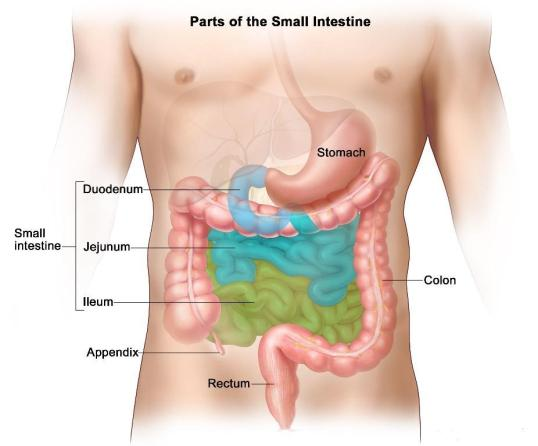
The organ which absorbs most water eliminated from the body is the small intestine. The small intestine is majorly responsible for water absorption. The small intestine followed by the large intestine absorbs not only water but food particles too which are carried with the blood stream for elimination.
Note:
As we discussed why water is important in our body, apart from all the above-mentioned functions, it helps the muscles of the body to tone up and also helps in elasticity of the skin. Without adequate water level the skin and muscle will lose elasticity and the skin will start to wrinkle up. Also, it is maintaining the moisture in the body.
Complete answer:
Water maintains the osmotic balance of the body. It is not a component that we get from food. Water present in proportionate levels can be beneficial in many ways.
Water maintains the fluidity in the body, balancing all the organs in the form of blood so that organs do not collide with each other. Keep skin fresh and healthy. As skin has sweat glands underneath which will keep the body cool from inside when body temperature rises that is known as osmoregulation.
Without water in the body, the body will shrink, as water helps in rigidity of the body, helps to maintain water in tissues and cells. Cells require water in the form of vacuoles for its growth and function. Water acts as a medium of transport. It helps in absorbing elements that are nutrition from the food. It also eliminates toxic materials or substances from the body in the form of urine and sweat.
The organ which absorbs most water eliminated from the body is the small intestine. The small intestine is majorly responsible for water absorption. The small intestine followed by the large intestine absorbs not only water but food particles too which are carried with the blood stream for elimination.
Note:
As we discussed why water is important in our body, apart from all the above-mentioned functions, it helps the muscles of the body to tone up and also helps in elasticity of the skin. Without adequate water level the skin and muscle will lose elasticity and the skin will start to wrinkle up. Also, it is maintaining the moisture in the body.
Recently Updated Pages
Master Class 11 English: Engaging Questions & Answers for Success

Master Class 11 Social Science: Engaging Questions & Answers for Success
Master Class 11 Maths: Engaging Questions & Answers for Success
Master Class 11 Chemistry: Engaging Questions & Answers for Success
Master Class 11 Biology: Engaging Questions & Answers for Success
Master Class 11 Physics: Engaging Questions & Answers for Success
Trending doubts
Explain the Treaty of Vienna of 1815 class 10 social science CBSE
Why is it 530 pm in india when it is 1200 afternoon class 10 social science CBSE
What is the full form of POSCO class 10 social science CBSE
Define Potential, Developed, Stock and Reserved resources
Which Country Has the Largest Border with India?
Choose the feminine form of the given noun Fox AFoxess class 10 english CBSE