




Which one of the following semiconductor diodes is reverse biased?
(1)
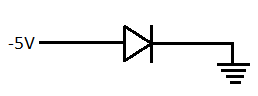
(2)
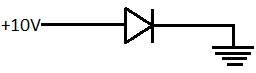
(3)

(4)

A. 2
B. 4
C. 1
D. 3
Answer
 Verified
533.4k+ views
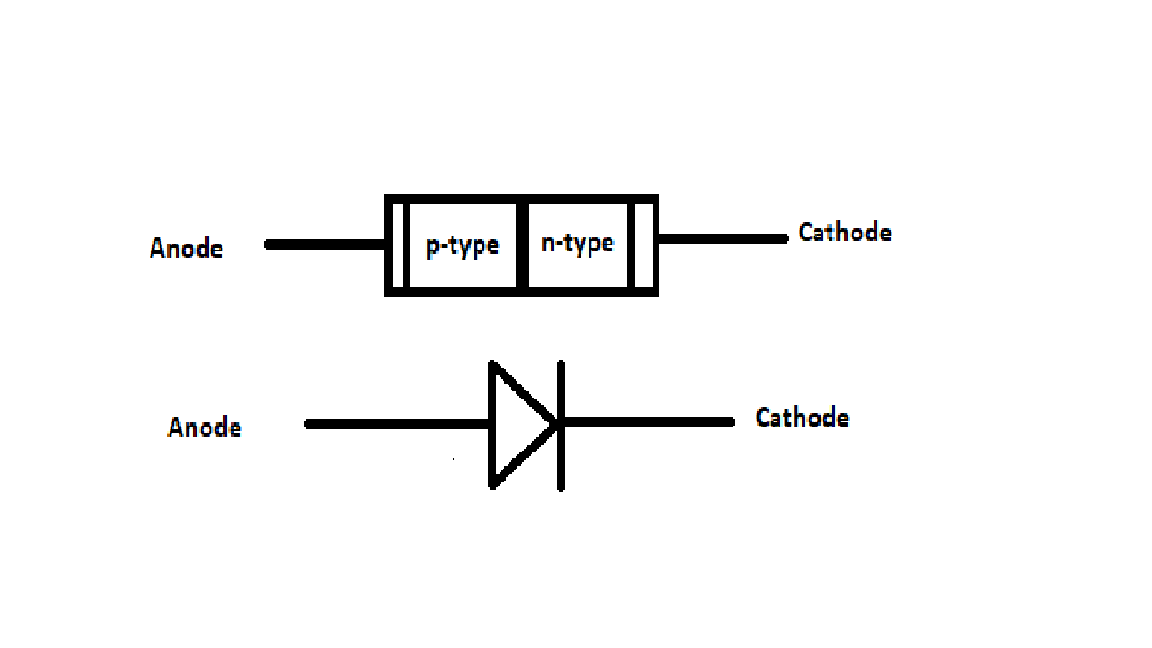
Hint: If we explain the term reverse biased in semiconductor diodes and evaluate why one option is right while the other is wrong, we have to look into these points. In the semiconductor diode, the current can flow in one direction only at the p-n junction when the voltage difference is provided. . As we know, the p-type with anode and n-type with the cathode, as in the diagram.
Complete step-by-step solution:
Terms: reverse biased in semiconductor
Reverse bias: It’s a condition where the cathode is higher than the anode. That’s why no current will flow and if anode becomes higher than the cathode or anode will break down so
Cathode needs to be higher and difference need to be negative to verify the p-n junction for the correct answer
Explaining with diagram when current flow is easy
Calculating the option a) Figure no.2
The cathode is \[0V\] here because it’s in the neutral position and anode is negative of \[10V\]is given. Then, the current flowing in the p-n junction because, the difference in both cathode (\[0V\]) and anode (\[10V\]) with the p-n junction give \[10V\] as an answer where n is facing the \[0V\] and p is facing the\[10V\]. Thus, the value it gives is positive, that's why it’s wrong.
Calculating the option b) Figure no.4
The cathode is \[-5V\] here because it’s in the neutral position and the anode is negative of \[-15V\] given. Then, the current flowing in the p-n junction because, the difference in both cathode (\[-5V\]) and anode (\[-15V\]) with the p-n junction give \[10V\] as an answer where n is facing the \[-15V\] and p is facing the\[-5V\]. Thus, the value it gives is positive, that's why it’s wrong.
Calculating the option c) Figure no.1
The cathode is \[0V\] here because it’s in the neutral position and the anode is negative of \[-5V\] given. Then, no- current flowing in the p-n junction, the difference in both cathode (\[0V\]) and anode (\[-5V\]) with the p-n junction gives \[5V\] as an answer. Thus, the value it gives is in negative that’s why correct answer
Calculating the option d) Figure no.3
The cathode is \[10V\] here because it’s in the neutral position and the anode is negative of \[5V\] given. Then, the current flowing in the p-n junction because, the difference in both cathode (\[10V\]) and anode (\[5V\]) with the p-n junction give \[10V\] as an answer where n is facing the \[5V\] and p is facing the\[10V\]. Thus, the value it gives is in positive that’s why it’s wrong
The correct answer is option (c) .
Note:Connecting the p-type region to the negative terminal of the voltage supply and the n-type region to the positive terminal corresponds to reverse bias. If a diode is reverse-biased, the voltage at the cathode is comparatively higher than at the anode. Different Types of Diodes , Small Signal Diode, Large Signal Diode, Zener Diode, Light Emitting Diode (LED), Constant Current Diodes, Schottky Diode, Shockley Diode, Step Recovery Diodes.
Complete step-by-step solution:
Terms: reverse biased in semiconductor
Reverse bias: It’s a condition where the cathode is higher than the anode. That’s why no current will flow and if anode becomes higher than the cathode or anode will break down so
Cathode needs to be higher and difference need to be negative to verify the p-n junction for the correct answer
Explaining with diagram when current flow is easy
Calculating the option a) Figure no.2
The cathode is \[0V\] here because it’s in the neutral position and anode is negative of \[10V\]is given. Then, the current flowing in the p-n junction because, the difference in both cathode (\[0V\]) and anode (\[10V\]) with the p-n junction give \[10V\] as an answer where n is facing the \[0V\] and p is facing the\[10V\]. Thus, the value it gives is positive, that's why it’s wrong.
Calculating the option b) Figure no.4
The cathode is \[-5V\] here because it’s in the neutral position and the anode is negative of \[-15V\] given. Then, the current flowing in the p-n junction because, the difference in both cathode (\[-5V\]) and anode (\[-15V\]) with the p-n junction give \[10V\] as an answer where n is facing the \[-15V\] and p is facing the\[-5V\]. Thus, the value it gives is positive, that's why it’s wrong.
Calculating the option c) Figure no.1
The cathode is \[0V\] here because it’s in the neutral position and the anode is negative of \[-5V\] given. Then, no- current flowing in the p-n junction, the difference in both cathode (\[0V\]) and anode (\[-5V\]) with the p-n junction gives \[5V\] as an answer. Thus, the value it gives is in negative that’s why correct answer
Calculating the option d) Figure no.3
The cathode is \[10V\] here because it’s in the neutral position and the anode is negative of \[5V\] given. Then, the current flowing in the p-n junction because, the difference in both cathode (\[10V\]) and anode (\[5V\]) with the p-n junction give \[10V\] as an answer where n is facing the \[5V\] and p is facing the\[10V\]. Thus, the value it gives is in positive that’s why it’s wrong
The correct answer is option (c) .
Note:Connecting the p-type region to the negative terminal of the voltage supply and the n-type region to the positive terminal corresponds to reverse bias. If a diode is reverse-biased, the voltage at the cathode is comparatively higher than at the anode. Different Types of Diodes , Small Signal Diode, Large Signal Diode, Zener Diode, Light Emitting Diode (LED), Constant Current Diodes, Schottky Diode, Shockley Diode, Step Recovery Diodes.
Recently Updated Pages
Master Class 12 Business Studies: Engaging Questions & Answers for Success

Master Class 12 Biology: Engaging Questions & Answers for Success
Master Class 12 Chemistry: Engaging Questions & Answers for Success
Class 12 Question and Answer - Your Ultimate Solutions Guide
Master Class 11 Social Science: Engaging Questions & Answers for Success
Master Class 11 English: Engaging Questions & Answers for Success
Trending doubts
Which are the Top 10 Largest Countries of the World?
Draw a labelled sketch of the human eye class 12 physics CBSE
Name the crygenes that control cotton bollworm and class 12 biology CBSE
Differentiate between homogeneous and heterogeneous class 12 chemistry CBSE
Ribosomal RNA is actively synthesised in A Nucleoplasm class 12 biology CBSE
How many molecules of ATP and NADPH are required information class 12 biology CBSE