




Which one of the following is called horsetail?
A)Lycopodium
B)Marsilea
C)Equisetum
D)Selaginella
Answer
 Verified
589.5k+ views
Hint: It is a spreading reed-like perennial herb, the stems are cylindrical and evergreen. Stems are usually branched and have rough longitudinal ridges. Their leaves are tiny and they are joined together around a stem forming a black-green band. They are also known as common scouring rush.
Complete answer:
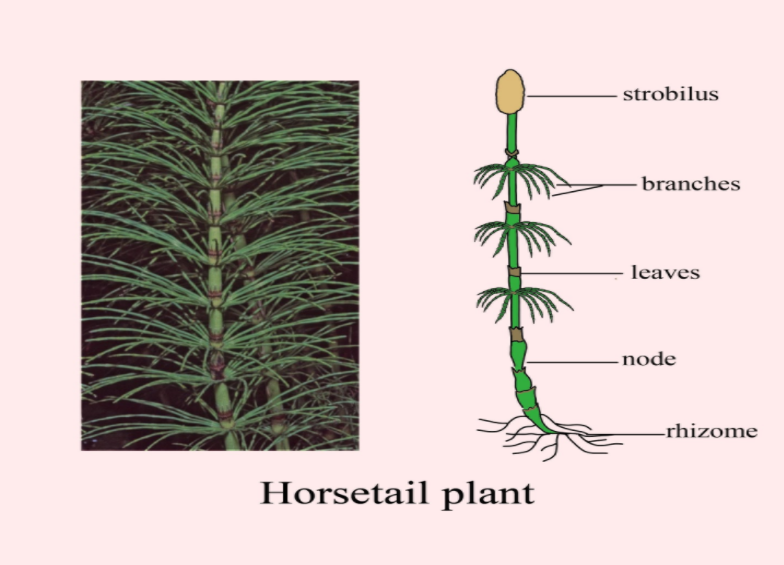
Equisetum belongs to the genus of ferns. They are commonly known as horsetails. Equisetum (Eauisetopsida) is a unique plant from the class of ferns.
-Their growth is distinct and has spores. Spores have the ability to travel along the ground. They are mostly found in wet environments.
-The stems, leaves, and roots of the Equisetum plant are unique which makes this a very interesting group of the plant. Their growth form is different from all other ferns.
-Stems are generally straight, have erect stalks or creep along the ground. These stems are reinforced with silica which makes a stem strong and hard.
-the multiple leaves grow from the same point in an Equisetum plant. Their branches also grow in the same manner.
-Roots grow deep below the surface of the grounds. Some species also have strobili that produce the plant's spores for reproduction.
Additional Information: Lycopodium - also known as ground pines belongs to the family Lycopodiaceae. It is a genus of club mosses.
Marsilea - it has a creeping rhizomatous stem on or just below the soil surface. They are generally aquatic or amphibious in nature found embedded in mud or damp soil.
Selaginella - it is commonly known as a spike moss or small club moss. It is a living genus of the order Selaginellales.
So, the correct answer is,” Equisetum”.
Note: -Because of the branched species, Equisetum is known as horsetail because they resembled a tail of a horse.
-It belongs to the family of a vascular plant mostly produced by spores rather than seeds.
Complete answer:
Equisetum belongs to the genus of ferns. They are commonly known as horsetails. Equisetum (Eauisetopsida) is a unique plant from the class of ferns.
-Their growth is distinct and has spores. Spores have the ability to travel along the ground. They are mostly found in wet environments.
-The stems, leaves, and roots of the Equisetum plant are unique which makes this a very interesting group of the plant. Their growth form is different from all other ferns.
-Stems are generally straight, have erect stalks or creep along the ground. These stems are reinforced with silica which makes a stem strong and hard.
-the multiple leaves grow from the same point in an Equisetum plant. Their branches also grow in the same manner.
-Roots grow deep below the surface of the grounds. Some species also have strobili that produce the plant's spores for reproduction.
Additional Information: Lycopodium - also known as ground pines belongs to the family Lycopodiaceae. It is a genus of club mosses.
Marsilea - it has a creeping rhizomatous stem on or just below the soil surface. They are generally aquatic or amphibious in nature found embedded in mud or damp soil.
Selaginella - it is commonly known as a spike moss or small club moss. It is a living genus of the order Selaginellales.
So, the correct answer is,” Equisetum”.
Note: -Because of the branched species, Equisetum is known as horsetail because they resembled a tail of a horse.
-It belongs to the family of a vascular plant mostly produced by spores rather than seeds.
Recently Updated Pages
Master Class 11 Social Science: Engaging Questions & Answers for Success

Master Class 11 Physics: Engaging Questions & Answers for Success
Master Class 11 Maths: Engaging Questions & Answers for Success
Master Class 11 Economics: Engaging Questions & Answers for Success
Master Class 11 Computer Science: Engaging Questions & Answers for Success
Master Class 11 Chemistry: Engaging Questions & Answers for Success
Trending doubts
One Metric ton is equal to kg A 10000 B 1000 C 100 class 11 physics CBSE
There are 720 permutations of the digits 1 2 3 4 5 class 11 maths CBSE
1 Quintal is equal to a 110 kg b 10 kg c 100kg d 1000 class 11 physics CBSE
State and prove Bernoullis theorem class 11 physics CBSE
Difference Between Prokaryotic Cells and Eukaryotic Cells
Which among the following are examples of coming together class 11 social science CBSE