




Which one of the following does not have larvae in its life cycle?
A. Prawn
B. Earthworm
C. Crab
D. None of the above
Answer
 Verified
598.2k+ views
Hint: In the early developmental phase, the larval stage is described as an organism, which varies dramatically from its adult phase. This stage is converted into an adult phase in later stages. A larva is a separate immature phase of animal development in insects in particular. The term larva is used to denote young hatchling, which differs from the adult in the absence of essential organs such as sexual glands and related components.
Complete answer: The earthworm's life cycle begins with an embryo. It contains a young earthworm ready to hatch. In a cocoon, the egg is enclosed. The number of eggs can vary among species in the cocoon, for example, the Lumbricid family ranges from 1 to 20. When an earthworm reaches maturity, it sexually matures for the next generation to produce eggs. Between 3 to 80 cocoons are produced annually. Species of earthworms living in the deep underground produce fewer cocoons, as they are covered and hatch without any disturbance.
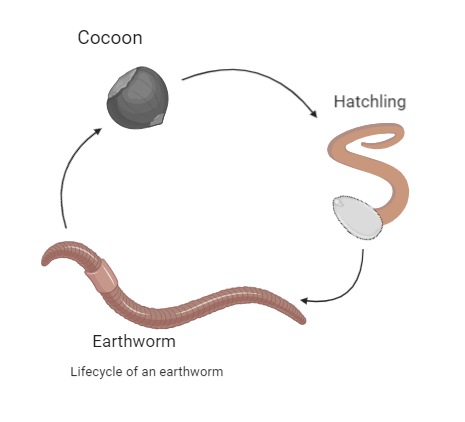
A larva is a different juvenile phase, in which several species are subjected to adult metamorphosis. The earthworm is part of the phylum Annelida and in their life cycle, there are no larvae. It has cocoons that burrow on the ground into a young worm and eventually a mature worm.
Therefore, option B is the correct answer.
Note: During development, large mosquito larvae live exclusively in the aquatic area and after metamorphosing into adult forms, they live outside the water. In different environments, such adaptations are intended to defend them against predators and prevent competition for resources.
Complete answer: The earthworm's life cycle begins with an embryo. It contains a young earthworm ready to hatch. In a cocoon, the egg is enclosed. The number of eggs can vary among species in the cocoon, for example, the Lumbricid family ranges from 1 to 20. When an earthworm reaches maturity, it sexually matures for the next generation to produce eggs. Between 3 to 80 cocoons are produced annually. Species of earthworms living in the deep underground produce fewer cocoons, as they are covered and hatch without any disturbance.
A larva is a different juvenile phase, in which several species are subjected to adult metamorphosis. The earthworm is part of the phylum Annelida and in their life cycle, there are no larvae. It has cocoons that burrow on the ground into a young worm and eventually a mature worm.
Therefore, option B is the correct answer.
Note: During development, large mosquito larvae live exclusively in the aquatic area and after metamorphosing into adult forms, they live outside the water. In different environments, such adaptations are intended to defend them against predators and prevent competition for resources.
Recently Updated Pages
Master Class 11 English: Engaging Questions & Answers for Success

Master Class 11 Social Science: Engaging Questions & Answers for Success
Master Class 11 Maths: Engaging Questions & Answers for Success
Master Class 11 Chemistry: Engaging Questions & Answers for Success
Master Class 11 Biology: Engaging Questions & Answers for Success
Master Class 11 Physics: Engaging Questions & Answers for Success
Trending doubts
One Metric ton is equal to kg A 10000 B 1000 C 100 class 11 physics CBSE
Difference Between Prokaryotic Cells and Eukaryotic Cells
Find the value of the expression given below sin 30circ class 11 maths CBSE
1 ton equals to A 100 kg B 1000 kg C 10 kg D 10000 class 11 physics CBSE
Two of the body parts which do not appear in MRI are class 11 biology CBSE
What are hard magnetic materials class 11 physics CBSE