




Which one of the following cells in sponges catch food?
A. Pinacocytes
B. Choanocytes
C. Thesocytes
D. Archaeocytes
Answer
 Verified
607.2k+ views
Hint: Sponges are primitive organisms that belong to the phylum Porifera. They have a porous body and cellular level of organization. They have different types of cells for different functions. Flagellated cells that line the internal chamber of sponges are involved in catching food for sponges.
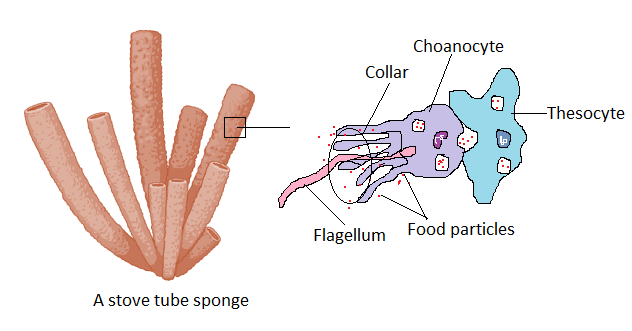
Complete answer:Sponges are marine primitive animals that have cylindrical porous bodies. They have simple cellular organization. The outer walls of the sponges surround the internal cavity. They are multicellular organisms. The pores and channels throughout their outer wall allow water and nutrients to circulate through them. They do not have nervous, circulatory, or digestive systems. They rely on the constant flow of water to obtain food and to excrete. The flowing water brings microorganisms that can be entrapped by specialized catching cells of sponges. These cells are flagellated and have a collar of protoplasm at the base of their flagellum. They line up the internal chamber of sponges. They are present along the spongocoel and the water canal system. These are called choanocytes. They also function as first digestion units as digestion in sponges is intracellular.
Let us discuss other types of cells that sponges consist of.
Thesocytes are specialized cells that are used to store food. These are types of amoebocyte cells. pinacocytes and porocytes line the outer dermal layer called pinacoderm. Trophocytes are cells where further digestion happens in sponges after choanocytes.
So, from the above discussion, we can conclude that the right answer is option B.
Note: Sponges consist of unspecialized cells that migrate between the main cell layers and mesophyll. These cells can transform to make any cell of the sponges. They can regenerate from the cut parts. The sponges are considered a common ancestor of all animals.
Complete answer:Sponges are marine primitive animals that have cylindrical porous bodies. They have simple cellular organization. The outer walls of the sponges surround the internal cavity. They are multicellular organisms. The pores and channels throughout their outer wall allow water and nutrients to circulate through them. They do not have nervous, circulatory, or digestive systems. They rely on the constant flow of water to obtain food and to excrete. The flowing water brings microorganisms that can be entrapped by specialized catching cells of sponges. These cells are flagellated and have a collar of protoplasm at the base of their flagellum. They line up the internal chamber of sponges. They are present along the spongocoel and the water canal system. These are called choanocytes. They also function as first digestion units as digestion in sponges is intracellular.
Let us discuss other types of cells that sponges consist of.
Thesocytes are specialized cells that are used to store food. These are types of amoebocyte cells. pinacocytes and porocytes line the outer dermal layer called pinacoderm. Trophocytes are cells where further digestion happens in sponges after choanocytes.
So, from the above discussion, we can conclude that the right answer is option B.
Note: Sponges consist of unspecialized cells that migrate between the main cell layers and mesophyll. These cells can transform to make any cell of the sponges. They can regenerate from the cut parts. The sponges are considered a common ancestor of all animals.
Recently Updated Pages
Master Class 11 English: Engaging Questions & Answers for Success

Master Class 11 Social Science: Engaging Questions & Answers for Success
Master Class 11 Maths: Engaging Questions & Answers for Success
Master Class 11 Biology: Engaging Questions & Answers for Success
Master Class 11 Physics: Engaging Questions & Answers for Success
Master Class 11 Chemistry: Engaging Questions & Answers for Success
Trending doubts
One Metric ton is equal to kg A 10000 B 1000 C 100 class 11 physics CBSE
What is cell theory Who formulated it class 11 biology CBSE
Phyllotaxy is the arrangement of ALeaflets BLeaves class 11 biology CBSE
Difference Between Prokaryotic Cells and Eukaryotic Cells
The symbiotic association of fungi and algae is called class 11 biology CBSE
Cell theory was formulated by A Schleiden and Schwann class 11 biology CBSE