




Which one is called a century plant?
(A)Dracaena
(B)Xanthorrhoea
(C)Agave
(D)Aloe
Answer
 Verified
595.5k+ views
Hint: Century plant is the common name of the plant which is found commonly in hot and the arid regions of America and also in some hot regions of Asia. It is known for its succulent and xerophytic species.
Complete answer:
Century plant is also known as Agave. It is a monocot and found in hot and arid regions. The characteristic feature of the genus Agave is observed to be having succulent and xerophytic properties that consist of a large, strong, and fleshy leaves having a rosette. Plants in this genus are usually considered as perennial because they require many years to mature and flower.
Additional Information: The succulent leaves of most Agave species have sharp marginal teeth, a particularly sharp terminal spine, and are very fibrous inside The stout stem is typically extremely short, which can make the plant appear as if it's stemless.
Agave rosettes are mostly monocarpic, but exceptions are everywhere and some species are polycarpic. During flowering, a tall stem or "mast", which may grow to be 40 feet (12 m) high, grows apically from the middle of the rosette and bears an outsized number of short, tubular flowers and sometimes vegetatively produced bulbils which may be a sort of agamogenesis. Special adaptation is seen in the Agave. The root system is made up of a network of rhizomes that are shallow and helps the Agave in absorbing moisture from the condensation, rain, or dew.
So, the correct answer is ‘Agave’.
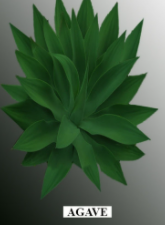
Note: Agaves can be easily confused with cacti, aloes, or stonecrops as it looks similar to them i.e they have a morphological similarity. Even though it is also known as America Aloe, All these plants are somewhere similar in appearance because of their adaptations to the arid environment.
Complete answer:
Century plant is also known as Agave. It is a monocot and found in hot and arid regions. The characteristic feature of the genus Agave is observed to be having succulent and xerophytic properties that consist of a large, strong, and fleshy leaves having a rosette. Plants in this genus are usually considered as perennial because they require many years to mature and flower.
Additional Information: The succulent leaves of most Agave species have sharp marginal teeth, a particularly sharp terminal spine, and are very fibrous inside The stout stem is typically extremely short, which can make the plant appear as if it's stemless.
Agave rosettes are mostly monocarpic, but exceptions are everywhere and some species are polycarpic. During flowering, a tall stem or "mast", which may grow to be 40 feet (12 m) high, grows apically from the middle of the rosette and bears an outsized number of short, tubular flowers and sometimes vegetatively produced bulbils which may be a sort of agamogenesis. Special adaptation is seen in the Agave. The root system is made up of a network of rhizomes that are shallow and helps the Agave in absorbing moisture from the condensation, rain, or dew.
So, the correct answer is ‘Agave’.
Note: Agaves can be easily confused with cacti, aloes, or stonecrops as it looks similar to them i.e they have a morphological similarity. Even though it is also known as America Aloe, All these plants are somewhere similar in appearance because of their adaptations to the arid environment.
Recently Updated Pages
Master Class 11 Social Science: Engaging Questions & Answers for Success

Master Class 11 Physics: Engaging Questions & Answers for Success
Master Class 11 Maths: Engaging Questions & Answers for Success
Master Class 11 Economics: Engaging Questions & Answers for Success
Master Class 11 Computer Science: Engaging Questions & Answers for Success
Master Class 11 Chemistry: Engaging Questions & Answers for Success
Trending doubts
One Metric ton is equal to kg A 10000 B 1000 C 100 class 11 physics CBSE
How many bones are in the spine class 11 biology CBSE
1 Quintal is equal to a 110 kg b 10 kg c 100kg d 1000 class 11 physics CBSE
There are 720 permutations of the digits 1 2 3 4 5 class 11 maths CBSE
State and prove Bernoullis theorem class 11 physics CBSE
Difference Between Prokaryotic Cells and Eukaryotic Cells