




Which of these combinations of spherical mirrors can produce a point image?
A). Convex mirror, at centre
B). Concave mirror, at centre
C). Convex mirror, object placed at infinity
D). Concave mirror, object placed at infinity
Answer
 Verified
529.2k+ views
Hint: An image can be formed only when the reflected light beams converge to a single point. If the reflected beams are not converged to a single point, image formation is not possible. Only concave mirrors can produce an image, convex mirrors diverge the light beams.
Complete answer:
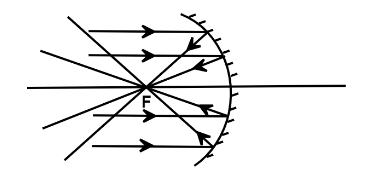
After reflection, rays emerging from a point meet at another point, which is known as the image of the initial point. The image is real if the rays converge to the point, and virtual if the rays do not meet but appear to diverge from a point when the rays are produced backwards. After reflection from the concave mirror, all light rays parallel to the principal axis of a concave mirror converge at the principal focus (F). A concave mirror is also known as a converging mirror because it converges a parallel beam of light rays.
After reflection, these rays converge and produce an image in front of the mirror at F, the principal focus of the mirror. The resulting image is significantly reduced, point size, real, and inverted.
The correct answer is option D, Concave mirror, object placed at infinity.
Note:
When light beams converge to create an image, it is called a real image. Only concave mirrors can produce a real image. Even though a plane mirror produces an upright image, it is laterally inverted. In other words, the image created by a plane mirror reverses the left and right sides of the object.
Complete answer:
After reflection, rays emerging from a point meet at another point, which is known as the image of the initial point. The image is real if the rays converge to the point, and virtual if the rays do not meet but appear to diverge from a point when the rays are produced backwards. After reflection from the concave mirror, all light rays parallel to the principal axis of a concave mirror converge at the principal focus (F). A concave mirror is also known as a converging mirror because it converges a parallel beam of light rays.
After reflection, these rays converge and produce an image in front of the mirror at F, the principal focus of the mirror. The resulting image is significantly reduced, point size, real, and inverted.
The correct answer is option D, Concave mirror, object placed at infinity.
Note:
When light beams converge to create an image, it is called a real image. Only concave mirrors can produce a real image. Even though a plane mirror produces an upright image, it is laterally inverted. In other words, the image created by a plane mirror reverses the left and right sides of the object.
Recently Updated Pages
Basicity of sulphurous acid and sulphuric acid are

Master Class 11 English: Engaging Questions & Answers for Success
Master Class 11 Physics: Engaging Questions & Answers for Success
Master Class 11 Computer Science: Engaging Questions & Answers for Success
Master Class 11 Chemistry: Engaging Questions & Answers for Success
Master Class 11 Social Science: Engaging Questions & Answers for Success
Trending doubts
Difference Between Prokaryotic Cells and Eukaryotic Cells
Two of the body parts which do not appear in MRI are class 11 biology CBSE
One Metric ton is equal to kg A 10000 B 1000 C 100 class 11 physics CBSE
10 examples of friction in our daily life
Draw a diagram of nephron and explain its structur class 11 biology CBSE
What will happen if the mucus is not secreted by the class 11 biology CBSE