




Which of these are respiratory poisons or inhibitors of ETC?
a. Cyanides
b. Antimycin A
c. Carbon monoxide
d. All of these
Answer
 Verified
611.4k+ views
Hint: Electron transport chain is composed of a series of complexes which are known for transferring electrons from an electron donor to electron acceptors through a redox reaction. So, the inhibitors of ETC will inhibit this process of electron transfer.
Complete answer:
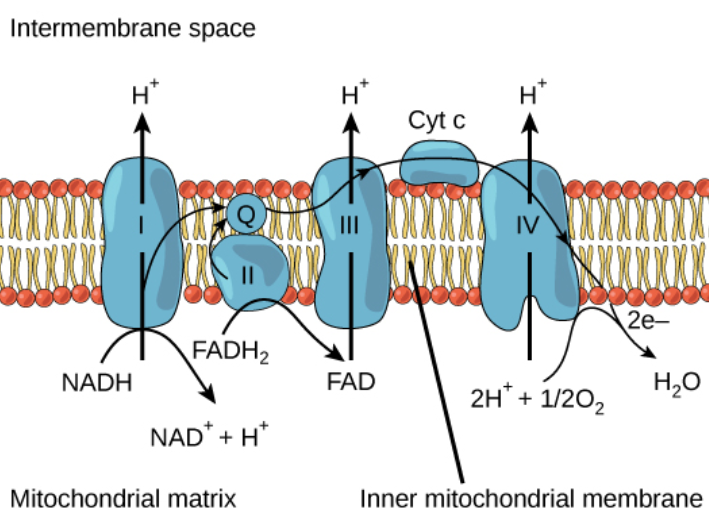
Electron Transport Chain (ETC) refers to a series of complexes that are known for transferring electrons to generate ATP. The inhibition of ETC will result in the accumulation of oxidized forms of the components of ETC after the point of inhibition and the reduced forms before the point of inhibition. This inhibition will tend to stop the production of ATP. The most important inhibitors of ETC are amytal, rotenone, antimycin A, cyanides, sodium azide, and CO.
Amytal and rotenone are known to block the ETC between NADH dehydrogenase (Complex I) and CoQ.
Cyanides, sodium azides, and carbon monoxide (CO) are known for inhibiting the electron transport chain by binding to \[F{e^{ + 3}}\] in Haem groups in cytochrome oxidase. Thereby, inhibiting the terminal transfer of electrons to oxygen.
Antimycin A is an antibiotic that inhibits the ETC by interfering with the electron flow at the level of $CoQ{H_2}$-cytochrome c reductase (complex III).
Hence, the correct answer is option (D).
Additional information:
Electron transport chain is located in the inner mitochondrial membrane and it is the final stage of aerobic respiration. The ETC is known to synthesize the energy in the form of ATP by a process called oxidative phosphorylation because the energy that is required to produce ATP is derived from the oxidation of hydrogen carriers.
Note: The inhibitors of ETC are those substances that bind to the components of ETC thereby blocking the transfer of electrons and hence, preventing its ability to change in its reversible form i.e., from oxidized state to reduced state.
Complete answer:
Electron Transport Chain (ETC) refers to a series of complexes that are known for transferring electrons to generate ATP. The inhibition of ETC will result in the accumulation of oxidized forms of the components of ETC after the point of inhibition and the reduced forms before the point of inhibition. This inhibition will tend to stop the production of ATP. The most important inhibitors of ETC are amytal, rotenone, antimycin A, cyanides, sodium azide, and CO.
Amytal and rotenone are known to block the ETC between NADH dehydrogenase (Complex I) and CoQ.
Cyanides, sodium azides, and carbon monoxide (CO) are known for inhibiting the electron transport chain by binding to \[F{e^{ + 3}}\] in Haem groups in cytochrome oxidase. Thereby, inhibiting the terminal transfer of electrons to oxygen.
Antimycin A is an antibiotic that inhibits the ETC by interfering with the electron flow at the level of $CoQ{H_2}$-cytochrome c reductase (complex III).
Hence, the correct answer is option (D).
Additional information:
Electron transport chain is located in the inner mitochondrial membrane and it is the final stage of aerobic respiration. The ETC is known to synthesize the energy in the form of ATP by a process called oxidative phosphorylation because the energy that is required to produce ATP is derived from the oxidation of hydrogen carriers.
Note: The inhibitors of ETC are those substances that bind to the components of ETC thereby blocking the transfer of electrons and hence, preventing its ability to change in its reversible form i.e., from oxidized state to reduced state.
Recently Updated Pages
Master Class 12 Economics: Engaging Questions & Answers for Success

Master Class 12 English: Engaging Questions & Answers for Success
Master Class 12 Social Science: Engaging Questions & Answers for Success
Master Class 12 Maths: Engaging Questions & Answers for Success
Master Class 12 Physics: Engaging Questions & Answers for Success
Master Class 9 General Knowledge: Engaging Questions & Answers for Success
Trending doubts
One Metric ton is equal to kg A 10000 B 1000 C 100 class 11 physics CBSE
Difference Between Prokaryotic Cells and Eukaryotic Cells
Two of the body parts which do not appear in MRI are class 11 biology CBSE
1 ton equals to A 100 kg B 1000 kg C 10 kg D 10000 class 11 physics CBSE
Draw a diagram of nephron and explain its structur class 11 biology CBSE
10 examples of friction in our daily life