




Which of the following triplets is not the right triangle?
(a) 7, 24, 25
(b) 60, 80, 90
(c) 5, 12, 13
(d) 9, 40, 41
Answer
 Verified
605.7k+ views
Hint: First, let us draw a diagram of a right-angled triangle for the reference. Let use the method of trial and error method to check whether which one of the options is not a right-angled triangle with the help of the Pythagoras theorem, ${{\left( \text{Hypotenuse} \right)}^{2}}={{\left( \text{side one} \right)}^{2}}+{{\left( \text{side two} \right)}^{2}}$. Substitute the values in the formula and check if L.H.S is equal to R.H.S, the one which is not equal is the required answer.
Complete step-by-step solution
We have 4 options out of which three of them are the sides of the right-angled triangle, here we have to find the one which is not a right-angled triangle.
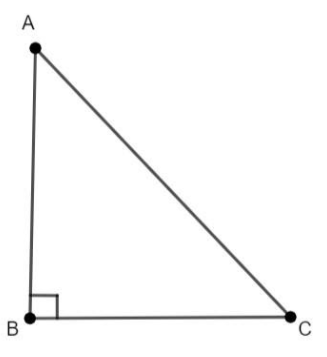
First, let us consider a triangle ABC which is a triangle that has three sides AB, BC, and AC, and let us draw a right-angled triangle for reference.
Let us check for the first option,
(a) 7, 24, 25:
We need to check if these three sides make a right-angled triangle.
In a right-angled triangle, the hypotenuse is the longest side. Hence, 25 is the hypotenuse and 7 and 24 are the remaining two sides.
From Pythagoras theorem, we know
${{\left( \text{Hypotenuse} \right)}^{2}}={{\left( \text{side one} \right)}^{2}}+{{\left( \text{side two} \right)}^{2}}$
So, if the right-hand side equals the left-hand side, we can say that the respective triangle is a right-angled triangle.
$\begin{align}
& \text{L}\text{.H}\text{.S = }{{\left( \text{Hypotenuse} \right)}^{2}} \\
& ={{\left( 25 \right)}^{2}} \\
& =625
\end{align}$
$\begin{align}
& \text{R}\text{.H}\text{.S = }{{\left( \text{side one} \right)}^{2}}+{{\left( \text{side two} \right)}^{2}} \\
& ={{\left( 7 \right)}^{2}}+{{\left( 24 \right)}^{2}} \\
& =49+576 \\
& =625
\end{align}$
Here, L.H.S = R.H.S, therefore we can say that the sides are of right-angled triangles.
(b) 60, 80, 90
Similarly, let us check for these sides of the triangle.
Hypotenuse = 90, side one = 60, side two = 80
From Pythagoras theorem, we know
${{\left( \text{Hypotenuse} \right)}^{2}}={{\left( \text{side one} \right)}^{2}}+{{\left( \text{side two} \right)}^{2}}$
$\begin{align}
& \text{L}\text{.H}\text{.S =}{{\left( \text{Hypotenuse} \right)}^{2}} \\
& ={{\left( 90 \right)}^{2}} \\
& =8100
\end{align}$
$\begin{align}
& \text{R}\text{.H}\text{.S = }{{\left( \text{side one} \right)}^{2}}+{{\left( \text{side two} \right)}^{2}} \\
& ={{\left( 60 \right)}^{2}}+{{\left( 80 \right)}^{2}} \\
& =3600+6400 \\
& =10000
\end{align}$
Here,$\text{L}\text{.H}\text{.S}\ne \text{R}\text{.H}\text{.S}$, therefore these three sides do not make a right-angled triangle.
For option (c):
Hypotenuse = 13, side one = 12, side two = 5
From Pythagoras theorem, we get
${{\left( \text{Hypotenuse} \right)}^{2}}={{\left( \text{side one} \right)}^{2}}+{{\left( \text{side two} \right)}^{2}}$
$\begin{align}
& \text{L}\text{.H}\text{.S =}{{\left( \text{Hypotenuse} \right)}^{2}} \\
& ={{\left( 13 \right)}^{2}} \\
& =169
\end{align}$
\[\begin{align}
& \text{R}\text{.H}\text{.S = }{{\left( \text{side one} \right)}^{2}}+{{\left( \text{side two} \right)}^{2}} \\
& ={{\left( 12 \right)}^{2}}+{{\left( 5 \right)}^{2}} \\
& =144+25 \\
& =169
\end{align}\]
Here, L.H.S = R.H.S, therefore we can say that the sides are of right-angled triangles.
For option (d):
Hypotenuse = 41, side one = 9, side two = 40
From Pythagoras theorem, we get
${{\left( \text{Hypotenuse} \right)}^{2}}={{\left( \text{side one} \right)}^{2}}+{{\left( \text{side two} \right)}^{2}}$
$\begin{align}
& \text{L}\text{.H}\text{.S =}{{\left( \text{Hypotenuse} \right)}^{2}} \\
& ={{\left( 41 \right)}^{2}} \\
& =1681
\end{align}$
\[\begin{align}
& \text{R}\text{.H}\text{.S = }{{\left( \text{side one} \right)}^{2}}+{{\left( \text{side two} \right)}^{2}} \\
& ={{\left( 9 \right)}^{2}}+{{\left( 40 \right)}^{2}} \\
& =81+1600 \\
& =1681
\end{align}\]
Here, L.H.S = R.H.S, therefore we can say that the sides are of right-angled triangles.
Hence, only option (b) is the triplet which is not a right-angled triangle.
Note: In a right-angled triangle, there are mainly two types of a right-angled triangle. They are classified with respect to the angles in the triangle. The two types are, (30 – 60 – 90) which indicates the three angles in the right-angled triangle, the next is (45 – 45 – 90) which is an isosceles right-angled triangle since two of its angles are congruent which indicates that two opposite sides of those equal angles will also be congruent.
Complete step-by-step solution
We have 4 options out of which three of them are the sides of the right-angled triangle, here we have to find the one which is not a right-angled triangle.
First, let us consider a triangle ABC which is a triangle that has three sides AB, BC, and AC, and let us draw a right-angled triangle for reference.
Let us check for the first option,
(a) 7, 24, 25:
We need to check if these three sides make a right-angled triangle.
In a right-angled triangle, the hypotenuse is the longest side. Hence, 25 is the hypotenuse and 7 and 24 are the remaining two sides.
From Pythagoras theorem, we know
${{\left( \text{Hypotenuse} \right)}^{2}}={{\left( \text{side one} \right)}^{2}}+{{\left( \text{side two} \right)}^{2}}$
So, if the right-hand side equals the left-hand side, we can say that the respective triangle is a right-angled triangle.
$\begin{align}
& \text{L}\text{.H}\text{.S = }{{\left( \text{Hypotenuse} \right)}^{2}} \\
& ={{\left( 25 \right)}^{2}} \\
& =625
\end{align}$
$\begin{align}
& \text{R}\text{.H}\text{.S = }{{\left( \text{side one} \right)}^{2}}+{{\left( \text{side two} \right)}^{2}} \\
& ={{\left( 7 \right)}^{2}}+{{\left( 24 \right)}^{2}} \\
& =49+576 \\
& =625
\end{align}$
Here, L.H.S = R.H.S, therefore we can say that the sides are of right-angled triangles.
(b) 60, 80, 90
Similarly, let us check for these sides of the triangle.
Hypotenuse = 90, side one = 60, side two = 80
From Pythagoras theorem, we know
${{\left( \text{Hypotenuse} \right)}^{2}}={{\left( \text{side one} \right)}^{2}}+{{\left( \text{side two} \right)}^{2}}$
$\begin{align}
& \text{L}\text{.H}\text{.S =}{{\left( \text{Hypotenuse} \right)}^{2}} \\
& ={{\left( 90 \right)}^{2}} \\
& =8100
\end{align}$
$\begin{align}
& \text{R}\text{.H}\text{.S = }{{\left( \text{side one} \right)}^{2}}+{{\left( \text{side two} \right)}^{2}} \\
& ={{\left( 60 \right)}^{2}}+{{\left( 80 \right)}^{2}} \\
& =3600+6400 \\
& =10000
\end{align}$
Here,$\text{L}\text{.H}\text{.S}\ne \text{R}\text{.H}\text{.S}$, therefore these three sides do not make a right-angled triangle.
For option (c):
Hypotenuse = 13, side one = 12, side two = 5
From Pythagoras theorem, we get
${{\left( \text{Hypotenuse} \right)}^{2}}={{\left( \text{side one} \right)}^{2}}+{{\left( \text{side two} \right)}^{2}}$
$\begin{align}
& \text{L}\text{.H}\text{.S =}{{\left( \text{Hypotenuse} \right)}^{2}} \\
& ={{\left( 13 \right)}^{2}} \\
& =169
\end{align}$
\[\begin{align}
& \text{R}\text{.H}\text{.S = }{{\left( \text{side one} \right)}^{2}}+{{\left( \text{side two} \right)}^{2}} \\
& ={{\left( 12 \right)}^{2}}+{{\left( 5 \right)}^{2}} \\
& =144+25 \\
& =169
\end{align}\]
Here, L.H.S = R.H.S, therefore we can say that the sides are of right-angled triangles.
For option (d):
Hypotenuse = 41, side one = 9, side two = 40
From Pythagoras theorem, we get
${{\left( \text{Hypotenuse} \right)}^{2}}={{\left( \text{side one} \right)}^{2}}+{{\left( \text{side two} \right)}^{2}}$
$\begin{align}
& \text{L}\text{.H}\text{.S =}{{\left( \text{Hypotenuse} \right)}^{2}} \\
& ={{\left( 41 \right)}^{2}} \\
& =1681
\end{align}$
\[\begin{align}
& \text{R}\text{.H}\text{.S = }{{\left( \text{side one} \right)}^{2}}+{{\left( \text{side two} \right)}^{2}} \\
& ={{\left( 9 \right)}^{2}}+{{\left( 40 \right)}^{2}} \\
& =81+1600 \\
& =1681
\end{align}\]
Here, L.H.S = R.H.S, therefore we can say that the sides are of right-angled triangles.
Hence, only option (b) is the triplet which is not a right-angled triangle.
Note: In a right-angled triangle, there are mainly two types of a right-angled triangle. They are classified with respect to the angles in the triangle. The two types are, (30 – 60 – 90) which indicates the three angles in the right-angled triangle, the next is (45 – 45 – 90) which is an isosceles right-angled triangle since two of its angles are congruent which indicates that two opposite sides of those equal angles will also be congruent.
Recently Updated Pages
Master Class 12 Business Studies: Engaging Questions & Answers for Success

Master Class 12 Biology: Engaging Questions & Answers for Success
Master Class 12 Chemistry: Engaging Questions & Answers for Success
Class 12 Question and Answer - Your Ultimate Solutions Guide
Master Class 11 Social Science: Engaging Questions & Answers for Success
Master Class 11 English: Engaging Questions & Answers for Success
Trending doubts
Explain the Treaty of Vienna of 1815 class 10 social science CBSE
Who Won 36 Oscar Awards? Record Holder Revealed
What is the median of the first 10 natural numbers class 10 maths CBSE
Why is it 530 pm in india when it is 1200 afternoon class 10 social science CBSE
The highest temperature in Karnataka is recorded in class 10 social science CBSE
Define Potential, Developed, Stock and Reserved resources