




Which of the following structures may be traversed by plasmodesmata that connect the cytoplasm of two neighboring plant cells?
A. Middle lamella only
B. Endoplasmic reticulum only
C. Both cell wall and middle lamella
D. Plasma membrane only
Answer
 Verified
608.1k+ views
Hint: The channels present in plant cells that are microscopic and facilitate the transport of substances across the plant body and also in intercellular communication are known as plasmodesmata. The type of movement allowed through the plasmodesmata is symplastic in nature.
Complete answer: The adjacent cells in a plant body are connected through Plasmodesmata. These are traversed by both the cell wall and the middle lamella. The cell wall is the outermost covering of a plant cell, made up of cellulose, and provides rigidity to the cell. While the middle lamella is also a part of the cell wall, whose function is in cementing together the adjacently located cells. On maturation of the plant cells, it gets developed into the outermost portion of the cell wall. It is composed of magnesium and calcium pectate.
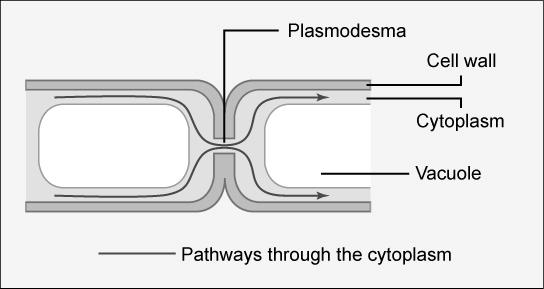
Considering the other given options:
-Middle lamella only cannot be traversed by the plasmodesmata since it is a part of the cell wall and while forming the channels, it gets past the cell wall also. Thus, option A is incorrect.
-The endoplasmic reticulum is a cell organelle that is involved in the storage of calcium as well as in lipid metabolism. Since it is not a part of the membrane structures, the organelles cannot be traversed by the plasmodesmata. Thus option B is also a wrong choice.
-The plasmodesmata cannot traverse only the plasma membrane, therefore it is also not the appropriate option.
Thus, the options given above is C, that is, both cell wall and middle lamella.
Note: The middle lamella is the first structure that is formed during the process of cytokinesis or cell division. These structures are developed from the part known as the cell plate. The middle lamella by the action of enzymes gets degraded, while the fruit ripens.
Complete answer: The adjacent cells in a plant body are connected through Plasmodesmata. These are traversed by both the cell wall and the middle lamella. The cell wall is the outermost covering of a plant cell, made up of cellulose, and provides rigidity to the cell. While the middle lamella is also a part of the cell wall, whose function is in cementing together the adjacently located cells. On maturation of the plant cells, it gets developed into the outermost portion of the cell wall. It is composed of magnesium and calcium pectate.
Considering the other given options:
-Middle lamella only cannot be traversed by the plasmodesmata since it is a part of the cell wall and while forming the channels, it gets past the cell wall also. Thus, option A is incorrect.
-The endoplasmic reticulum is a cell organelle that is involved in the storage of calcium as well as in lipid metabolism. Since it is not a part of the membrane structures, the organelles cannot be traversed by the plasmodesmata. Thus option B is also a wrong choice.
-The plasmodesmata cannot traverse only the plasma membrane, therefore it is also not the appropriate option.
Thus, the options given above is C, that is, both cell wall and middle lamella.
Note: The middle lamella is the first structure that is formed during the process of cytokinesis or cell division. These structures are developed from the part known as the cell plate. The middle lamella by the action of enzymes gets degraded, while the fruit ripens.
Recently Updated Pages
Master Class 11 English: Engaging Questions & Answers for Success

Master Class 11 Social Science: Engaging Questions & Answers for Success
Master Class 11 Maths: Engaging Questions & Answers for Success
Master Class 11 Biology: Engaging Questions & Answers for Success
Master Class 11 Physics: Engaging Questions & Answers for Success
Master Class 11 Chemistry: Engaging Questions & Answers for Success
Trending doubts
One Metric ton is equal to kg A 10000 B 1000 C 100 class 11 physics CBSE
Difference Between Prokaryotic Cells and Eukaryotic Cells
1 ton equals to A 100 kg B 1000 kg C 10 kg D 10000 class 11 physics CBSE
Find the value of the expression given below sin 30circ class 11 maths CBSE
Two of the body parts which do not appear in MRI are class 11 biology CBSE
What are hard magnetic materials class 11 physics CBSE