




Which of the following structures helps you to determine that it is not an animal cell?
A. Cell wall and Vacuole
B. Mitochondria and Ribosome
C. Ribosomes and Lysosomes
D. Plasma membrane
Answer
 Verified
601.8k+ views
Hint: The animal cell is protected with the plasma membrane, whereas the plant cell is surrounded by an extra layer apart from the plasma membrane.
Complete answer: The cell is the structural and fundamental unit of life. It is also the smallest biological unit of living organisms. The predominant distinction between an animal cell and a plant cell is that there is a cell wall in plant cells and the cell wall is absent in animal cells. The cell wall consisting of cellulose gives rigidity to the plant cell, resulting in a fixed, rectangular shape. The rigidity of animal cells is lacking, as a result, they appear to have a round and irregular form.
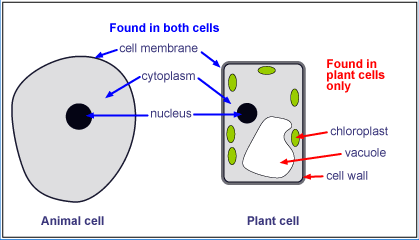
The scale of animal cells ranges between a few microscopic microns and a few millimetres. The largest animal cell known to exist is the ostrich egg. Often, the shape of animal cells varies, with some being smooth, others being oval or rod-shaped. More fascinating shapes like curved, spherical, concave and rectangular are also visible.
Hence, the correct answer is option A.
Note: In appearance also, animal cells tend to differ greatly from plant cells. The cell wall allows high pressure to develop within the plant cell and no bursting can occur. Because of this, the plant cell is able to accept significant volumes of liquid by osmosis. Animal cells, which have only a thin membrane limiting cell entry, appear to burst if too much extra water is absorbed.
Complete answer: The cell is the structural and fundamental unit of life. It is also the smallest biological unit of living organisms. The predominant distinction between an animal cell and a plant cell is that there is a cell wall in plant cells and the cell wall is absent in animal cells. The cell wall consisting of cellulose gives rigidity to the plant cell, resulting in a fixed, rectangular shape. The rigidity of animal cells is lacking, as a result, they appear to have a round and irregular form.
The scale of animal cells ranges between a few microscopic microns and a few millimetres. The largest animal cell known to exist is the ostrich egg. Often, the shape of animal cells varies, with some being smooth, others being oval or rod-shaped. More fascinating shapes like curved, spherical, concave and rectangular are also visible.
Hence, the correct answer is option A.
Note: In appearance also, animal cells tend to differ greatly from plant cells. The cell wall allows high pressure to develop within the plant cell and no bursting can occur. Because of this, the plant cell is able to accept significant volumes of liquid by osmosis. Animal cells, which have only a thin membrane limiting cell entry, appear to burst if too much extra water is absorbed.
Recently Updated Pages
Master Class 11 English: Engaging Questions & Answers for Success

Master Class 11 Social Science: Engaging Questions & Answers for Success
Master Class 11 Maths: Engaging Questions & Answers for Success
Master Class 11 Biology: Engaging Questions & Answers for Success
Master Class 11 Physics: Engaging Questions & Answers for Success
Master Class 11 Chemistry: Engaging Questions & Answers for Success
Trending doubts
One Metric ton is equal to kg A 10000 B 1000 C 100 class 11 physics CBSE
Difference Between Prokaryotic Cells and Eukaryotic Cells
1 ton equals to A 100 kg B 1000 kg C 10 kg D 10000 class 11 physics CBSE
Find the value of the expression given below sin 30circ class 11 maths CBSE
Two of the body parts which do not appear in MRI are class 11 biology CBSE
What are hard magnetic materials class 11 physics CBSE