




Which of the following statement(s) is(are) true for respiration?
(a)During respiration, ribs move inward and the diaphragm is raised.
(b) In the alveoli, exchange of gases takes place i.e. oxygen from alveolar air diffuses into blood and carbon dioxide from the blood into the alveolar air.
(c)Alveoli increases surface area for exchange of gases.
(d)Both B and C
Answer
 Verified
600k+ views
Hint: Respiration is a catabolic process. It is a Physico-chemical process, which involves the exchange of oxygen and carbon dioxide with the formation of energy. Respiration involves gaseous exchange in both internal and external respiration, depending on the principle of diffusion.
Complete answer:
Respiratory system in a human being is a respiratory tract which starts at the nostril and ends at alveoli. There are two parts of the respiratory tract: the conducting part and the respiratory part. Lungs communicate to the outside through a respiratory tract formed of nostrils, nasal chambers, pharynx, larynx, trachea and primary bronchi. Lungs are soft, spongy and very elastic pairs of organs present in the thoracic cavity. Each bronchus, after entering into the lung, terminates finally into alveoli or air sacs, which are the main structures of the lungs. There are about 750 million alveoli in both the lungs of man, which provide about 100 sq.m. surface area of respiration. Each alveolus is lined by a thin cover of flat cells of glandular epithelium, which is immediately surrounded by blood capillaries. The alveolar wall shows small alveolar pores.
Lungs are well protected in the thoracic chamber bounded dorsally by the vertebral column, ventral by the sternum, laterally by ribs and on the lower side by the diaphragm.
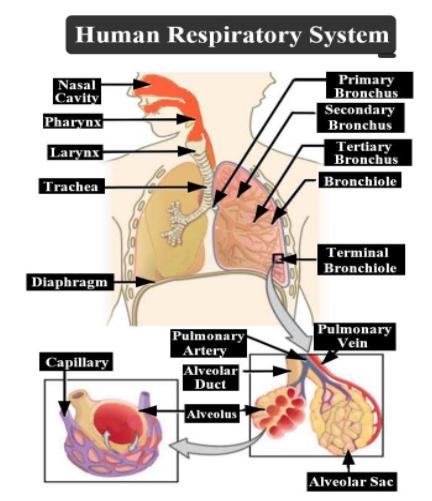
So the correct answer is “both b and c”.
Note: Common respiratory disorders include bronchitis, bronchial asthma, pneumonia, emphysema, occupational disorders like asbestosis and silicosis, asphyxia, common cold, allergic rhinitis( Hay fever). These disorders can be caused by smoking tobacco, breathing in air pollutants, and some allergic substances.
Complete answer:
Respiratory system in a human being is a respiratory tract which starts at the nostril and ends at alveoli. There are two parts of the respiratory tract: the conducting part and the respiratory part. Lungs communicate to the outside through a respiratory tract formed of nostrils, nasal chambers, pharynx, larynx, trachea and primary bronchi. Lungs are soft, spongy and very elastic pairs of organs present in the thoracic cavity. Each bronchus, after entering into the lung, terminates finally into alveoli or air sacs, which are the main structures of the lungs. There are about 750 million alveoli in both the lungs of man, which provide about 100 sq.m. surface area of respiration. Each alveolus is lined by a thin cover of flat cells of glandular epithelium, which is immediately surrounded by blood capillaries. The alveolar wall shows small alveolar pores.
Lungs are well protected in the thoracic chamber bounded dorsally by the vertebral column, ventral by the sternum, laterally by ribs and on the lower side by the diaphragm.
So the correct answer is “both b and c”.
Note: Common respiratory disorders include bronchitis, bronchial asthma, pneumonia, emphysema, occupational disorders like asbestosis and silicosis, asphyxia, common cold, allergic rhinitis( Hay fever). These disorders can be caused by smoking tobacco, breathing in air pollutants, and some allergic substances.
Recently Updated Pages
Master Class 11 Business Studies: Engaging Questions & Answers for Success

Master Class 11 Computer Science: Engaging Questions & Answers for Success
Master Class 11 Economics: Engaging Questions & Answers for Success
Master Class 11 Social Science: Engaging Questions & Answers for Success
Master Class 11 English: Engaging Questions & Answers for Success
Master Class 11 Chemistry: Engaging Questions & Answers for Success
Trending doubts
Draw a diagram of nephron and explain its structur class 11 biology CBSE
Explain zero factorial class 11 maths CBSE
Chemical formula of Bleaching powder is A Ca2OCl2 B class 11 chemistry CBSE
Name the part of the brain responsible for the precision class 11 biology CBSE
The growth of tendril in pea plants is due to AEffect class 11 biology CBSE
One Metric ton is equal to kg A 10000 B 1000 C 100 class 11 physics CBSE