




Which of the following statements are correct:
If M is the midpoint of AB and O is any point then
(This question has multiple correct options)
\[
(a){\text{ }}\vec O\vec M = \vec O\vec A + \vec M\vec A \\
(b){\text{ }}\vec O\vec M = \vec O\vec A - \vec M\vec A \\
(c){\text{ }}\vec O\vec M = \dfrac{1}{2}\left( {\vec O\vec A - \vec O\vec B} \right) \\
(d){\text{ }}\vec O\vec M = \dfrac{1}{2}\left( {\vec O\vec B + \vec O\vec A} \right) \\
\]
Answer
 Verified
624.6k+ views
Hint: In this question it has been given that M is the midpoint of AB and O is any point. Use the concept of vectors that if a vector is reversed its sign gets reversed as well that is $\vec A\vec M = - \vec M\vec A$ along with the concepts of mid-point that a mid-points divides the line into two equal portions to get the answer.
Complete step-by-step answer:
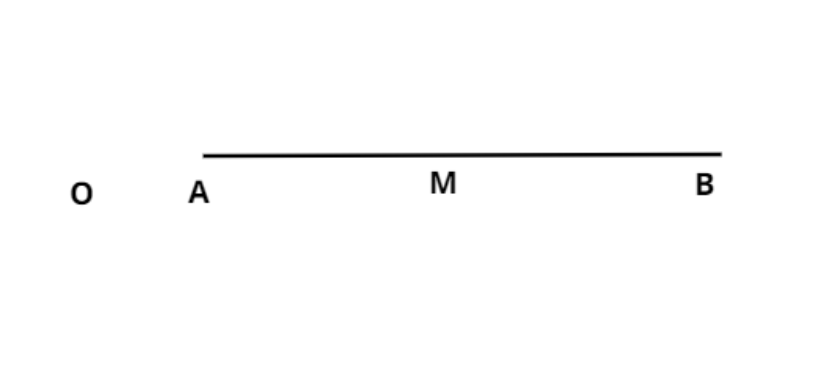
It is given M is the midpoint of line AB.
$ \Rightarrow \vec A\vec M = \vec M\vec B$………………………. (1)
Now O is any point.
Now position vector OM is written as
$ \Rightarrow {\text{ }}\vec O\vec M = \vec O\vec A + \vec A\vec M$…………………… (2)
And we all know if the direction of the vector is changed then the magnitude of the vector is changed (i.e. if magnitude is positive it becomes negative or vice-versa).
$ \Rightarrow \vec A\vec M = - \vec M\vec A$
Substitute this value in equation (2) we have,
$ \Rightarrow {\text{ }}\vec O\vec M = \vec O\vec A - \vec M\vec A$ (Which is option (b))
Now from equation (1)
$ \Rightarrow \vec A\vec M = \vec M\vec B$
Now break the vectors in terms of position vector of O we have,
$ \Rightarrow \vec A\vec O + \vec O\vec M = \vec M\vec O + \vec O\vec B$
Now according to above property we have
$ \Rightarrow - \vec O\vec A + \vec O\vec M = - \vec O\vec M + \vec O\vec B$
Now simplify the above equation we have,
\[ \Rightarrow 2\vec O\vec M = \vec O\vec A + \vec O\vec B\]
\[ \Rightarrow \vec O\vec M = \dfrac{1}{2}\left( {\vec O\vec A + \vec O\vec B} \right)\] (Which is option number (d))
Hence options (b) and (d) are correct.
Note – Whenever we face such types of problems the key concept is simply to have a good understanding of vectors. The diagrammatic representation of the information given in question helps in better understanding of the question. The midpoint properties will eventually take you on the right track to get the answer.
Complete step-by-step answer:
It is given M is the midpoint of line AB.
$ \Rightarrow \vec A\vec M = \vec M\vec B$………………………. (1)
Now O is any point.
Now position vector OM is written as
$ \Rightarrow {\text{ }}\vec O\vec M = \vec O\vec A + \vec A\vec M$…………………… (2)
And we all know if the direction of the vector is changed then the magnitude of the vector is changed (i.e. if magnitude is positive it becomes negative or vice-versa).
$ \Rightarrow \vec A\vec M = - \vec M\vec A$
Substitute this value in equation (2) we have,
$ \Rightarrow {\text{ }}\vec O\vec M = \vec O\vec A - \vec M\vec A$ (Which is option (b))
Now from equation (1)
$ \Rightarrow \vec A\vec M = \vec M\vec B$
Now break the vectors in terms of position vector of O we have,
$ \Rightarrow \vec A\vec O + \vec O\vec M = \vec M\vec O + \vec O\vec B$
Now according to above property we have
$ \Rightarrow - \vec O\vec A + \vec O\vec M = - \vec O\vec M + \vec O\vec B$
Now simplify the above equation we have,
\[ \Rightarrow 2\vec O\vec M = \vec O\vec A + \vec O\vec B\]
\[ \Rightarrow \vec O\vec M = \dfrac{1}{2}\left( {\vec O\vec A + \vec O\vec B} \right)\] (Which is option number (d))
Hence options (b) and (d) are correct.
Note – Whenever we face such types of problems the key concept is simply to have a good understanding of vectors. The diagrammatic representation of the information given in question helps in better understanding of the question. The midpoint properties will eventually take you on the right track to get the answer.
Recently Updated Pages
Basicity of sulphurous acid and sulphuric acid are

Master Class 12 English: Engaging Questions & Answers for Success
Master Class 12 Social Science: Engaging Questions & Answers for Success
Master Class 12 Maths: Engaging Questions & Answers for Success
Master Class 12 Economics: Engaging Questions & Answers for Success
Master Class 12 Physics: Engaging Questions & Answers for Success
Trending doubts
Which are the Top 10 Largest Countries of the World?
Draw a labelled sketch of the human eye class 12 physics CBSE
Draw ray diagrams each showing i myopic eye and ii class 12 physics CBSE
Give 10 examples of unisexual and bisexual flowers
Coming together federation is practiced in A India class 12 social science CBSE
How was the Civil Disobedience Movement different from class 12 social science CBSE