




Which of the following species makes the largest true flower in the world?
A. Amorphophallus titanum
B. Rafflesia arnoldii
C. Nelumbo nucifera
D. Helianthus amnuus
Answer
 Verified
601.5k+ views
Hint: The diameter of the largest true flower is around 1 meter. It is the parasitic flower that is found in parts of Indonesia and the odor of this flower is just like rotten flesh. The color of this flower is reddish-brown and it lacks a stem, leaves, and roots.
Complete answer:
> Amorphophallus titanum is a flowering plant that has the largest unbranched inflorescence in the world. It does not produce a single individual flower but consists of a group of flowers arranged on a floral axis.
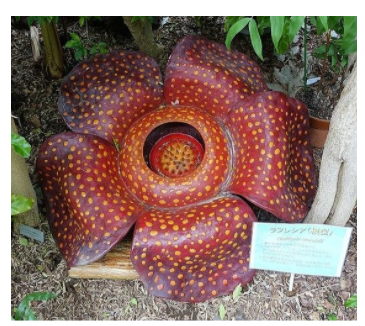
> Rafflesia arnoldii is also known as corpse lily or stinking corpse lily. It is known for the production of the largest individual flower on the Earth. The flower emerges from a very large, cabbage-like bud of a diameter of about 30 cm and the diameter of the flower can reach upto 105 cm. It grows in association with the host to derive nutrients and water from the host because R. arnoldii lack stem, leaves, and roots. It is a rare flower and hard to locate.
> Nelumbo nucifera is also called Indian lotus, sacred lotus, or simply lotus. The lotus plants grow well in flood plains of slow-moving rivers. The flowers of this plant can have a diameter of about 30 cm.
> Helianthus amnuus is a common sunflower that is known for its edible oil and fruits. The flower of a sunflower is not a flower but actually a flower head consisting of numerous small individual five-petaled flowers or florets. These heads are about 15 cm wide in wild species and often 30 cm in cultivated species.
Hence, the correct option is (B).
Note:
Rafflesia arnoldii is the plant that possesses the largest true flower in the world of diameter approximately 150 cm. It is a rare plant found in the parts of Indonesia. It is present in close association with the host plant to derive nutrients and water.
Complete answer:
> Amorphophallus titanum is a flowering plant that has the largest unbranched inflorescence in the world. It does not produce a single individual flower but consists of a group of flowers arranged on a floral axis.
> Rafflesia arnoldii is also known as corpse lily or stinking corpse lily. It is known for the production of the largest individual flower on the Earth. The flower emerges from a very large, cabbage-like bud of a diameter of about 30 cm and the diameter of the flower can reach upto 105 cm. It grows in association with the host to derive nutrients and water from the host because R. arnoldii lack stem, leaves, and roots. It is a rare flower and hard to locate.
> Nelumbo nucifera is also called Indian lotus, sacred lotus, or simply lotus. The lotus plants grow well in flood plains of slow-moving rivers. The flowers of this plant can have a diameter of about 30 cm.
> Helianthus amnuus is a common sunflower that is known for its edible oil and fruits. The flower of a sunflower is not a flower but actually a flower head consisting of numerous small individual five-petaled flowers or florets. These heads are about 15 cm wide in wild species and often 30 cm in cultivated species.
Hence, the correct option is (B).
Note:
Rafflesia arnoldii is the plant that possesses the largest true flower in the world of diameter approximately 150 cm. It is a rare plant found in the parts of Indonesia. It is present in close association with the host plant to derive nutrients and water.
Recently Updated Pages
Master Class 12 Economics: Engaging Questions & Answers for Success

Master Class 12 English: Engaging Questions & Answers for Success
Master Class 12 Social Science: Engaging Questions & Answers for Success
Master Class 12 Maths: Engaging Questions & Answers for Success
Master Class 12 Physics: Engaging Questions & Answers for Success
Master Class 9 General Knowledge: Engaging Questions & Answers for Success
Trending doubts
One Metric ton is equal to kg A 10000 B 1000 C 100 class 11 physics CBSE
Difference Between Prokaryotic Cells and Eukaryotic Cells
Two of the body parts which do not appear in MRI are class 11 biology CBSE
Find the value of the expression given below sin 30circ class 11 maths CBSE
1 ton equals to A 100 kg B 1000 kg C 10 kg D 10000 class 11 physics CBSE
Draw a diagram of nephron and explain its structur class 11 biology CBSE