




Which of the following species is/are polar in nature?
A) $Xe{{F}_{4}}$
B) $Xe{{F}_{6}}$
C) $XeO{{F}_{4}}$
D) $XeF_{5}^{-}$
Answer
 Verified
619.5k+ views
Hint: The answer to this question includes the fact about the polarity measurement which is based on the dipole moment where if the value of this dipole moment is not zero then that compound is polar in nature.
Complete answer:
In the lower classes of chemistry, we have studied the basic concepts of chemistry that deal with the inorganic part that includes the definition for polarity and which is further based on the dipole moment of the compound given.
Now, let us see this in detail so that we will know which among the following will be polar in nature.
Now, the dipole moment denoted by $\mu $ is nothing but defined as the quantity which describes two opposite charges that are separated by a certain distance ‘r’.
- It is the measure of net molecular polarity which is the magnitude of the charge at either end of the molecular dipole times the distance between them.
- Polarity therefore can be checked by drawing the structures of given compounds and if the dipole moment $\mu $ is zero then the compound is polar.
In option A) $Xe{{F}_{4}}$, the structure is
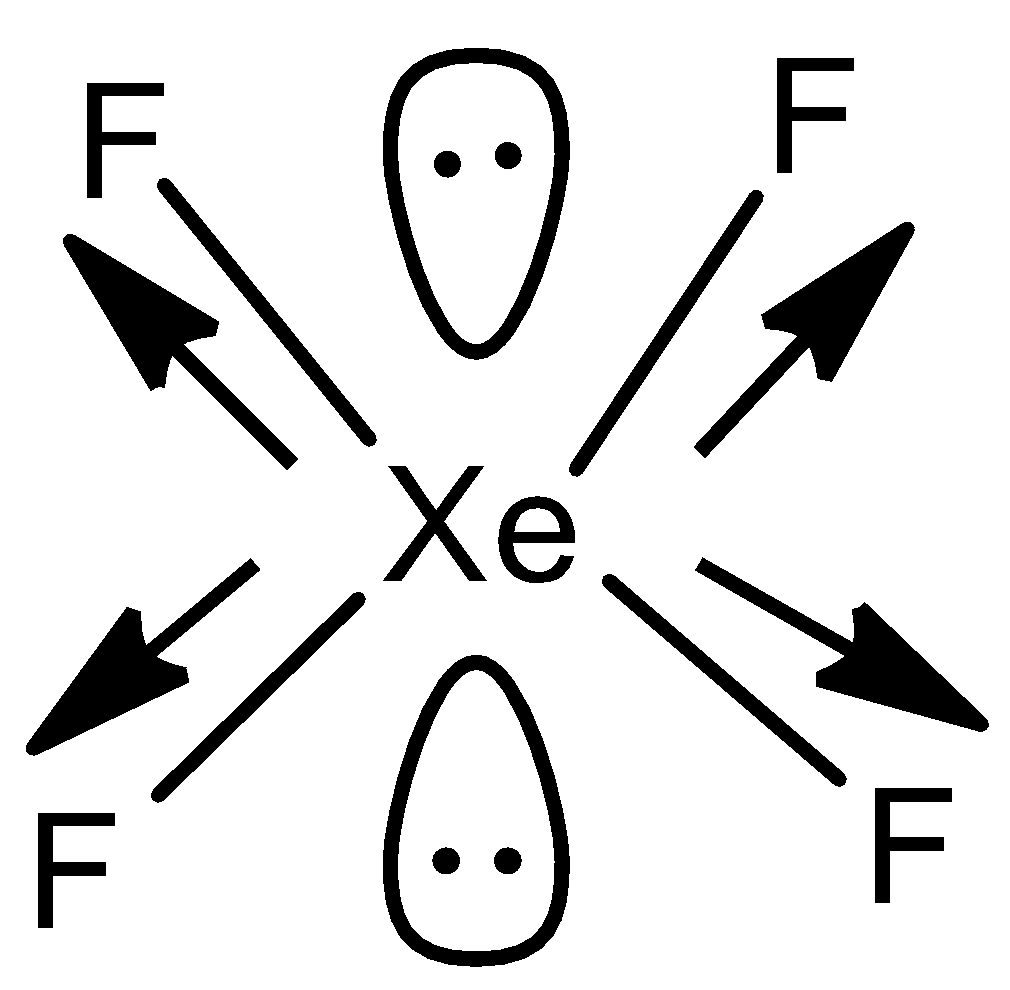
Here, the compound has square plane structure with hybridisation of $s{{p}^{3}}{{d}^{2}}$ and here the dipole moments cancel each other as shown with arrows and thus the value will be $\mu =0$
In option B) $Xe{{F}_{6}}$, the structure will be,
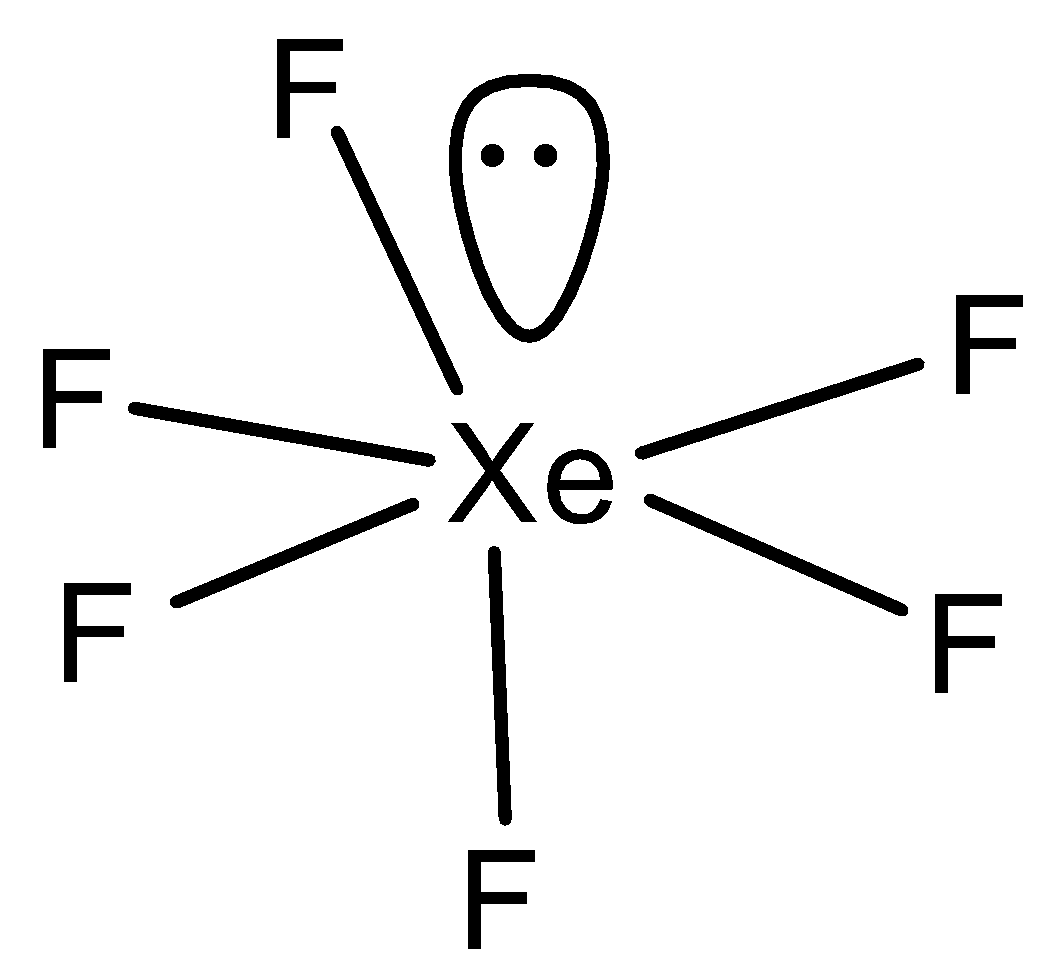
Here, this compound has distorted octahedral structure and since it is distorted, the dipole moment cannot become zero and thus $\mu \ne 0$
In option C) $XeO{{F}_{4}}$, the structure will be,
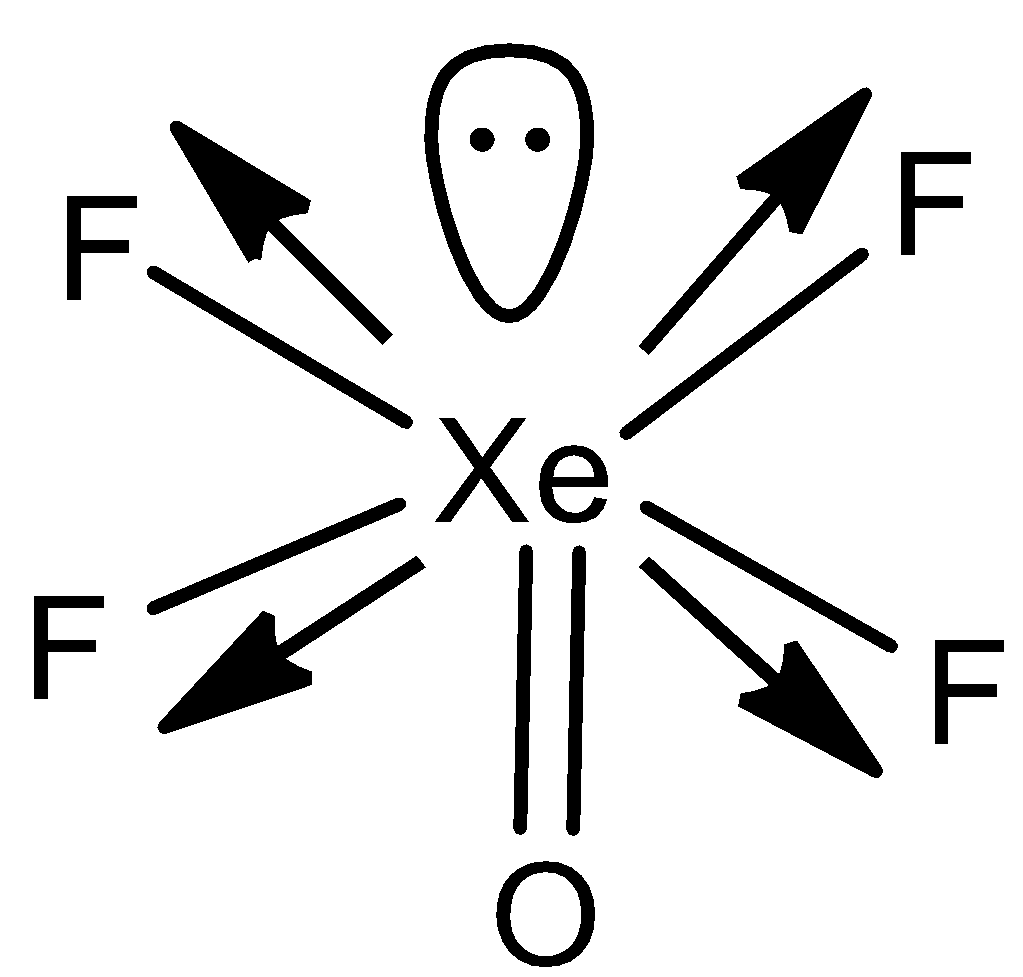
In this case, the dipole moments of fluorine will cancel each other but that of oxygen and lone pair of electrons cannot cancel and therefore $\mu \ne 0$ in this case.
In option D) $XeF_{5}^{-}$, the structure is,
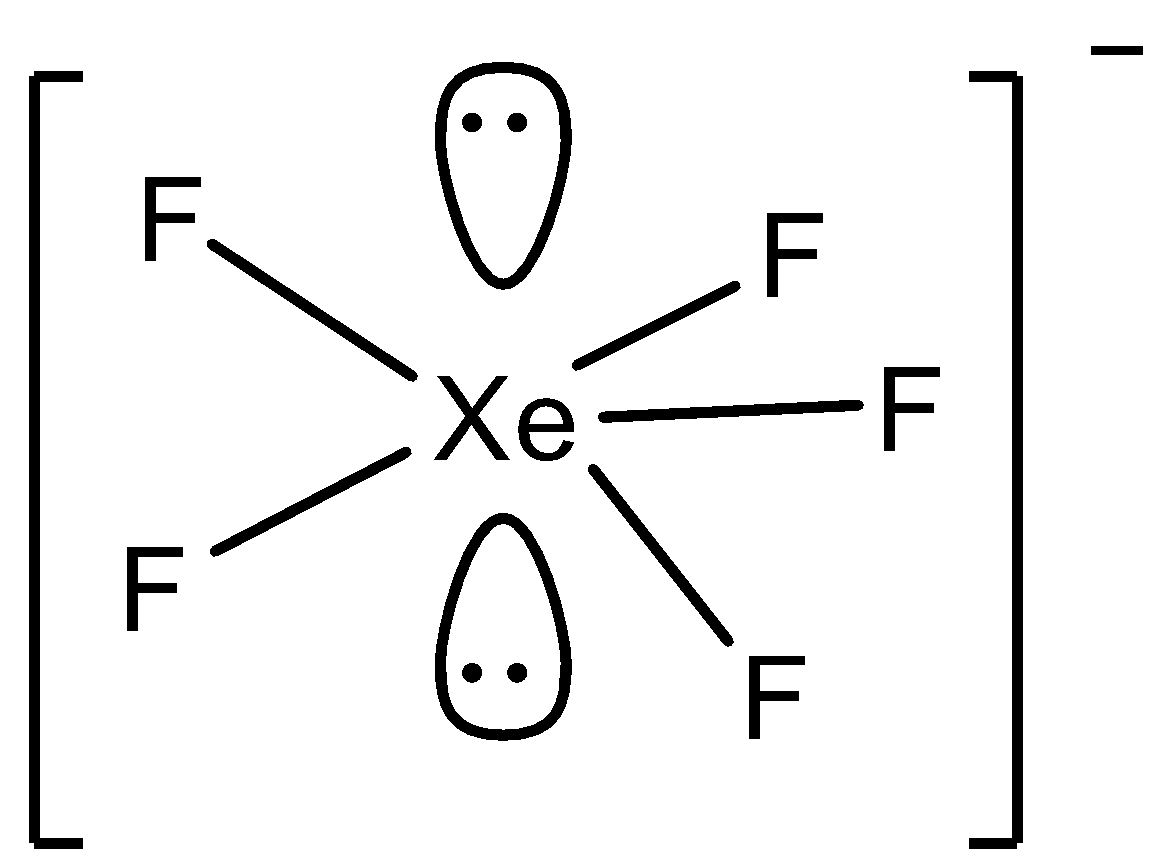
Even in this structure there is no complete cancellation of the dipole moment since the geometry is pentagonal bipyramidal. Thus $\mu \ne 0$ in this case too.
Therefore, the correct answer is option B), C) and D).
Note:
Note that to know the polarity, structures of the given compound plays an important role and be thorough with the structures of common compounds and also sometimes the multiple choice question can have several correct answers and do not stop the calculation when one answer obtained is correct.
Complete answer:
In the lower classes of chemistry, we have studied the basic concepts of chemistry that deal with the inorganic part that includes the definition for polarity and which is further based on the dipole moment of the compound given.
Now, let us see this in detail so that we will know which among the following will be polar in nature.
Now, the dipole moment denoted by $\mu $ is nothing but defined as the quantity which describes two opposite charges that are separated by a certain distance ‘r’.
- It is the measure of net molecular polarity which is the magnitude of the charge at either end of the molecular dipole times the distance between them.
- Polarity therefore can be checked by drawing the structures of given compounds and if the dipole moment $\mu $ is zero then the compound is polar.
In option A) $Xe{{F}_{4}}$, the structure is
Here, the compound has square plane structure with hybridisation of $s{{p}^{3}}{{d}^{2}}$ and here the dipole moments cancel each other as shown with arrows and thus the value will be $\mu =0$
In option B) $Xe{{F}_{6}}$, the structure will be,
Here, this compound has distorted octahedral structure and since it is distorted, the dipole moment cannot become zero and thus $\mu \ne 0$
In option C) $XeO{{F}_{4}}$, the structure will be,
In this case, the dipole moments of fluorine will cancel each other but that of oxygen and lone pair of electrons cannot cancel and therefore $\mu \ne 0$ in this case.
In option D) $XeF_{5}^{-}$, the structure is,
Even in this structure there is no complete cancellation of the dipole moment since the geometry is pentagonal bipyramidal. Thus $\mu \ne 0$ in this case too.
Therefore, the correct answer is option B), C) and D).
Note:
Note that to know the polarity, structures of the given compound plays an important role and be thorough with the structures of common compounds and also sometimes the multiple choice question can have several correct answers and do not stop the calculation when one answer obtained is correct.
Recently Updated Pages
Basicity of sulphurous acid and sulphuric acid are

Master Class 11 English: Engaging Questions & Answers for Success
Master Class 11 Physics: Engaging Questions & Answers for Success
Master Class 11 Computer Science: Engaging Questions & Answers for Success
Master Class 11 Chemistry: Engaging Questions & Answers for Success
Master Class 11 Social Science: Engaging Questions & Answers for Success
Trending doubts
Difference Between Prokaryotic Cells and Eukaryotic Cells
Two of the body parts which do not appear in MRI are class 11 biology CBSE
One Metric ton is equal to kg A 10000 B 1000 C 100 class 11 physics CBSE
10 examples of friction in our daily life
Draw a diagram of nephron and explain its structur class 11 biology CBSE
What will happen if the mucus is not secreted by the class 11 biology CBSE