




Which of the following shows anaerobic respiration?
A. Earthworms
B. Rabbit
C. Echinoderms
D. Tapeworms
Answer
 Verified
592.5k+ views
Hint: In the absence of oxygen, anaerobic respiration takes place, while aerobic respiration occurs in the presence of oxygen. This glucose is partly broken down. Compared to aerobic respiration, it is a quick operation.
Complete answer: Respiration is the catabolic mechanism of breaking down reduced substrates. Respiration can occur in two ways if the presence of oxygen (aerobic respiration) or in absence of oxygen (anaerobic respiration). The anaerobic respiration process is also called fermentation. The anaerobic respiration (fermentation) process results in incomplete glucose breakdown into ethanol and carbon dioxide in certain microorganisms, such as yeast. Some species live in the intestines of host animals or humans, such as parasitic tapeworms. The parasitic tapeworm is not exposed to free oxygen and, for its energy needs, depends on anaerobic respiration.
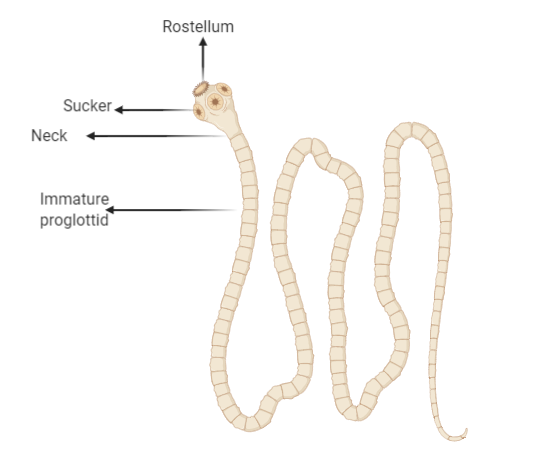
Taenia solium is a facultative anaerobe. To release energy, it decomposes glycogen into fatty acids, but it is also capable of aerobic respiration and even utilizes traces of oxygen when accessible in host fluids.
So, Option D-' Tapeworms' is the right answer.
Note: Anaerobic respiration creates harmful end products in both eukaryotic and prokaryotic cells, such as ethanol and ethyl alcohol which are given out. It will be easy to better understand anaerobic respiration by keeping these key points in mind. Incomplete glucose oxidation is anaerobic respiration. It takes place in the absolute absence of oxygen, or a lower volume. By glycolysis, glucose is converted into pyruvate and further broken down into lactic acid or alcohol and carbon dioxide (i.e. decarboxylation accompanied by decrease). Glucose breakdown occurs in cells without the use of oxygen, which gives us the energy to perform different activities. This method, without the aid of oxygen, of breaking glucose into carbon dioxide, alcohol, water, and energy, is known as anaerobic respiration.
Complete answer: Respiration is the catabolic mechanism of breaking down reduced substrates. Respiration can occur in two ways if the presence of oxygen (aerobic respiration) or in absence of oxygen (anaerobic respiration). The anaerobic respiration process is also called fermentation. The anaerobic respiration (fermentation) process results in incomplete glucose breakdown into ethanol and carbon dioxide in certain microorganisms, such as yeast. Some species live in the intestines of host animals or humans, such as parasitic tapeworms. The parasitic tapeworm is not exposed to free oxygen and, for its energy needs, depends on anaerobic respiration.
Taenia solium is a facultative anaerobe. To release energy, it decomposes glycogen into fatty acids, but it is also capable of aerobic respiration and even utilizes traces of oxygen when accessible in host fluids.
So, Option D-' Tapeworms' is the right answer.
Note: Anaerobic respiration creates harmful end products in both eukaryotic and prokaryotic cells, such as ethanol and ethyl alcohol which are given out. It will be easy to better understand anaerobic respiration by keeping these key points in mind. Incomplete glucose oxidation is anaerobic respiration. It takes place in the absolute absence of oxygen, or a lower volume. By glycolysis, glucose is converted into pyruvate and further broken down into lactic acid or alcohol and carbon dioxide (i.e. decarboxylation accompanied by decrease). Glucose breakdown occurs in cells without the use of oxygen, which gives us the energy to perform different activities. This method, without the aid of oxygen, of breaking glucose into carbon dioxide, alcohol, water, and energy, is known as anaerobic respiration.
Recently Updated Pages
Master Class 11 Social Science: Engaging Questions & Answers for Success

Master Class 11 Physics: Engaging Questions & Answers for Success
Master Class 11 Maths: Engaging Questions & Answers for Success
Master Class 11 Economics: Engaging Questions & Answers for Success
Master Class 11 Computer Science: Engaging Questions & Answers for Success
Master Class 11 Chemistry: Engaging Questions & Answers for Success
Trending doubts
One Metric ton is equal to kg A 10000 B 1000 C 100 class 11 physics CBSE
There are 720 permutations of the digits 1 2 3 4 5 class 11 maths CBSE
1 Quintal is equal to a 110 kg b 10 kg c 100kg d 1000 class 11 physics CBSE
State and prove Bernoullis theorem class 11 physics CBSE
Difference Between Prokaryotic Cells and Eukaryotic Cells
Which among the following are examples of coming together class 11 social science CBSE