




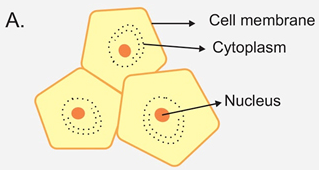
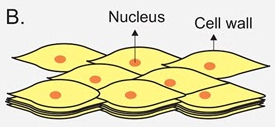
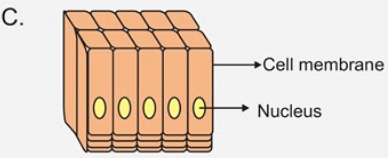
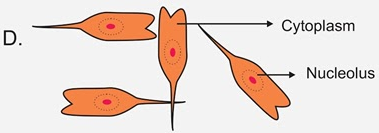
Which of the following represents the human cheek cell?
Answer
 Verified
579.6k+ views
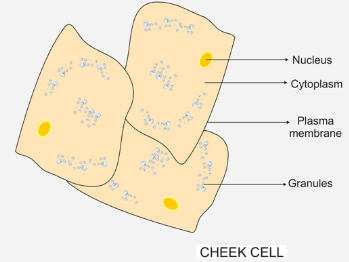
Hint: Human cheek cells are the most common example of simple squamous epithelial. These cells are eukaryotic in nature and consist of the cell membrane along with the prominent nucleus in between. they are present in the lining of the mouth. These cells are very good and important examples of animal cells.
Complete answer:
Cheek cells contain a nucleus and other organelles enclosed in a membrane. These cells divide approximately every 24 hours and are constantly shed from the body therefore they are easy for observation under the microscope.
-Epithelial cells are cells that are present on the surfaces of the body, such as your skin, blood vessels, urinary tract, or organs.
-They serve as a barrier between the inside and outside of your body, and protect it from pathogens.
-There are three types of cell shapes associated with epithelial cells: squamous epithelium, cuboidal epithelium, and columnar epithelium.
-These cells can be simple or arranged in layers and called as stratified. Epithelial cells can be keratinized for extra protection and scattered with goblet cells that secrete various substances with different purposes.
-The experiment can be performed to extract the cheek cell from the mouth by simply scratching the mouth lining with the help of a sterilized needle and then place the white substance that is obtained on the slide. Stain the substance with the help of safranin or acetocarmine solution and then put a coverslip over it and wipe the excessive stain. At last,we have to observe the slide under the microscope.
-They are found to be single-lines squamous cells with cell walls and nucleus in between.
So, the correct answer is option ‘A’.
Note:
Different types of epithelial cell are:
-Squamous: Flattened and scale-like.
-Simple columnar: A columnar epithelium that is single-layered.
-Stratified squamous: cells are flattened, joined tightly together, and stacked.
-Cuboidal: Cells resemble a cube.
-Keratinized: cells produce or become like keratin.
-Columnar: cells have the shape of a column.
Complete answer:
Cheek cells contain a nucleus and other organelles enclosed in a membrane. These cells divide approximately every 24 hours and are constantly shed from the body therefore they are easy for observation under the microscope.
-Epithelial cells are cells that are present on the surfaces of the body, such as your skin, blood vessels, urinary tract, or organs.
-They serve as a barrier between the inside and outside of your body, and protect it from pathogens.
-There are three types of cell shapes associated with epithelial cells: squamous epithelium, cuboidal epithelium, and columnar epithelium.
-These cells can be simple or arranged in layers and called as stratified. Epithelial cells can be keratinized for extra protection and scattered with goblet cells that secrete various substances with different purposes.
-The experiment can be performed to extract the cheek cell from the mouth by simply scratching the mouth lining with the help of a sterilized needle and then place the white substance that is obtained on the slide. Stain the substance with the help of safranin or acetocarmine solution and then put a coverslip over it and wipe the excessive stain. At last,we have to observe the slide under the microscope.
-They are found to be single-lines squamous cells with cell walls and nucleus in between.
So, the correct answer is option ‘A’.
Note:
Different types of epithelial cell are:
-Squamous: Flattened and scale-like.
-Simple columnar: A columnar epithelium that is single-layered.
-Stratified squamous: cells are flattened, joined tightly together, and stacked.
-Cuboidal: Cells resemble a cube.
-Keratinized: cells produce or become like keratin.
-Columnar: cells have the shape of a column.
Recently Updated Pages
Master Class 11 English: Engaging Questions & Answers for Success

Master Class 11 Social Science: Engaging Questions & Answers for Success
Master Class 11 Maths: Engaging Questions & Answers for Success
Master Class 11 Chemistry: Engaging Questions & Answers for Success
Master Class 11 Biology: Engaging Questions & Answers for Success
Master Class 11 Physics: Engaging Questions & Answers for Success
Trending doubts
One Metric ton is equal to kg A 10000 B 1000 C 100 class 11 physics CBSE
Difference Between Prokaryotic Cells and Eukaryotic Cells
Find the value of the expression given below sin 30circ class 11 maths CBSE
1 ton equals to A 100 kg B 1000 kg C 10 kg D 10000 class 11 physics CBSE
Two of the body parts which do not appear in MRI are class 11 biology CBSE
Draw a diagram of nephron and explain its structur class 11 biology CBSE