




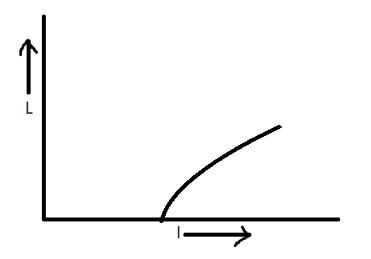
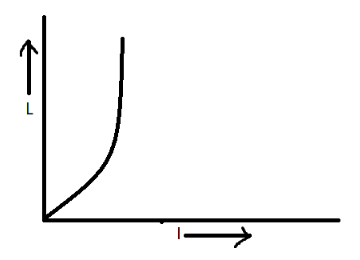
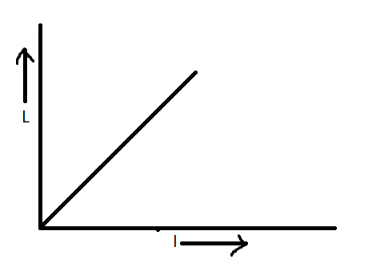
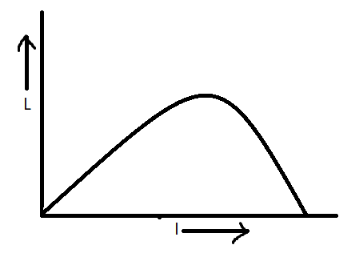
Which of the following represents loudness versus intensity of sound graph?
(A)
(B)
(C)
(D)
Answer
 Verified
599.1k+ views
Hint: We are looking for the graph between loudness and intensity. This could be gained establishing an equation between loudness and intensity. From there we can draw the graph.
Formula used: To calculate loudness, we use the equation: $ {\text{Loudness = 10lo}}{{\text{g}}_{{\text{10}}}}\dfrac{{\text{I}}}{{{{\text{I}}_{\text{0}}}}} $
Here, $ {\text{I}} $ is the intensity of the wave
$ {{\text{I}}_{\text{0}}} $ is the reference intensity.
Complete step by step answer:
It is already known that $ {\text{Loudness = 10lo}}{{\text{g}}_{{\text{10}}}}\dfrac{{\text{I}}}{{{{\text{I}}_{\text{0}}}}} $ ,
On evaluating it further,
$ {\text{loudness = 10}}\left( {{\text{lo}}{{\text{g}}_{{\text{10}}}}{\text{I - lo}}{{\text{g}}_{{\text{10}}}}{{\text{I}}_{\text{0}}}} \right) $
And here, $ {\text{lo}}{{\text{g}}_{{\text{10}}}}{{\text{I}}_{\text{0}}} $ is constant.
So, $ {\text{loudness}} \propto {\text{lo}}{{\text{g}}_{{\text{10}}}}{\text{I}} $
The graph will not start from zero or the origin because of the constant value $ {\text{lo}}{{\text{g}}_{{\text{10}}}}{{\text{I}}_{\text{0}}} $ .
So, we need to see from the above options, and select the correct value.
Thus, the correct answer is option A.
Additional Information:
Sound travels through a material as a mechanical wave. Other sound wave properties include the frequency in Hertz. The wave is a longitudinal or transverse wave. Sound occurs when energy causes air particles to move closer together and further apart. The closer the particles get or the further apart they get, the greater the sound's amplitude. Sound amplitude causes a sound's loudness and intensity. The bigger the amplitude is, the louder and more intense the sound. Sound intensity is measured in Watts per meter squared. Humans can only hear sounds between 20 and 20,000 Hertz. The properties of sound waves are known, particularly from sound intensity and loudness. We should be knowing how to measure intensity and loudness, the difference between sound and noise, and when a sound is considered noise pollution. Using data like intensity readings and spectrograms, and simple techniques like listening to and identifying sounds, we can research how sounds affect people and the environment.
Note:
The intensity of a sound is the power of the sound in Watts divided by the area the sound covers in square meters. The loudness of a sound relates the intensity of any given sound to the intensity at the threshold of hearing. It is measured in decibels $ {\text{dB}} $ .
Formula used: To calculate loudness, we use the equation: $ {\text{Loudness = 10lo}}{{\text{g}}_{{\text{10}}}}\dfrac{{\text{I}}}{{{{\text{I}}_{\text{0}}}}} $
Here, $ {\text{I}} $ is the intensity of the wave
$ {{\text{I}}_{\text{0}}} $ is the reference intensity.
Complete step by step answer:
It is already known that $ {\text{Loudness = 10lo}}{{\text{g}}_{{\text{10}}}}\dfrac{{\text{I}}}{{{{\text{I}}_{\text{0}}}}} $ ,
On evaluating it further,
$ {\text{loudness = 10}}\left( {{\text{lo}}{{\text{g}}_{{\text{10}}}}{\text{I - lo}}{{\text{g}}_{{\text{10}}}}{{\text{I}}_{\text{0}}}} \right) $
And here, $ {\text{lo}}{{\text{g}}_{{\text{10}}}}{{\text{I}}_{\text{0}}} $ is constant.
So, $ {\text{loudness}} \propto {\text{lo}}{{\text{g}}_{{\text{10}}}}{\text{I}} $
The graph will not start from zero or the origin because of the constant value $ {\text{lo}}{{\text{g}}_{{\text{10}}}}{{\text{I}}_{\text{0}}} $ .
So, we need to see from the above options, and select the correct value.
Thus, the correct answer is option A.
Additional Information:
Sound travels through a material as a mechanical wave. Other sound wave properties include the frequency in Hertz. The wave is a longitudinal or transverse wave. Sound occurs when energy causes air particles to move closer together and further apart. The closer the particles get or the further apart they get, the greater the sound's amplitude. Sound amplitude causes a sound's loudness and intensity. The bigger the amplitude is, the louder and more intense the sound. Sound intensity is measured in Watts per meter squared. Humans can only hear sounds between 20 and 20,000 Hertz. The properties of sound waves are known, particularly from sound intensity and loudness. We should be knowing how to measure intensity and loudness, the difference between sound and noise, and when a sound is considered noise pollution. Using data like intensity readings and spectrograms, and simple techniques like listening to and identifying sounds, we can research how sounds affect people and the environment.
Note:
The intensity of a sound is the power of the sound in Watts divided by the area the sound covers in square meters. The loudness of a sound relates the intensity of any given sound to the intensity at the threshold of hearing. It is measured in decibels $ {\text{dB}} $ .
Recently Updated Pages
Master Class 11 English: Engaging Questions & Answers for Success

Master Class 11 Social Science: Engaging Questions & Answers for Success
Master Class 11 Maths: Engaging Questions & Answers for Success
Master Class 11 Biology: Engaging Questions & Answers for Success
Master Class 11 Physics: Engaging Questions & Answers for Success
Master Class 11 Chemistry: Engaging Questions & Answers for Success
Trending doubts
One Metric ton is equal to kg A 10000 B 1000 C 100 class 11 physics CBSE
Difference Between Prokaryotic Cells and Eukaryotic Cells
1 ton equals to A 100 kg B 1000 kg C 10 kg D 10000 class 11 physics CBSE
Find the value of the expression given below sin 30circ class 11 maths CBSE
Two of the body parts which do not appear in MRI are class 11 biology CBSE
What are hard magnetic materials class 11 physics CBSE