




Which of the following representations show the pyramid of number in a forest ecosystem?
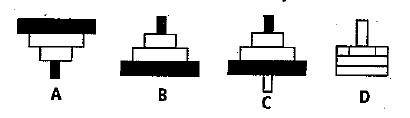
A. D
B. A
C. B
D. C
Answer
 Verified
597k+ views
Hint: An ecological pyramid also called trophic pyramid, energy pyramid, Eltonian pyramid or food pyramid, is a graphical representation to show the biomass or bioproductivity of each trophic level in an ecosystem.
Complete answer:
An ecological pyramid generally shows the relationship between the biomass, productivity and energy at different trophic levels. The number of individual organisms at successive trophic levels is usually depicted through a pyramid of numbers. Primary producers which produce the food on which consumers live are shown at the bottom of such a pyramid while apex predators (alpha predator or top predators) are predators at top of the food chain and are shown at the top of the pyramid.
The producers in a forest ecosystem are large size trees which are abundant in numbers. This makes the base of the forest pyramid. The primary consumers which are herbivores including horse, deer, birds, elephants and fruit-eating birds are always less in numbers than primary producers. Thus they are placed above primary producers. In this way at each successive level the number goes down. Therefore, the Pyramid of numbers in a Forest Ecosystem is partially upright or spindle-shaped. This can be seen in Figure C.
Option A, B & C: Since the Forest ecosystem is depicted by Figure C, this is the incorrect option.
Option D: The Pyramid of numbers in a Forest Ecosystem is partially upright or spindle-shaped. This can be seen in Figure C. Therefore, this is the correct option.
Hence, the correct answer is option (D)
Note: Different ecological systems have different pyramids of numbers but for every pyramid the number of organsms decreases at each successive trophic level. Pyramids are also based on energy and biomass and are called pyramids of energy and pyramids of biomass.
Complete answer:
An ecological pyramid generally shows the relationship between the biomass, productivity and energy at different trophic levels. The number of individual organisms at successive trophic levels is usually depicted through a pyramid of numbers. Primary producers which produce the food on which consumers live are shown at the bottom of such a pyramid while apex predators (alpha predator or top predators) are predators at top of the food chain and are shown at the top of the pyramid.
The producers in a forest ecosystem are large size trees which are abundant in numbers. This makes the base of the forest pyramid. The primary consumers which are herbivores including horse, deer, birds, elephants and fruit-eating birds are always less in numbers than primary producers. Thus they are placed above primary producers. In this way at each successive level the number goes down. Therefore, the Pyramid of numbers in a Forest Ecosystem is partially upright or spindle-shaped. This can be seen in Figure C.
Option A, B & C: Since the Forest ecosystem is depicted by Figure C, this is the incorrect option.
Option D: The Pyramid of numbers in a Forest Ecosystem is partially upright or spindle-shaped. This can be seen in Figure C. Therefore, this is the correct option.
Hence, the correct answer is option (D)
Note: Different ecological systems have different pyramids of numbers but for every pyramid the number of organsms decreases at each successive trophic level. Pyramids are also based on energy and biomass and are called pyramids of energy and pyramids of biomass.
Recently Updated Pages
Master Class 12 Business Studies: Engaging Questions & Answers for Success

Master Class 12 Chemistry: Engaging Questions & Answers for Success
Master Class 12 Biology: Engaging Questions & Answers for Success
Class 12 Question and Answer - Your Ultimate Solutions Guide
Master Class 11 Social Science: Engaging Questions & Answers for Success
Master Class 11 Chemistry: Engaging Questions & Answers for Success
Trending doubts
Which are the Top 10 Largest Countries of the World?
Draw a labelled sketch of the human eye class 12 physics CBSE
Name the crygenes that control cotton bollworm and class 12 biology CBSE
Differentiate between homogeneous and heterogeneous class 12 chemistry CBSE
How many molecules of ATP and NADPH are required information class 12 biology CBSE
In a transcription unit the promoter is said to be class 12 biology CBSE