




Which of the following produce Oxonium salt with mineral acid?
(A) Diethyl ether
(B) Ethene
(C) Ethanoic acid
(D) None of the above
Answer
 Verified
550.8k+ views
Hint: To proceed with this question, first of all we need to understand the concept of oxonium salts i.e the oxonium ions. So we will understand the formation of oxonium ions. Oxonium ions can be formed by the alcohols and the ethers in acidic conditions i.e. in the presence of mineral acids.
Complete answer:
As we know , oxonium ions can be formed from ether and the alcohols easily in acidic conditions.
So, hydrocarbon’s oxonium ions can be formed by the protonation or the alkylation of alcohols or the ethers, $ {R_1} - O - {R_2} $ . Where, R1 and R2 are two alkyl groups attached to the oxygen atom.
Now looking at our given options, let’s start with option A i.e. Diethyl ether.
So, we will write a chemical equation of reaction between the Diethyl ether with the mineral acid, let's say Hydrochloric acid, $ HCl $ .
So, let’s understand our chemical reaction structurally:
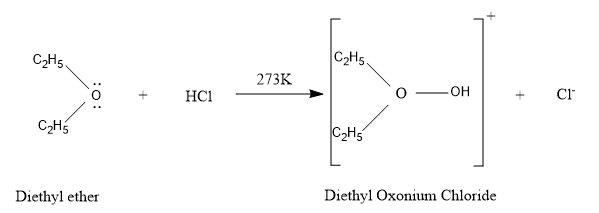
Hence, the reaction is very clear that Diethyl ether reacts with hydrochloric acid at the temperature of $ 273K $ and produces the Diethyl oxonium chloride and the chloride ions are released.
So, the correct answer is option A only. Therefore, Diethyl ether on reacting with mineral acid produces the oxonium ion i.e. the Diethyl oxonium chloride.
Note:
Here in the above reaction between hydrochloric acid and Diethyl ether i.e. in the production of oxonium ions, the ether bond changes to the hydroxyl bonds. Ether has changed into the alcohol ions with a positive charge on the whole molecule and the chloride ion is released in the above equation.
Complete answer:
As we know , oxonium ions can be formed from ether and the alcohols easily in acidic conditions.
So, hydrocarbon’s oxonium ions can be formed by the protonation or the alkylation of alcohols or the ethers, $ {R_1} - O - {R_2} $ . Where, R1 and R2 are two alkyl groups attached to the oxygen atom.
Now looking at our given options, let’s start with option A i.e. Diethyl ether.
So, we will write a chemical equation of reaction between the Diethyl ether with the mineral acid, let's say Hydrochloric acid, $ HCl $ .
So, let’s understand our chemical reaction structurally:
Hence, the reaction is very clear that Diethyl ether reacts with hydrochloric acid at the temperature of $ 273K $ and produces the Diethyl oxonium chloride and the chloride ions are released.
So, the correct answer is option A only. Therefore, Diethyl ether on reacting with mineral acid produces the oxonium ion i.e. the Diethyl oxonium chloride.
Note:
Here in the above reaction between hydrochloric acid and Diethyl ether i.e. in the production of oxonium ions, the ether bond changes to the hydroxyl bonds. Ether has changed into the alcohol ions with a positive charge on the whole molecule and the chloride ion is released in the above equation.
Recently Updated Pages
Master Class 11 English: Engaging Questions & Answers for Success

Master Class 11 Social Science: Engaging Questions & Answers for Success
Master Class 11 Maths: Engaging Questions & Answers for Success
Master Class 11 Biology: Engaging Questions & Answers for Success
Master Class 11 Physics: Engaging Questions & Answers for Success
Master Class 11 Chemistry: Engaging Questions & Answers for Success
Trending doubts
One Metric ton is equal to kg A 10000 B 1000 C 100 class 11 physics CBSE
Difference Between Prokaryotic Cells and Eukaryotic Cells
Find the value of the expression given below sin 30circ class 11 maths CBSE
1 ton equals to A 100 kg B 1000 kg C 10 kg D 10000 class 11 physics CBSE
Two of the body parts which do not appear in MRI are class 11 biology CBSE
What are hard magnetic materials class 11 physics CBSE