




Which of the following parts of the brain constitute the brain stem?
A. Midbrain and hindbrain
B. Hindbrain and forebrain
C. Forebrain and midbrain
D. Forebrain only
Answer
 Verified
633k+ views
Hint: The brainstem is the lowest part of the brain in vertebrate anatomy, parallel to it, and structurally consistent with the brain and spinal cord. It is one of the largest and most complex organs of the human body is the brain. It is made up of over 100 billion nerves that interact with synapses.
Complete answer: The brain is the mass of the nerve tissue of the organism's anterior end. The brain processes sensory feedback and directs motor responses; in higher vertebrates, it is also the center of learning. The human brain weighs about 3 pounds (1.4kg) and consists of billions of neurons. Neuron junctions, known as synapses, enable the transfer of electrical and chemical signals in the brain from one neuron to the next, a process that underlies fundamental sensory functions and is important for learning, memory, and thought formation, and other cognitive activities. The midbrain, pons, and medulla oblongata are the distal part of the brain consisting of the brain stem (brain stem). Each of the three elements has its own unique structure and functionality. Together, they help to track breathing, blood pressure, heart rate, and many other vital functions. All these brainstem functions are activated because of their unique structure; also, because the brainstem houses cranial nerve nuclei as well as being a passageway for many important neural pathways. The brainstem binds the spinal cord to the cerebrum. It is made up of the midbrain (mesencephalon), the medulla oblongata, and the hindbrain sections (pons). It enables the communication between the spinal cord and the cerebrum.
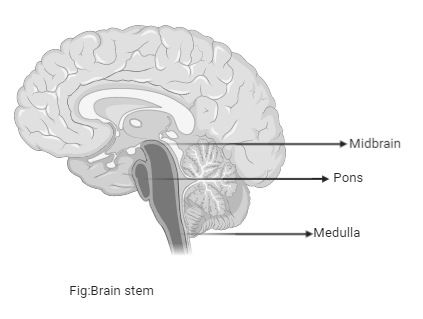
Hence, the correct answer is option A-Midbrain and hindbrain.
Note: The brain stem has three basic functions: -
1. To serve as a conduit for ascending and descending pathways to and from the brain.
2. To hold cranial nerve nuclei.
3. To combine with each other and the tasks of several vital structures.
Complete answer: The brain is the mass of the nerve tissue of the organism's anterior end. The brain processes sensory feedback and directs motor responses; in higher vertebrates, it is also the center of learning. The human brain weighs about 3 pounds (1.4kg) and consists of billions of neurons. Neuron junctions, known as synapses, enable the transfer of electrical and chemical signals in the brain from one neuron to the next, a process that underlies fundamental sensory functions and is important for learning, memory, and thought formation, and other cognitive activities. The midbrain, pons, and medulla oblongata are the distal part of the brain consisting of the brain stem (brain stem). Each of the three elements has its own unique structure and functionality. Together, they help to track breathing, blood pressure, heart rate, and many other vital functions. All these brainstem functions are activated because of their unique structure; also, because the brainstem houses cranial nerve nuclei as well as being a passageway for many important neural pathways. The brainstem binds the spinal cord to the cerebrum. It is made up of the midbrain (mesencephalon), the medulla oblongata, and the hindbrain sections (pons). It enables the communication between the spinal cord and the cerebrum.
Hence, the correct answer is option A-Midbrain and hindbrain.
Note: The brain stem has three basic functions: -
1. To serve as a conduit for ascending and descending pathways to and from the brain.
2. To hold cranial nerve nuclei.
3. To combine with each other and the tasks of several vital structures.
Recently Updated Pages
Master Class 11 Social Science: Engaging Questions & Answers for Success

Master Class 11 English: Engaging Questions & Answers for Success
Master Class 11 Accountancy: Engaging Questions & Answers for Success
Master Class 11 Physics: Engaging Questions & Answers for Success
Master Class 11 Computer Science: Engaging Questions & Answers for Success
Master Class 11 Business Studies: Engaging Questions & Answers for Success
Trending doubts
Find the value of the expression given below sin 30circ class 11 maths CBSE
One Metric ton is equal to kg A 10000 B 1000 C 100 class 11 physics CBSE
10 examples of friction in our daily life
Draw a diagram of nephron and explain its structur class 11 biology CBSE
The teeth used for biting and cutting food are called class 11 biology CBSE
Proton was discovered by A Thomson B Rutherford C Chadwick class 11 chemistry CBSE