




Which of the following obeys Ohm’s law?
A. Transistor
B. Nichrome
C. Diode
D. Liquid electrolyte
Answer
 Verified
579.3k+ views
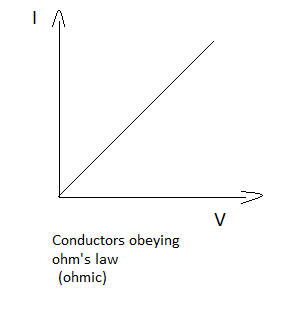
Hint: Conductors that obey Ohm's Law are those which has a constant resistance when the current through them is increased or the voltage is varied across them. These conductors are known as ohmic conductors. If we plot a graph of the current vs. the voltage across these conductors, we will get a straight line.
Complete step-by-step solution:
The conductors which obey Ohm’s law are called Ohmic conductors. Ohm’s law states that temperature remaining constant current through the conductor is directly proportional to the voltage applied across the terminals of the conductor.
Below is the graphical representation with I-V curve of ohmic or non-ohmic or we can say conductors or non-conductors.
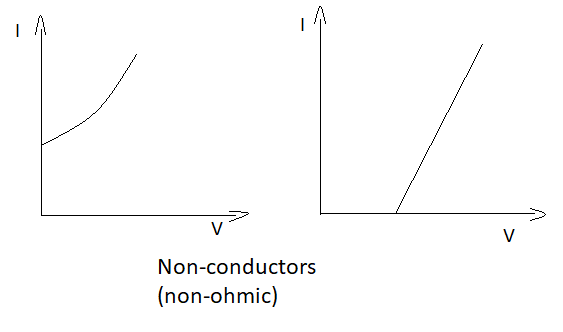
A transistor/diode is made up of semiconductors. All the semiconductor devices are non-ohmic because the current drawn by them is not proportional to the applied voltage. The voltage and current have a nonlinear relationship in the case of semiconductor devices. So, option (A and C) is wrong.
Liquid electrolytes are good conductors of electricity but they also have a non-linear relation between voltage and current just like semiconductors. So, option D is not correct.
Nichrome is an alloy of nickel and chromium (it sometimes also has iron). Nichrome has a constant resistance so it shows a linear relationship between voltage and current and thus is an ohmic conductor.
So, the correct answer is option B.
Note: Ohm’s law is one of the most fundamental laws of electricity and students often consider it to be universal. However, that is not the case, more conductors don’t obey Ohm’s law than there are that do. It’s always better to remember some examples of Ohmic and non-Ohmic conductors so that we can at least use the option elimination method to determine the answer.
Complete step-by-step solution:
The conductors which obey Ohm’s law are called Ohmic conductors. Ohm’s law states that temperature remaining constant current through the conductor is directly proportional to the voltage applied across the terminals of the conductor.
Below is the graphical representation with I-V curve of ohmic or non-ohmic or we can say conductors or non-conductors.
A transistor/diode is made up of semiconductors. All the semiconductor devices are non-ohmic because the current drawn by them is not proportional to the applied voltage. The voltage and current have a nonlinear relationship in the case of semiconductor devices. So, option (A and C) is wrong.
Liquid electrolytes are good conductors of electricity but they also have a non-linear relation between voltage and current just like semiconductors. So, option D is not correct.
Nichrome is an alloy of nickel and chromium (it sometimes also has iron). Nichrome has a constant resistance so it shows a linear relationship between voltage and current and thus is an ohmic conductor.
So, the correct answer is option B.
Note: Ohm’s law is one of the most fundamental laws of electricity and students often consider it to be universal. However, that is not the case, more conductors don’t obey Ohm’s law than there are that do. It’s always better to remember some examples of Ohmic and non-Ohmic conductors so that we can at least use the option elimination method to determine the answer.
Recently Updated Pages
Master Class 12 Business Studies: Engaging Questions & Answers for Success

Master Class 12 Biology: Engaging Questions & Answers for Success
Master Class 12 Chemistry: Engaging Questions & Answers for Success
Class 12 Question and Answer - Your Ultimate Solutions Guide
Master Class 11 Social Science: Engaging Questions & Answers for Success
Master Class 11 English: Engaging Questions & Answers for Success
Trending doubts
Which are the Top 10 Largest Countries of the World?
Draw a labelled sketch of the human eye class 12 physics CBSE
Name the crygenes that control cotton bollworm and class 12 biology CBSE
Differentiate between homogeneous and heterogeneous class 12 chemistry CBSE
Ribosomal RNA is actively synthesised in A Nucleoplasm class 12 biology CBSE
How many molecules of ATP and NADPH are required information class 12 biology CBSE