




Which of the following is true about the field between parallel charged plates?
A. It is stronger between the plates
B. It is stronger near the positive plate
C. It is stronger near the negative plate
D. The field is constant between the plates
E. The field is variable, therefore the strong point also varies
Answer
 Verified
496.2k+ views
Hint: In an electric circuit, a capacitor is a device that stores charge. In a capacitor, two plates with equal and opposite charges are separated by a distance. Using the equation for potential difference and electric field between two plates, get the capacitance of a parallel plate capacitor. And using this we will determine the correct option.
Complete step by step answer:
As we know, in a capacitor, two parallel plates separated by a distance $d$ and with charges $Q$ and $-Q$ on each of them. This can be seen in the below figure.
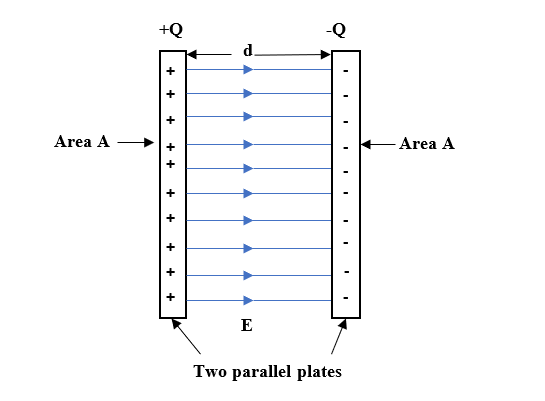
As we know that the electric field ($E$) between the two oppositely charged plates is given by
\[E = \dfrac{\sigma_1 - \sigma_2 }{{{2 \varepsilon _0}}}\]
And the field is constant between the plates as $\sigma $ is the surface charge density of the corresponding plate, i.e.,
The amount of electric charge accumulated over a surface is measured by surface charge density. It's calculated as a charge per square metre of surface area.
Here we can see that the electric field is not depending upon the distances between the plates, whereas we can say from the above statement and formula that it is nothing but constant.
Hence the correct option is Option (D).
Note:
• The amount of charge that a capacitor can hold is determined by two things. The voltage and the physical features of the capacitors.
• The capacitor's capacity to store energy rises when a dielectric medium is added between the two parallel plates. It gains energy by a factor $K$, which is known as the dielectric constant.
• Enhance the area, lower the gap between the two plates, and employ a dielectric media to increase the capacitance of parallel plate capacitors.
Complete step by step answer:
As we know, in a capacitor, two parallel plates separated by a distance $d$ and with charges $Q$ and $-Q$ on each of them. This can be seen in the below figure.
As we know that the electric field ($E$) between the two oppositely charged plates is given by
\[E = \dfrac{\sigma_1 - \sigma_2 }{{{2 \varepsilon _0}}}\]
And the field is constant between the plates as $\sigma $ is the surface charge density of the corresponding plate, i.e.,
The amount of electric charge accumulated over a surface is measured by surface charge density. It's calculated as a charge per square metre of surface area.
Here we can see that the electric field is not depending upon the distances between the plates, whereas we can say from the above statement and formula that it is nothing but constant.
Hence the correct option is Option (D).
Note:
• The amount of charge that a capacitor can hold is determined by two things. The voltage and the physical features of the capacitors.
• The capacitor's capacity to store energy rises when a dielectric medium is added between the two parallel plates. It gains energy by a factor $K$, which is known as the dielectric constant.
• Enhance the area, lower the gap between the two plates, and employ a dielectric media to increase the capacitance of parallel plate capacitors.
Recently Updated Pages
Master Class 12 Social Science: Engaging Questions & Answers for Success

Master Class 12 Physics: Engaging Questions & Answers for Success
Master Class 12 Maths: Engaging Questions & Answers for Success
Master Class 12 Economics: Engaging Questions & Answers for Success
Master Class 12 Chemistry: Engaging Questions & Answers for Success
Master Class 12 Business Studies: Engaging Questions & Answers for Success
Trending doubts
Which are the Top 10 Largest Countries of the World?
Draw a labelled sketch of the human eye class 12 physics CBSE
Explain the structure of megasporangium class 12 biology CBSE
What are the major means of transport Explain each class 12 social science CBSE
How many chromosomes are found in human ovum a 46 b class 12 biology CBSE
The diagram of the section of a maize grain is given class 12 biology CBSE