




Which of the following is the function of Rhizobium?
(a)Denitrification
(b)Nitrogen fixation
(c)Ammonification
(d)Nitrification
Answer
 Verified
618k+ views
Hint: During this process, any natural or process that causes free nitrogen, which may be a relatively noble gas plentiful in air, to mix chemically with other elements to make more-reactive nitrogen compounds like ammonia, nitrates, or nitrites.
Complete answer:
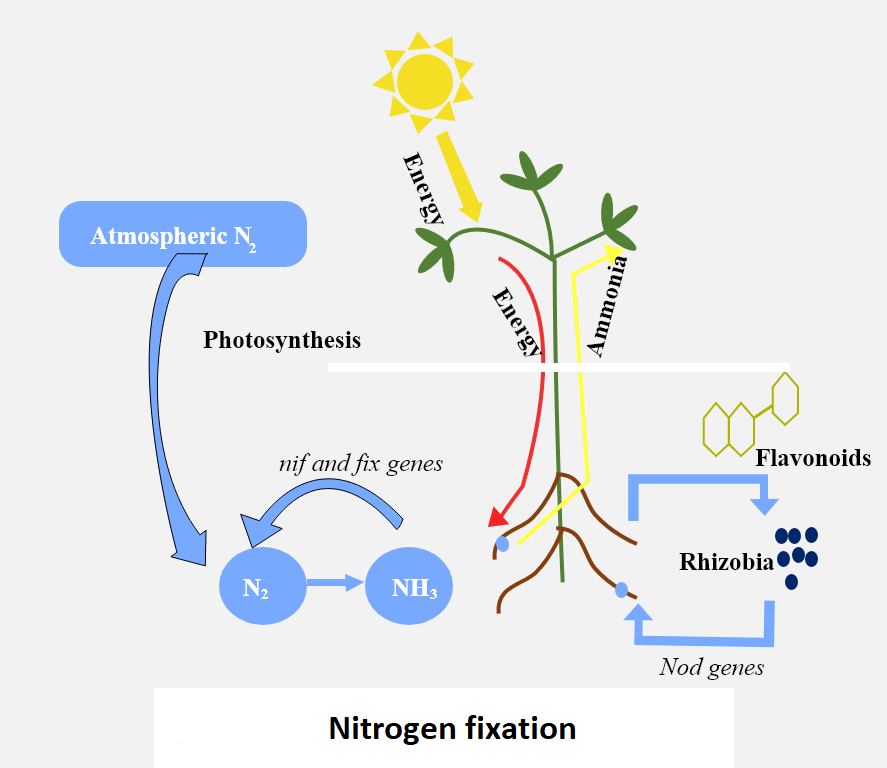
Its function is of "Nitrogen fixation" in leguminous plants, for ex:- gram, peas, etc. Rhizobium bacteria live in the root nodules of leguminous plants and provide nitrogen to plants in the form of nitrates converted by them from the atmosphere.
Additional Information: The symbiotic nitrogen-fixing bacteria attack the premise hairs of host plants, where they duplicate and invigorate the development of root nodules, extensions of plant cells, and bacteria in cozy affiliation. Inside the nodules, the bacteria can convert free nitrogen to ammonia, which the host plant uses for its turn of events. To guarantee adequate nodule arrangement and ideal development of legumes (e.g., horse feed, beans, clovers, peas, and soybeans), seeds are typically inoculated with commercial cultures of fitting Rhizobium species, particularly in soils poor or lacking inside the necessary bacterium.
So the correct answer is ‘ Nitrogen fixation’.
Note: Nitrogen is fixed or consolidated, in nature on the grounds that the gas by lightning and ultraviolet rays, however more critical measures of nitrogen are fixed as ammonia, nitrites, and nitrates by soil microorganisms. In excess of 90% of the all-natural cycle is affected by them. Generally, there are two types of nitrogen-fixing microorganisms are perceived: the first one is free-living (nonsymbiotic) bacteria, which incorporates the cyanobacteria (or blue-green growth) Anabaena and Nostoc and genera such as Clostridium, Azotobacter, and Beijerinckia; and the second one is mutualistic (symbiotic) bacteria such as Rhizobium, and the rhizobium bacteria present in the leguminous plants, and different Azospirillum species, are present in the cereal grasses.
Complete answer:
Its function is of "Nitrogen fixation" in leguminous plants, for ex:- gram, peas, etc. Rhizobium bacteria live in the root nodules of leguminous plants and provide nitrogen to plants in the form of nitrates converted by them from the atmosphere.
Additional Information: The symbiotic nitrogen-fixing bacteria attack the premise hairs of host plants, where they duplicate and invigorate the development of root nodules, extensions of plant cells, and bacteria in cozy affiliation. Inside the nodules, the bacteria can convert free nitrogen to ammonia, which the host plant uses for its turn of events. To guarantee adequate nodule arrangement and ideal development of legumes (e.g., horse feed, beans, clovers, peas, and soybeans), seeds are typically inoculated with commercial cultures of fitting Rhizobium species, particularly in soils poor or lacking inside the necessary bacterium.
So the correct answer is ‘ Nitrogen fixation’.
Note: Nitrogen is fixed or consolidated, in nature on the grounds that the gas by lightning and ultraviolet rays, however more critical measures of nitrogen are fixed as ammonia, nitrites, and nitrates by soil microorganisms. In excess of 90% of the all-natural cycle is affected by them. Generally, there are two types of nitrogen-fixing microorganisms are perceived: the first one is free-living (nonsymbiotic) bacteria, which incorporates the cyanobacteria (or blue-green growth) Anabaena and Nostoc and genera such as Clostridium, Azotobacter, and Beijerinckia; and the second one is mutualistic (symbiotic) bacteria such as Rhizobium, and the rhizobium bacteria present in the leguminous plants, and different Azospirillum species, are present in the cereal grasses.
Recently Updated Pages
Basicity of sulphurous acid and sulphuric acid are

Master Class 12 Economics: Engaging Questions & Answers for Success
Master Class 12 Biology: Engaging Questions & Answers for Success
Master Class 11 English: Engaging Questions & Answers for Success
Master Class 11 Physics: Engaging Questions & Answers for Success
Master Class 11 Computer Science: Engaging Questions & Answers for Success
Trending doubts
Draw a labelled sketch of the human eye class 12 physics CBSE
The chemical formula of tear gas is A CO Cl 2 B C 10 class 12 chemistry CBSE
Draw ray diagrams each showing i myopic eye and ii class 12 physics CBSE
Which are the Top 10 Largest Countries of the World?
Differentiate between homogeneous and heterogeneous class 12 chemistry CBSE
Which is the correct genotypic ratio of mendel dihybrid class 12 biology CBSE