




Which of the following is not the function of the large intestine?
A. Absorption of water
B. Nutrient absorption
C. Secretion of mucus to lubricate faeces
D. Temporary storage faeces in the rectum
Answer
 Verified
594k+ views
Hint: Large intestine or large bowel is broader than the small intestine and does not have small villi-like projections to increase the surface area for nutrient absorption.
Complete step by step answer: Digestion is a complex process that enables the breakdown of complex substances into its simpler form. Digestion in humans is divided into five nutritional stages which are as follows:
a. Ingestion - The food substances are ingested and broken down by chewing and grinding. The food is then swallowed that goes to the digestive tract by peristaltic movements.
b. Digestion - In this process, complex substances are broken down into simpler ones with the help of several enzymes that can be assimilated into the body tissues. The enzymes are categorized into four types based on the molecule they act upon:
i. Carbohydrases - These enzymes help in digesting carbohydrates such as amylases.
ii. Proteinases - These enzymes help in the breakdown of proteins such as pepsin.
iii. Lipases - These enzymes breakdown lipids into fatty acids and glycerol such as gastric lipase.
iv. Nucleases - These enzymes help in the breakdown of nucleic acids.
v. Absorption - This process mainly takes place in the small intestine because it has finger-like projections known as villi that increase the surface area for the absorption of nutrients.
c. Assimilation - After digestion and absorption, chemicals from the food are taken into the cells of the body. The nutrients are transported by the blood to the required cells of the body.
d. Egestion - The process of removal of undigested food materials in form of faeces from the anus is known as egestion.
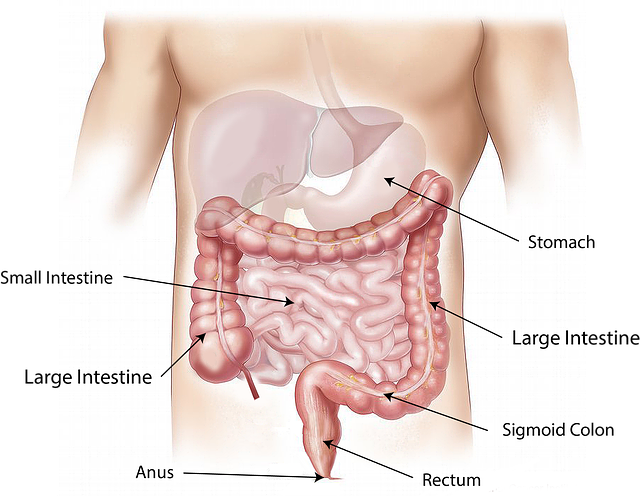
The large intestine is involved in two major processes; reabsorption and egestion. It helps in the reabsorption of water and mineral ions such as sodium and chloride. It also helps in the formation and temporary storage of faeces. It has a resident bacterial population that will initiate the bacterial fermentation of indigestible materials.
Hence, the correct answer is option B.
Note: The large intestine is divided into cecum, colon and rectum. The absorption of vitamins also occurs in the large intestine. It takes a much straighter path through your belly or abdomen.
Complete step by step answer: Digestion is a complex process that enables the breakdown of complex substances into its simpler form. Digestion in humans is divided into five nutritional stages which are as follows:
a. Ingestion - The food substances are ingested and broken down by chewing and grinding. The food is then swallowed that goes to the digestive tract by peristaltic movements.
b. Digestion - In this process, complex substances are broken down into simpler ones with the help of several enzymes that can be assimilated into the body tissues. The enzymes are categorized into four types based on the molecule they act upon:
i. Carbohydrases - These enzymes help in digesting carbohydrates such as amylases.
ii. Proteinases - These enzymes help in the breakdown of proteins such as pepsin.
iii. Lipases - These enzymes breakdown lipids into fatty acids and glycerol such as gastric lipase.
iv. Nucleases - These enzymes help in the breakdown of nucleic acids.
v. Absorption - This process mainly takes place in the small intestine because it has finger-like projections known as villi that increase the surface area for the absorption of nutrients.
c. Assimilation - After digestion and absorption, chemicals from the food are taken into the cells of the body. The nutrients are transported by the blood to the required cells of the body.
d. Egestion - The process of removal of undigested food materials in form of faeces from the anus is known as egestion.
The large intestine is involved in two major processes; reabsorption and egestion. It helps in the reabsorption of water and mineral ions such as sodium and chloride. It also helps in the formation and temporary storage of faeces. It has a resident bacterial population that will initiate the bacterial fermentation of indigestible materials.
Hence, the correct answer is option B.
Note: The large intestine is divided into cecum, colon and rectum. The absorption of vitamins also occurs in the large intestine. It takes a much straighter path through your belly or abdomen.
Recently Updated Pages
Master Class 11 Social Science: Engaging Questions & Answers for Success

Master Class 11 Physics: Engaging Questions & Answers for Success
Master Class 11 Maths: Engaging Questions & Answers for Success
Master Class 11 Economics: Engaging Questions & Answers for Success
Master Class 11 Computer Science: Engaging Questions & Answers for Success
Master Class 11 Chemistry: Engaging Questions & Answers for Success
Trending doubts
One Metric ton is equal to kg A 10000 B 1000 C 100 class 11 physics CBSE
There are 720 permutations of the digits 1 2 3 4 5 class 11 maths CBSE
1 Quintal is equal to a 110 kg b 10 kg c 100kg d 1000 class 11 physics CBSE
State and prove Bernoullis theorem class 11 physics CBSE
Difference Between Prokaryotic Cells and Eukaryotic Cells
Discuss the various forms of bacteria class 11 biology CBSE