




Which of the following is not required for the Calvin cycle to occur?
a) ATP, NADPH
b) Carbon dioxide
c) Light
d) Ribulose bisphosphate
Answer
 Verified
633.6k+ views
Hint: Calvin cycle occurs in the plants. They take in carbon dioxide released by organisms and use it to make simple sugars. The Calvin cycle involves three steps which are fixation, reduction, and regeneration.
Complete answer:
Calvin cycle is a dark reaction which means it is a light-independent cycle. It occurs in the absence of light during night time. It also occurs during daytime but the energy from sunlight is not needed by it to perform its function.
Additional information: Calvin cycle occurs in three steps of fixation, reduction, and regeneration. To start the cycle energy resources are required. These energy resources are met by the ATP and NADPH present in the plant cell which is derived from the sun’s energy. Calvin cycle uses these energy molecules to convert the three molecules of carbon dioxide to one molecule of the three-carbon sugar. In the Calvin cycle three molecules of carbon dioxide and water are converted into one molecule of glyceraldehyde, during this process six atoms of oxygen are formed which are released into the atmosphere for the organism to use for respiration.
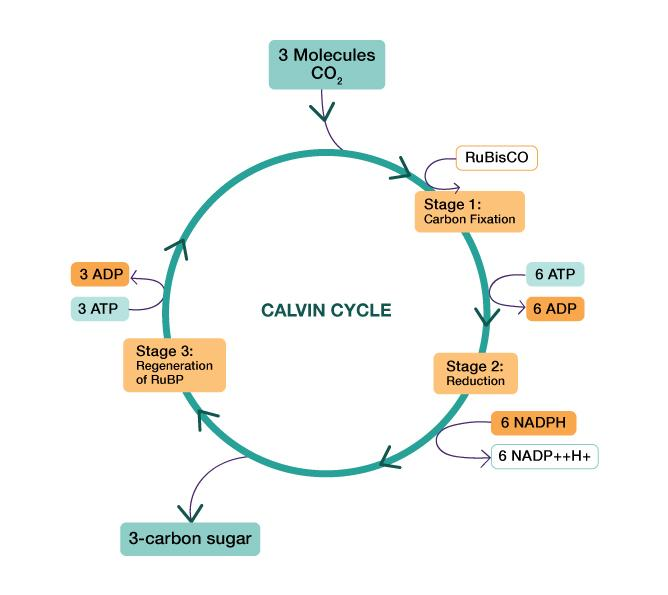
In the first stage of the cycle fixation of carbon dioxide occurs, as it is converting from an inorganic molecule to an organic molecule. This stage also witnesses the initiation of the light independent reactions. In the second stage of the cycle which is a reduction, ATP and NADPH are used to reduce 3-PGA into G-3-P, and conversion of ATP and NADPH to ADP and NADP+ occurs. The last stage of the cycle is the regeneration stage where RuBP is regenerated so that more carbon dioxide can be fixed in the plants.
So the answer is ‘c) Light’.
Note: Calvin cycle occurs in the stroma of the leaves. It generates oxygen molecules. The end product of glyceraldehyde is sent to the cytoplasm of the cell to help in the generation of other molecules needed by the plant. The main function of the Calvin cycle is the production of three carbon sugars which can be further used by the plants to create other substances.
Complete answer:
Calvin cycle is a dark reaction which means it is a light-independent cycle. It occurs in the absence of light during night time. It also occurs during daytime but the energy from sunlight is not needed by it to perform its function.
Additional information: Calvin cycle occurs in three steps of fixation, reduction, and regeneration. To start the cycle energy resources are required. These energy resources are met by the ATP and NADPH present in the plant cell which is derived from the sun’s energy. Calvin cycle uses these energy molecules to convert the three molecules of carbon dioxide to one molecule of the three-carbon sugar. In the Calvin cycle three molecules of carbon dioxide and water are converted into one molecule of glyceraldehyde, during this process six atoms of oxygen are formed which are released into the atmosphere for the organism to use for respiration.
In the first stage of the cycle fixation of carbon dioxide occurs, as it is converting from an inorganic molecule to an organic molecule. This stage also witnesses the initiation of the light independent reactions. In the second stage of the cycle which is a reduction, ATP and NADPH are used to reduce 3-PGA into G-3-P, and conversion of ATP and NADPH to ADP and NADP+ occurs. The last stage of the cycle is the regeneration stage where RuBP is regenerated so that more carbon dioxide can be fixed in the plants.
So the answer is ‘c) Light’.
Note: Calvin cycle occurs in the stroma of the leaves. It generates oxygen molecules. The end product of glyceraldehyde is sent to the cytoplasm of the cell to help in the generation of other molecules needed by the plant. The main function of the Calvin cycle is the production of three carbon sugars which can be further used by the plants to create other substances.
Recently Updated Pages
Master Class 11 Social Science: Engaging Questions & Answers for Success

Master Class 11 English: Engaging Questions & Answers for Success
Master Class 11 Accountancy: Engaging Questions & Answers for Success
Master Class 11 Physics: Engaging Questions & Answers for Success
Master Class 11 Computer Science: Engaging Questions & Answers for Success
Master Class 11 Business Studies: Engaging Questions & Answers for Success
Trending doubts
One Metric ton is equal to kg A 10000 B 1000 C 100 class 11 physics CBSE
Find the value of the expression given below sin 30circ class 11 maths CBSE
Draw a diagram of nephron and explain its structur class 11 biology CBSE
10 examples of friction in our daily life
Proton was discovered by A Thomson B Rutherford C Chadwick class 11 chemistry CBSE
How many kilometers are there in 100 meters class 11 maths CBSE