




Which of the following is not aromatic?
(A) Benzene
(B) Naphthalene
(C) Pyridine
(D) $ 1,3,5 - $ heptatriene
Answer
 Verified
508.5k+ views
Hint: Aromaticity of any compound is determined by applying Huckle’s rule which states that if any compound possesses $ \left( {4n + 2} \right)\pi $ electrons which have capability to delocalize are known as aromatic compounds.
Complete Step By Step Answer:
In order to calculate the aromaticity of a compound we begin with determining the number of electrons present in it. After this, put the value of $ \left( \pi \right) $ electrons in Huckle’s formula. If the final answer is a whole number then the compound must be aromatic.
Structure of benzene is:
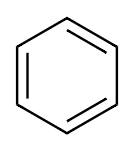
From the above structure we find that there are a total $ 6\pi $ electrons present in benzene. On applying Huckle’s rule we get,
$ \left( {4n + 2} \right) = 6 $
$ 4n = 6 - 2 $
After solving this we get
$ n = \dfrac{4}{4} $
$ n = 1 $
Since, the value of $ \left( n \right) $ is a whole number, benzene is an aromatic compound.
Structure of Naphthalene is:
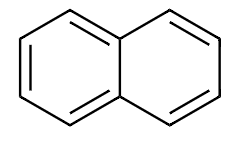
From the above structure we find that there are a total $ 10\pi $ electrons present in naphthalene. On applying Huckle’s rule we get,
$ \left( {4n + 2} \right) = 10 $
$ 4n = 10 - 2 $
After solving this we get
$ n = \dfrac{8}{4} $
$ n = 2 $
Since, the value of $ \left( n \right) $ is a whole number, naphthalene is an aromatic compound.
Structure of pyridine is:
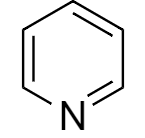
From the above structure we find that there are a total $ 6\pi $ electrons present in pyridine. On applying Huckle’s rule we get,
$ \left( {4n + 2} \right) = 6 $
$ 4n = 6 - 2 $
After solving this we get
$ n = \dfrac{4}{4} $
$ n = 1 $
Since, the value of $ \left( n \right) $ is a whole number, pyridine is an aromatic compound.
Structure of $ 1,3,5 - $ heptatriene is:
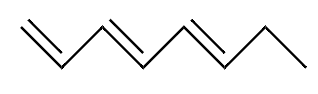
From the above structure we see that it is not a cyclic structure. therefore $ 1,3,5 - $ heptatriene fails to fulfill the basic requirement of aromaticity. Hence, $ 1,3,5 - $ heptatriene is not aromatic.
$ \Rightarrow $ $ 1,3,5 - $ heptatriene is not an aromatic compound. Therefore option $ \left( {iv} \right) $ is the correct option.
Note:
Due to the presence of aroma or pleasant smell from the compound they are known as aromatic. According to Huckle’s rule a compound is said to be aromatic if it satisfies the basic requirement like compound must be planar, cyclic, and have $ \left( {4n + 2} \right)\pi $ delocalized electrons.
Complete Step By Step Answer:
In order to calculate the aromaticity of a compound we begin with determining the number of electrons present in it. After this, put the value of $ \left( \pi \right) $ electrons in Huckle’s formula. If the final answer is a whole number then the compound must be aromatic.
Structure of benzene is:
From the above structure we find that there are a total $ 6\pi $ electrons present in benzene. On applying Huckle’s rule we get,
$ \left( {4n + 2} \right) = 6 $
$ 4n = 6 - 2 $
After solving this we get
$ n = \dfrac{4}{4} $
$ n = 1 $
Since, the value of $ \left( n \right) $ is a whole number, benzene is an aromatic compound.
Structure of Naphthalene is:
From the above structure we find that there are a total $ 10\pi $ electrons present in naphthalene. On applying Huckle’s rule we get,
$ \left( {4n + 2} \right) = 10 $
$ 4n = 10 - 2 $
After solving this we get
$ n = \dfrac{8}{4} $
$ n = 2 $
Since, the value of $ \left( n \right) $ is a whole number, naphthalene is an aromatic compound.
Structure of pyridine is:
From the above structure we find that there are a total $ 6\pi $ electrons present in pyridine. On applying Huckle’s rule we get,
$ \left( {4n + 2} \right) = 6 $
$ 4n = 6 - 2 $
After solving this we get
$ n = \dfrac{4}{4} $
$ n = 1 $
Since, the value of $ \left( n \right) $ is a whole number, pyridine is an aromatic compound.
Structure of $ 1,3,5 - $ heptatriene is:
From the above structure we see that it is not a cyclic structure. therefore $ 1,3,5 - $ heptatriene fails to fulfill the basic requirement of aromaticity. Hence, $ 1,3,5 - $ heptatriene is not aromatic.
$ \Rightarrow $ $ 1,3,5 - $ heptatriene is not an aromatic compound. Therefore option $ \left( {iv} \right) $ is the correct option.
Note:
Due to the presence of aroma or pleasant smell from the compound they are known as aromatic. According to Huckle’s rule a compound is said to be aromatic if it satisfies the basic requirement like compound must be planar, cyclic, and have $ \left( {4n + 2} \right)\pi $ delocalized electrons.
Recently Updated Pages
Master Class 11 Social Science: Engaging Questions & Answers for Success

Master Class 11 Physics: Engaging Questions & Answers for Success
Master Class 11 Maths: Engaging Questions & Answers for Success
Master Class 11 Economics: Engaging Questions & Answers for Success
Master Class 11 Computer Science: Engaging Questions & Answers for Success
Master Class 11 Chemistry: Engaging Questions & Answers for Success
Trending doubts
One Metric ton is equal to kg A 10000 B 1000 C 100 class 11 physics CBSE
There are 720 permutations of the digits 1 2 3 4 5 class 11 maths CBSE
1 Quintal is equal to a 110 kg b 10 kg c 100kg d 1000 class 11 physics CBSE
State and prove Bernoullis theorem class 11 physics CBSE
Difference Between Prokaryotic Cells and Eukaryotic Cells
Discuss the various forms of bacteria class 11 biology CBSE