




Which of the following is not a prism?
A) Parallelepiped
B) Cuboid
C) Cube
D) Cylinder
Answer
 Verified
604.2k+ views
Hint:
Here, we are asked to find the shape that cannot make a prism.
A prism is a solid three-dimensional object that has identical shapes at both the ends, flat faces and has the same cross-sectional area throughout and it has all flat faces.
Then, draw the figures of the shapes given in the options and find out which shapes satisfy the properties of the prism.
Thus, find the shape which cannot satisfy the properties of prism and choose the correct option.
Complete step by step solution:
Here, we are asked to find the shape that cannot make a prism.
To find that, firstly, we need to understand what a prism is.
The definition of a prism is stated as “A solid three dimensional object that has identical shapes at both the ends, flat faces and has the same cross sectional area throughout”. Also, a prism is always a polyhedron, which means all the faces of a prism are flat.
So, we will find out how the given shapes are made and see whether they have flat faces.
The shape given in option (A) is parallelepiped. The three dimensional figure of parallelepiped is shown on the figure below.
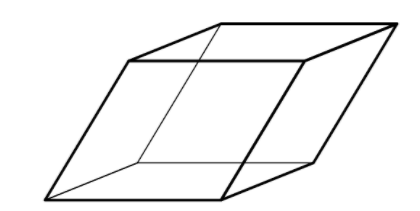
It is clear from the diagram that parallelepiped has all flat faces and has the same cross sectional area throughout. Thus, parallelepiped satisfies the properties of the prism.
So, parallelepiped can be used to make a prism.
Now, let us check for option (B) i.e. cuboid.
The three dimensional figure for cuboid is as given below.
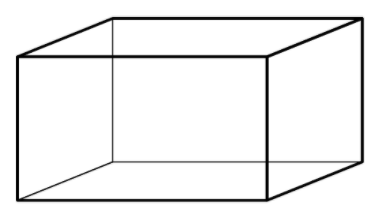
It is clear from the diagram that cuboid has all flat faces and has the same cross sectional area throughout. Thus, cuboid also satisfies the properties of the prism.
Let us check for option (C) now i.e. cube. The three dimensional figure of the cube is as given below.
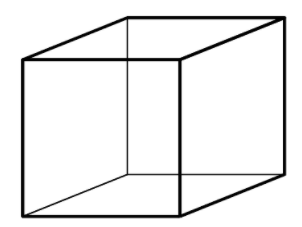
It is clear from the diagram that the cube has all flat faces and has the same cross sectional area throughout. Thus, the cube also satisfies the properties of the prism.
Now, let us check the same for option (D) i.e. cylinder. The three dimensional figure for cylinder is as given below.
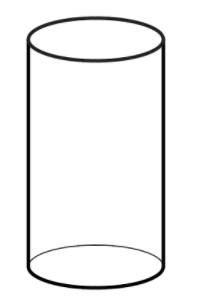
It can be seen in the above diagram that the shapes at the ends are identical but the face is curved. So, cylinders cannot be used to make a prism.
Thus, option (D) is the correct answer.
Note:
Some types of prism:
1) Cube:
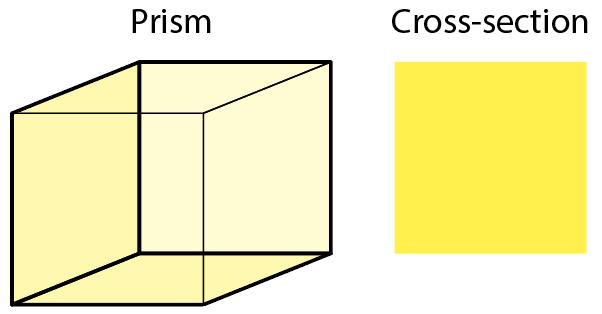
2) Cuboid:
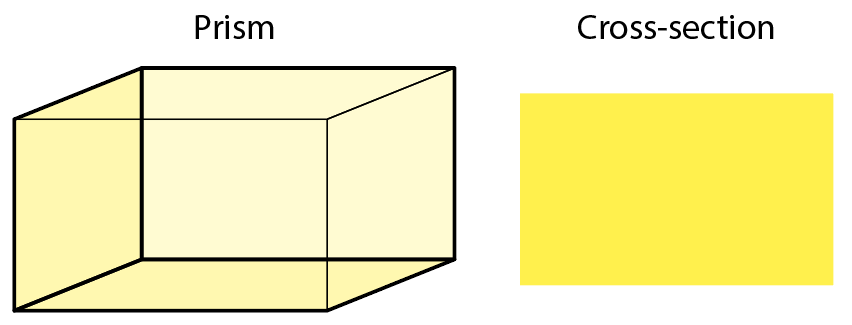
3) Triangular:
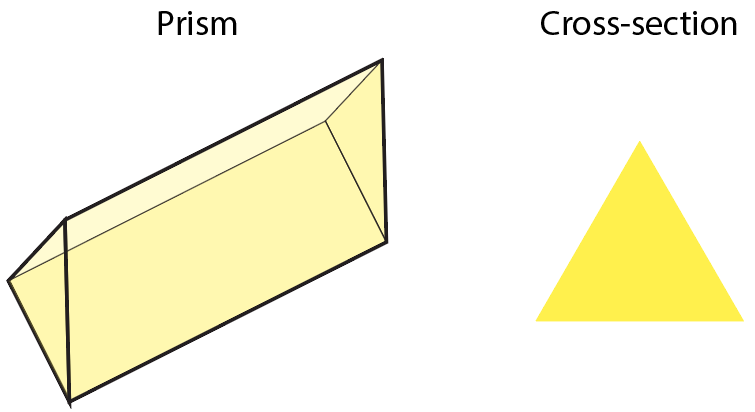
4) Parallelepiped:
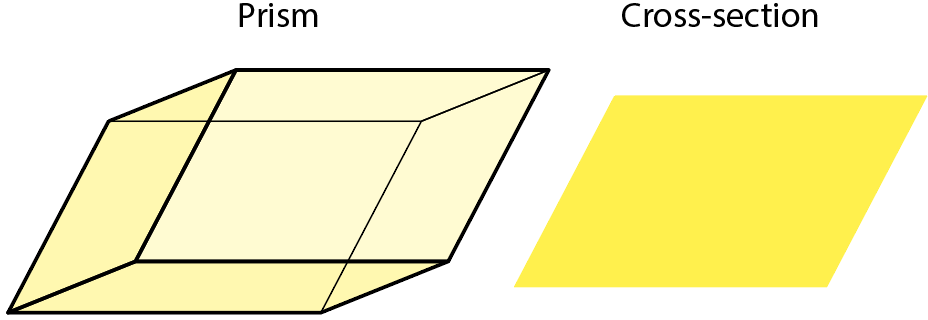
Here, we are asked to find the shape that cannot make a prism.
A prism is a solid three-dimensional object that has identical shapes at both the ends, flat faces and has the same cross-sectional area throughout and it has all flat faces.
Then, draw the figures of the shapes given in the options and find out which shapes satisfy the properties of the prism.
Thus, find the shape which cannot satisfy the properties of prism and choose the correct option.
Complete step by step solution:
Here, we are asked to find the shape that cannot make a prism.
To find that, firstly, we need to understand what a prism is.
The definition of a prism is stated as “A solid three dimensional object that has identical shapes at both the ends, flat faces and has the same cross sectional area throughout”. Also, a prism is always a polyhedron, which means all the faces of a prism are flat.
So, we will find out how the given shapes are made and see whether they have flat faces.
The shape given in option (A) is parallelepiped. The three dimensional figure of parallelepiped is shown on the figure below.
It is clear from the diagram that parallelepiped has all flat faces and has the same cross sectional area throughout. Thus, parallelepiped satisfies the properties of the prism.
So, parallelepiped can be used to make a prism.
Now, let us check for option (B) i.e. cuboid.
The three dimensional figure for cuboid is as given below.
It is clear from the diagram that cuboid has all flat faces and has the same cross sectional area throughout. Thus, cuboid also satisfies the properties of the prism.
Let us check for option (C) now i.e. cube. The three dimensional figure of the cube is as given below.
It is clear from the diagram that the cube has all flat faces and has the same cross sectional area throughout. Thus, the cube also satisfies the properties of the prism.
Now, let us check the same for option (D) i.e. cylinder. The three dimensional figure for cylinder is as given below.
It can be seen in the above diagram that the shapes at the ends are identical but the face is curved. So, cylinders cannot be used to make a prism.
Thus, option (D) is the correct answer.
Note:
Some types of prism:
1) Cube:
2) Cuboid:
3) Triangular:
4) Parallelepiped:
Recently Updated Pages
Master Class 12 Business Studies: Engaging Questions & Answers for Success

Master Class 12 Biology: Engaging Questions & Answers for Success
Master Class 12 Chemistry: Engaging Questions & Answers for Success
Class 12 Question and Answer - Your Ultimate Solutions Guide
Master Class 11 Social Science: Engaging Questions & Answers for Success
Master Class 11 English: Engaging Questions & Answers for Success
Trending doubts
Explain the Treaty of Vienna of 1815 class 10 social science CBSE
Which Indian city is known as the "City of Victory"?
Which instrument is used to measure the Blood Pressure?
Who Won 36 Oscar Awards? Record Holder Revealed
What is the median of the first 10 natural numbers class 10 maths CBSE
Why is it 530 pm in india when it is 1200 afternoon class 10 social science CBSE