




Which of the following is multinucleated?
A. Nervous tissue
B. Striated muscle
C. Non-striated muscle
D. None of these
Answer
 Verified
629.4k+ views
Hint: They are also present in the muscles of the human body, are voluntary in nature, and are under the control of the somatic nervous system.
Complete answer:
The striated muscles also called skeletal muscles are the multinucleated, voluntary muscles where the striations are present. Their main function is to attach the muscles to the bone with the help of tendons. Tendons at the specialized files that are made of bundles of collagen fibers.
Additional Information:
-Muscles are made up of actin and myosin filaments which help in the movement of the body.
-The human body consists of three types of muscles: skeletal muscle, smooth muscle, and cardiac muscle.
-Smooth muscles are the non-striated, uninucleated, and are present in the linings of the organs of the body.
-Cardiac muscles are the heart muscles, which are striated, branched, and multinucleated. They help in the functioning of the heart.
-The formation of the muscle cell from the myoblast fusion is known as myogenesis.
-The skeletal muscles have several filaments that are branched, and also have mitochondria that produce energy to perform their functions.
-The actin and myosin are the repeating units of the muscle cells that form the sarcomeres.
-The cell membrane of the muscle cell is called sarcolemma while the cytoplasm present in it is known as sarcoplasm.
-These muscle cells help in the contraction and relaxation of the muscles in the body.
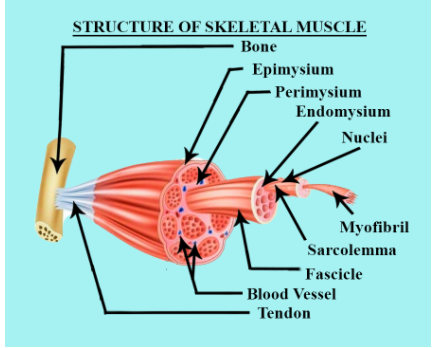
So, the correct answer is ‘Striated muscle‘.
Note: Myopathies are the diseases that are caused in the skeletal muscle. The neuropathies are the diseases of the nerves. The skeletal muscle is the function of the endocrine organs, they secrete myokines which was earlier known as cytokines and peptides by B. K. Pedersen and her colleagues.
Complete answer:
The striated muscles also called skeletal muscles are the multinucleated, voluntary muscles where the striations are present. Their main function is to attach the muscles to the bone with the help of tendons. Tendons at the specialized files that are made of bundles of collagen fibers.
Additional Information:
-Muscles are made up of actin and myosin filaments which help in the movement of the body.
-The human body consists of three types of muscles: skeletal muscle, smooth muscle, and cardiac muscle.
-Smooth muscles are the non-striated, uninucleated, and are present in the linings of the organs of the body.
-Cardiac muscles are the heart muscles, which are striated, branched, and multinucleated. They help in the functioning of the heart.
-The formation of the muscle cell from the myoblast fusion is known as myogenesis.
-The skeletal muscles have several filaments that are branched, and also have mitochondria that produce energy to perform their functions.
-The actin and myosin are the repeating units of the muscle cells that form the sarcomeres.
-The cell membrane of the muscle cell is called sarcolemma while the cytoplasm present in it is known as sarcoplasm.
-These muscle cells help in the contraction and relaxation of the muscles in the body.
So, the correct answer is ‘Striated muscle‘.
Note: Myopathies are the diseases that are caused in the skeletal muscle. The neuropathies are the diseases of the nerves. The skeletal muscle is the function of the endocrine organs, they secrete myokines which was earlier known as cytokines and peptides by B. K. Pedersen and her colleagues.
Recently Updated Pages
Master Class 11 English: Engaging Questions & Answers for Success

Master Class 11 Social Science: Engaging Questions & Answers for Success
Master Class 11 Maths: Engaging Questions & Answers for Success
Master Class 11 Chemistry: Engaging Questions & Answers for Success
Master Class 11 Biology: Engaging Questions & Answers for Success
Master Class 11 Physics: Engaging Questions & Answers for Success
Trending doubts
One Metric ton is equal to kg A 10000 B 1000 C 100 class 11 physics CBSE
Difference Between Prokaryotic Cells and Eukaryotic Cells
Find the value of the expression given below sin 30circ class 11 maths CBSE
1 ton equals to A 100 kg B 1000 kg C 10 kg D 10000 class 11 physics CBSE
Two of the body parts which do not appear in MRI are class 11 biology CBSE
Draw a diagram of nephron and explain its structur class 11 biology CBSE