




Which of the following is called pond silk?
(a)Spirogyra
(b)Volvox
(c)Chlamydomonas
(d)Euglena
Answer
 Verified
635.1k+ views
Hint: This is a filamentous charophyte green algae having a helical or spiral arrangement of the chloroplasts in their body. They are commonly found in freshwater habitats.
Complete answer:
Spirogyra has a spiral arrangement of green-colored chloroplasts that contain chlorophyll. It is also known as pond silk. It has two-layered cell walls, the inner layer is made up of cellulose whereas the outer layer is made up of pectin. This pectin dissolves in water to produce mucilage, which provides a shiny and silky texture to the body of Spirogyra. That is why it is called pond silk.
They are generally found in shallow ponds, ditches, and amongst vegetation at the edges of large lakes.
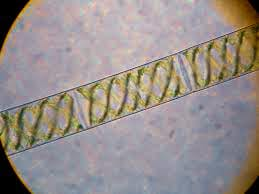
(Spirogyra as seen under the microscope)
Additional information:
-Cells of Spirogyra are joined end-to-end in an unbranched, largely unspecialized, stiff filament and are cylindrical with one or two spirally-wound chloroplasts on which many pyrenoids are borne.
-Filaments can be several centimeters in length and measure approximately 10 to 100 μm in width.
-They can reproduce sexually (Scalariform conjugation and lateral conjugation) and asexually (fragmentation) both.
-Volvox lives in a variety of freshwater habitats and was first reported by Antonie van Leeuwenhoek in 1700.
-Chloroplasts present within the body of euglena enable them to feed by autotrophy, like plants (photosynthesis).
-Chlamydomonas are unicellular flagellates named by C.G. Ehrenberg (1833, 1838).
So, the correct option is 'Spirogyra'
Notes:
-Scalariform conjugation means the association of two or more different filaments lined side by side either partially or throughout their length. It occurs between two filaments.
In lateral conjugation, gametes are formed in a single filament. It occurs between two adjacent cells on the same filament.
There are about 400 species of Spirogyra known to us.
Complete answer:
Spirogyra has a spiral arrangement of green-colored chloroplasts that contain chlorophyll. It is also known as pond silk. It has two-layered cell walls, the inner layer is made up of cellulose whereas the outer layer is made up of pectin. This pectin dissolves in water to produce mucilage, which provides a shiny and silky texture to the body of Spirogyra. That is why it is called pond silk.
They are generally found in shallow ponds, ditches, and amongst vegetation at the edges of large lakes.
(Spirogyra as seen under the microscope)
Additional information:
-Cells of Spirogyra are joined end-to-end in an unbranched, largely unspecialized, stiff filament and are cylindrical with one or two spirally-wound chloroplasts on which many pyrenoids are borne.
-Filaments can be several centimeters in length and measure approximately 10 to 100 μm in width.
-They can reproduce sexually (Scalariform conjugation and lateral conjugation) and asexually (fragmentation) both.
-Volvox lives in a variety of freshwater habitats and was first reported by Antonie van Leeuwenhoek in 1700.
-Chloroplasts present within the body of euglena enable them to feed by autotrophy, like plants (photosynthesis).
-Chlamydomonas are unicellular flagellates named by C.G. Ehrenberg (1833, 1838).
So, the correct option is 'Spirogyra'
Notes:
-Scalariform conjugation means the association of two or more different filaments lined side by side either partially or throughout their length. It occurs between two filaments.
In lateral conjugation, gametes are formed in a single filament. It occurs between two adjacent cells on the same filament.
There are about 400 species of Spirogyra known to us.
Recently Updated Pages
Master Class 12 Economics: Engaging Questions & Answers for Success

Master Class 12 English: Engaging Questions & Answers for Success
Master Class 12 Social Science: Engaging Questions & Answers for Success
Master Class 12 Maths: Engaging Questions & Answers for Success
Master Class 12 Physics: Engaging Questions & Answers for Success
Master Class 9 General Knowledge: Engaging Questions & Answers for Success
Trending doubts
One Metric ton is equal to kg A 10000 B 1000 C 100 class 11 physics CBSE
Difference Between Prokaryotic Cells and Eukaryotic Cells
Two of the body parts which do not appear in MRI are class 11 biology CBSE
Find the value of the expression given below sin 30circ class 11 maths CBSE
1 ton equals to A 100 kg B 1000 kg C 10 kg D 10000 class 11 physics CBSE
Draw a diagram of nephron and explain its structur class 11 biology CBSE