




Which of the following is a part of nu-body?
(a) Histone octamer
(b) DNA + core of the nucleosome
(c) H 1 protein
(d) 1 ¾ turn of DNA + H 1 protein
Answer
 Verified
577.2k+ views
Hint: Nu-body is the complex of protein present at the center of the nucleosome. This protein is very helpful as without it in the chromosome the DNA that is unwounded will be very long. It helps in the winding of DNA and functions in gene regulation.
Complete answer:
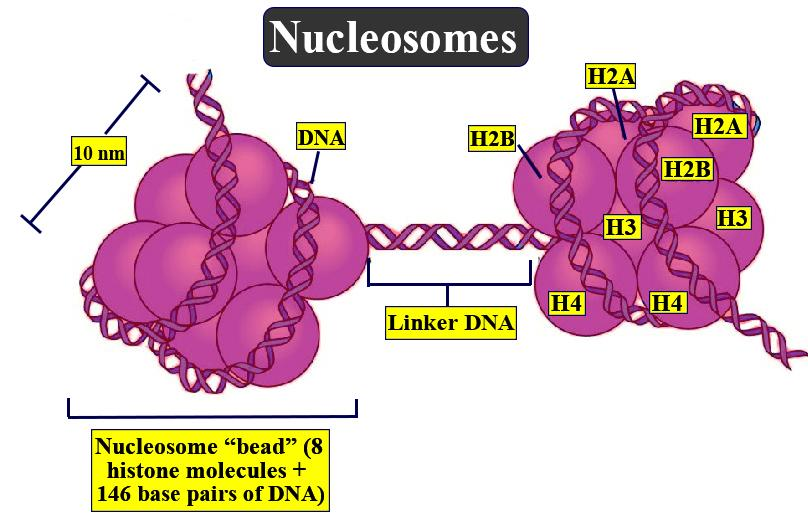
Every chromosome in a eukaryotic cell is composed of DNA which is wound and dense around an octamer of essential proteins called histones. The nu-body is the part of chromatin that is made up of DNA and is wrapped around histone protein molecules. The histone protein consists of eight complexes of proteins with two copies each, they are H2A, H2B, H3, H4. They are together called histone octamers.
-The histone proteins in the core of the nucleosome are H1, H2A, H2B, H3, H4 which are significant for the arrangement of chromosome structure or build-up of DNA.
-The DNA length is more easily observed than the compartment and its size where the DNA is stored in the core.
-The histones are the spool-like proteins that keep DNA from the chromosomal structure at its place and hold it firmly.
-The core of nucleosomes composed of various types of histones that are H2A, H2B, H3, and H4, and H1/H5 that are called the linker histones.
-The histones present in the core of the nucleosome are all similar in structure as they all are in forms of dimers having similar histone fold domain: three alpha-helices linked by two loops.
-The nu-body will consist of two copies of each histone protein along with nucleotide base pairs of around 140 bp.
So, the correct answer is ‘Histone octamer’.
Note:
The term histone was derived from the Greek word ‘Histon’, ‘histanai’, or ‘histos’ in the late nineteenth century. The word was first discovered by Albrecht Kossel in 1884. In the 1950s, a new type of histone called H5 was discovered which was found to be the isoform of H1 histone.
Complete answer:
Every chromosome in a eukaryotic cell is composed of DNA which is wound and dense around an octamer of essential proteins called histones. The nu-body is the part of chromatin that is made up of DNA and is wrapped around histone protein molecules. The histone protein consists of eight complexes of proteins with two copies each, they are H2A, H2B, H3, H4. They are together called histone octamers.
-The histone proteins in the core of the nucleosome are H1, H2A, H2B, H3, H4 which are significant for the arrangement of chromosome structure or build-up of DNA.
-The DNA length is more easily observed than the compartment and its size where the DNA is stored in the core.
-The histones are the spool-like proteins that keep DNA from the chromosomal structure at its place and hold it firmly.
-The core of nucleosomes composed of various types of histones that are H2A, H2B, H3, and H4, and H1/H5 that are called the linker histones.
-The histones present in the core of the nucleosome are all similar in structure as they all are in forms of dimers having similar histone fold domain: three alpha-helices linked by two loops.
-The nu-body will consist of two copies of each histone protein along with nucleotide base pairs of around 140 bp.
So, the correct answer is ‘Histone octamer’.
Note:
The term histone was derived from the Greek word ‘Histon’, ‘histanai’, or ‘histos’ in the late nineteenth century. The word was first discovered by Albrecht Kossel in 1884. In the 1950s, a new type of histone called H5 was discovered which was found to be the isoform of H1 histone.
Recently Updated Pages
Master Class 12 Economics: Engaging Questions & Answers for Success

Master Class 12 English: Engaging Questions & Answers for Success
Master Class 12 Social Science: Engaging Questions & Answers for Success
Master Class 12 Maths: Engaging Questions & Answers for Success
Master Class 12 Physics: Engaging Questions & Answers for Success
Master Class 11 Social Science: Engaging Questions & Answers for Success
Trending doubts
One Metric ton is equal to kg A 10000 B 1000 C 100 class 11 physics CBSE
Difference Between Prokaryotic Cells and Eukaryotic Cells
Two of the body parts which do not appear in MRI are class 11 biology CBSE
1 ton equals to A 100 kg B 1000 kg C 10 kg D 10000 class 11 physics CBSE
Draw a diagram of nephron and explain its structur class 11 biology CBSE
10 examples of friction in our daily life