




Which of the following is a hormone-releasing Intrauterine Device (IUD)?
(a) Multiload 375
(b) LNG- 20
(c) Cervical cap
(d) Vault
Answer
 Verified
638.1k+ views
Hint:This T shape & device features a collar attached to a vertical arm containing 52 mg of levonorgestrel dispersed in poly dimethyl siloxane. It secretes levonorgestrel 20 mcg/day.
Complete answer:
LNG-20 is a hormone-releasing Intrauterine Device (IUD) that produces levonorgestrel (LNG) , causes endometrial atrophy, and alters the stroma to restrict implantation. It also increases sperm phagocytosis in the uterus. Various IUDs are available and are the most widely used contraceptive measures. They are inserted through the vagina in the uterus. IUDs act by suppressing motility, fertilizing capacity, and increasing phagocytosis of sperms.
It is one of the most effective forms of birth control with a one-year failure rate of around 0.2 percent. The device is placed in the uterus and lasts three to seven years. Fertility often returns quickly to the following removal. Side effects involve irregular periods, benign ovarian cysts, pelvic pain, and depression.
Lippes loop is IUD impregnated with barium sulfate. Copper releasing IUDs, namely CuT, Cu7, Multiload 375, etc, release copper that suppresses the sperm motility which successively reduces its fertilizing capacity. Vaults are a type of barrier method which blocks the entry of sperm and prevents conception.
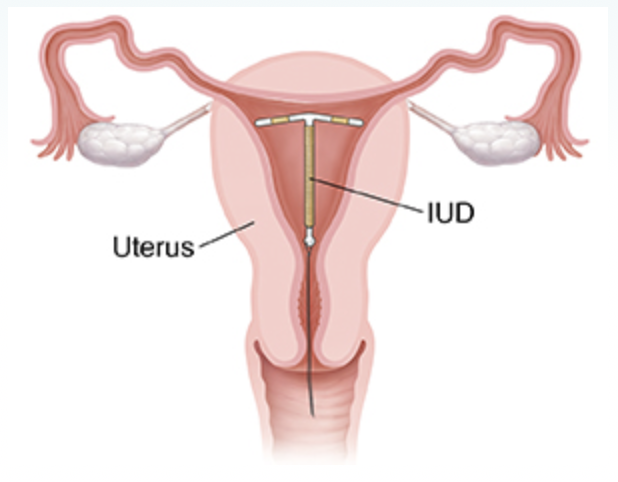 So, the correct answer is ‘(b) LNG- 20’.
Note: The IUD with levonorgestrel was first approved for medical use in 1990 in Finland and in the United States in 2000. It is on the World Health Organization's List of Essential Medicines, the safest and best medicines needed during a health system. More than 120 countries have approved the device and it is used by more than 10 million women.
Complete answer:
LNG-20 is a hormone-releasing Intrauterine Device (IUD) that produces levonorgestrel (LNG) , causes endometrial atrophy, and alters the stroma to restrict implantation. It also increases sperm phagocytosis in the uterus. Various IUDs are available and are the most widely used contraceptive measures. They are inserted through the vagina in the uterus. IUDs act by suppressing motility, fertilizing capacity, and increasing phagocytosis of sperms.
It is one of the most effective forms of birth control with a one-year failure rate of around 0.2 percent. The device is placed in the uterus and lasts three to seven years. Fertility often returns quickly to the following removal. Side effects involve irregular periods, benign ovarian cysts, pelvic pain, and depression.
Lippes loop is IUD impregnated with barium sulfate. Copper releasing IUDs, namely CuT, Cu7, Multiload 375, etc, release copper that suppresses the sperm motility which successively reduces its fertilizing capacity. Vaults are a type of barrier method which blocks the entry of sperm and prevents conception.
Note: The IUD with levonorgestrel was first approved for medical use in 1990 in Finland and in the United States in 2000. It is on the World Health Organization's List of Essential Medicines, the safest and best medicines needed during a health system. More than 120 countries have approved the device and it is used by more than 10 million women.
Recently Updated Pages
Basicity of sulphurous acid and sulphuric acid are

Master Class 11 English: Engaging Questions & Answers for Success
Master Class 11 Physics: Engaging Questions & Answers for Success
Master Class 11 Computer Science: Engaging Questions & Answers for Success
Master Class 11 Chemistry: Engaging Questions & Answers for Success
Master Class 11 Social Science: Engaging Questions & Answers for Success
Trending doubts
Difference Between Prokaryotic Cells and Eukaryotic Cells
Two of the body parts which do not appear in MRI are class 11 biology CBSE
One Metric ton is equal to kg A 10000 B 1000 C 100 class 11 physics CBSE
10 examples of friction in our daily life
Draw a diagram of nephron and explain its structur class 11 biology CBSE
What will happen if the mucus is not secreted by the class 11 biology CBSE