




Which of the following is a diatomic gas?
(A) Hydrogen
(B) Oxygen
(C) Chlorine
(D) All of the above
Answer
 Verified
562.2k+ views
Hint: In a free state and at standard temperature and pressure, some elements exist as diatomic molecules to achieve stability. In these diatomic molecules, both the atoms are of the same element and hence are homonuclear.
Complete answer:
To determine whether the gas exists as a diatomic molecule, we need to check the stability of the diatomic molecule formed.
(A) Hydrogen atom has 1 electron in its valence shell and needs 1 more electron to form a complete outermost shell. So when two hydrogen atoms form a bond, both the hydrogen atoms share two electrons between them, forming a covalent single bond and completing the octet.
Its Lewis structure is as follows:

Hence ${{H}_{2}}$ is stable and exists as a diatomic gas.
(B) Oxygen atom has 6 electrons in its valence shell and needs 2 more electrons to form a complete outermost octet shell. So, when 2 oxygen atoms form a bond, both the oxygen atoms share 4 electrons between them, forming a covalent double bond and completing the octet.
Its Lewis structure is as follows:
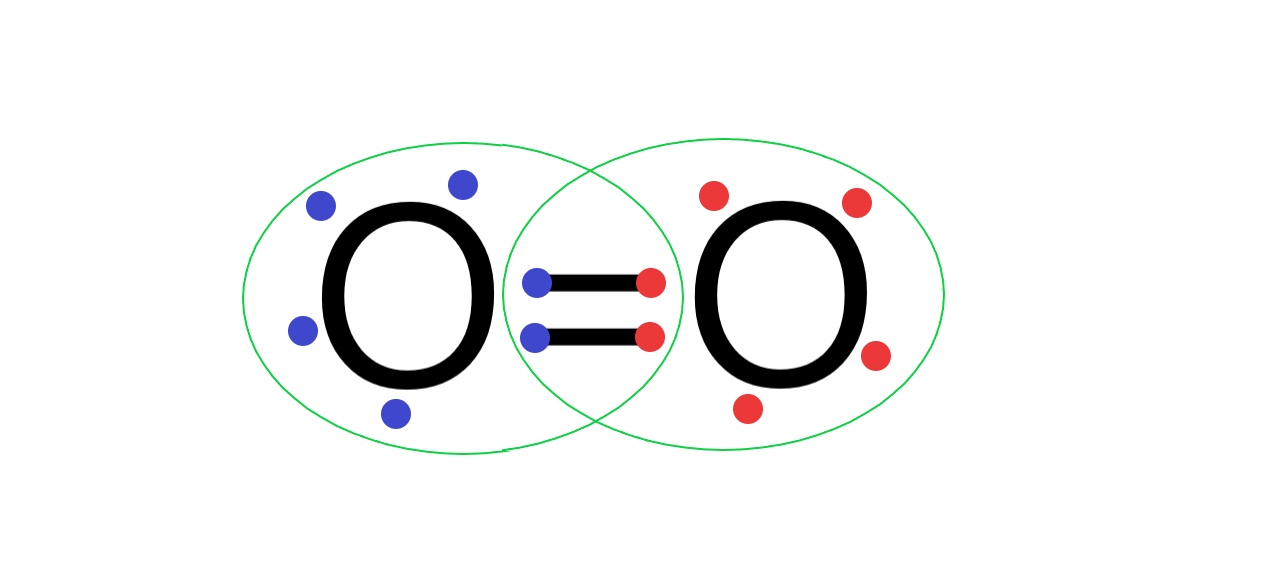
Hence ${{O}_{2}}$ is stable and exists as a diatomic gas.
(C) Chlorine atom has 7 electrons in its valence shell and needs 1 more electron to form a complete outermost octet shell. So when 2 chlorine atoms form a bond, both the chlorine atoms share 2 electrons between them, forming a covalent single bond and completing the octet.
Its Lewis structure is as follows:

Hence $C{{l}_{2}}$ is stable and exists as a diatomic gas.
So, the correct answer is option (D) All of the above.
Note:
It should be noted that other than chlorine $C{{l}_{2}}$, oxygen ${{O}_{2}}$, and hydrogen ${{H}_{2}}$, the only other gases that exist as homonuclear diatomic molecules at STP are fluorine ${{F}_{2}}$ and nitrogen ${{N}_{2}}$.
At temperatures higher than STP, bromine $B{{r}_{2}}$ , and iodine ${{I}_{2}}$ also exist as diatomic molecules.
Complete answer:
To determine whether the gas exists as a diatomic molecule, we need to check the stability of the diatomic molecule formed.
(A) Hydrogen atom has 1 electron in its valence shell and needs 1 more electron to form a complete outermost shell. So when two hydrogen atoms form a bond, both the hydrogen atoms share two electrons between them, forming a covalent single bond and completing the octet.
Its Lewis structure is as follows:
Hence ${{H}_{2}}$ is stable and exists as a diatomic gas.
(B) Oxygen atom has 6 electrons in its valence shell and needs 2 more electrons to form a complete outermost octet shell. So, when 2 oxygen atoms form a bond, both the oxygen atoms share 4 electrons between them, forming a covalent double bond and completing the octet.
Its Lewis structure is as follows:
Hence ${{O}_{2}}$ is stable and exists as a diatomic gas.
(C) Chlorine atom has 7 electrons in its valence shell and needs 1 more electron to form a complete outermost octet shell. So when 2 chlorine atoms form a bond, both the chlorine atoms share 2 electrons between them, forming a covalent single bond and completing the octet.
Its Lewis structure is as follows:
Hence $C{{l}_{2}}$ is stable and exists as a diatomic gas.
So, the correct answer is option (D) All of the above.
Note:
It should be noted that other than chlorine $C{{l}_{2}}$, oxygen ${{O}_{2}}$, and hydrogen ${{H}_{2}}$, the only other gases that exist as homonuclear diatomic molecules at STP are fluorine ${{F}_{2}}$ and nitrogen ${{N}_{2}}$.
At temperatures higher than STP, bromine $B{{r}_{2}}$ , and iodine ${{I}_{2}}$ also exist as diatomic molecules.
Recently Updated Pages
Master Class 12 Economics: Engaging Questions & Answers for Success

Master Class 12 English: Engaging Questions & Answers for Success
Master Class 12 Social Science: Engaging Questions & Answers for Success
Master Class 12 Maths: Engaging Questions & Answers for Success
Master Class 12 Physics: Engaging Questions & Answers for Success
Master Class 11 Social Science: Engaging Questions & Answers for Success
Trending doubts
1 ton equals to A 100 kg B 1000 kg C 10 kg D 10000 class 11 physics CBSE
DNA is not present in A Nucleus B Mitochondria C Chloroplast class 11 biology CBSE
What is the weight in lbs of a 75 Kg person class 11 physics CBSE
Proton was discovered by A Thomson B Rutherford C Chadwick class 11 chemistry CBSE
Arrange the bond angle order of NO2NO2 NO2 + and NO3 class 11 chemistry CBSE
The relation between molarity M and molality m is given class 11 chemistry CBSE