



Which of the following is a co-polymer?
A.Polytetrafluoroethylene
B.Polyvinyl chloride
C.Polyethylene
D.Nylon- 6, 6
E.Natural rubber
Answer
 Verified
573.9k+ views
Hint: A polymer made by reaction of more than one species of monomer is known as copolymer and the process of polymerization of two or more different monomers into copolymers is called copolymerization.
Complete step by step answer:
Polytetrafluoroethylene is also commonly called as Teflon. This polymer is polymerised from its monomer named tetrafluoroethylene by a free- radical polymerization mechanism.
The reaction can be written as:
$ \eta {F_2}C = C{F_2} \to {\left(- {F_2}C - C{F_2} - \right)_n} $
Since, this polymer is made only from one monomer thus it is not a copolymer.
Polyvinyl chloride (PVC) is also known as Polychloroethene. This polymer is made from only one monomer that is vinyl chloride or chloroethylene.
$\eta {\text{ }}{{\text{H}}_2}C = CClH \to {\left( { - {H_2}C - CClH - } \right)_n}$
This polymer is also not a copolymer since it is polymerised from one monomer only.
Polyethylene or polythene (PE) is also called polymethylene. The monomer used for the polymerization process of this polymer is ethylene.
$ \eta {H_2}C = C{H_2} \to {\left( - {H_2}C - C{H_2} - \right)_n} $
Therefore, it is also not a copolymer.
-Nylon- 6, 6 is a polymerised from two different monomers that are hexamethylenediamine and adipic acid by the process known as Polycondensation. The reaction can be shown as:
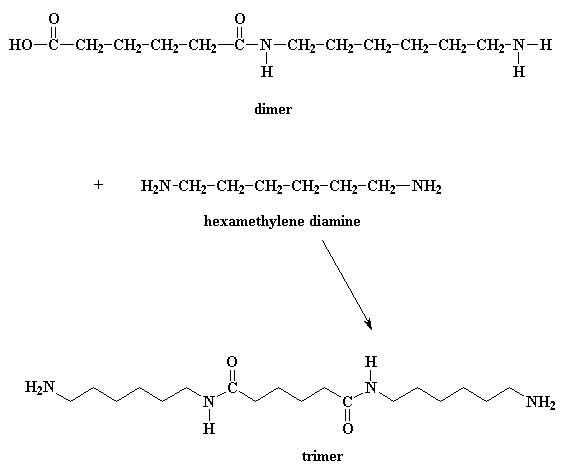
Since, this polymer is polymerised from two different monomers, hence it is a copolymer.
-Natural rubber is a polymer of isoprene.i.e. Isoprene is the monomer of natural rubber and natural rubber is also known as Poly-isoprene.
The common name of isoprene is:
2 methyl 1, 3 butadiene
The reaction can be shown as:
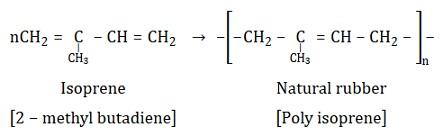
Thus, natural rubber is also not a copolymer.
Hence, the answer is option (D) i.e. Nylon 6,6 is a copolymer.
Note:
One should keep in mind that frequency of light is independent of the medium of the surrounding while wavelength is dependent on the medium of the surrounding. Frequency does not change because it is a property of light while wavelength changes according to the medium in which light is travelling.
Complete step by step answer:
Polytetrafluoroethylene is also commonly called as Teflon. This polymer is polymerised from its monomer named tetrafluoroethylene by a free- radical polymerization mechanism.
The reaction can be written as:
$ \eta {F_2}C = C{F_2} \to {\left(- {F_2}C - C{F_2} - \right)_n} $
Since, this polymer is made only from one monomer thus it is not a copolymer.
Polyvinyl chloride (PVC) is also known as Polychloroethene. This polymer is made from only one monomer that is vinyl chloride or chloroethylene.
$\eta {\text{ }}{{\text{H}}_2}C = CClH \to {\left( { - {H_2}C - CClH - } \right)_n}$
This polymer is also not a copolymer since it is polymerised from one monomer only.
Polyethylene or polythene (PE) is also called polymethylene. The monomer used for the polymerization process of this polymer is ethylene.
$ \eta {H_2}C = C{H_2} \to {\left( - {H_2}C - C{H_2} - \right)_n} $
Therefore, it is also not a copolymer.
-Nylon- 6, 6 is a polymerised from two different monomers that are hexamethylenediamine and adipic acid by the process known as Polycondensation. The reaction can be shown as:
Since, this polymer is polymerised from two different monomers, hence it is a copolymer.
-Natural rubber is a polymer of isoprene.i.e. Isoprene is the monomer of natural rubber and natural rubber is also known as Poly-isoprene.
The common name of isoprene is:
2 methyl 1, 3 butadiene
The reaction can be shown as:
Thus, natural rubber is also not a copolymer.
Hence, the answer is option (D) i.e. Nylon 6,6 is a copolymer.
Note:
One should keep in mind that frequency of light is independent of the medium of the surrounding while wavelength is dependent on the medium of the surrounding. Frequency does not change because it is a property of light while wavelength changes according to the medium in which light is travelling.
Recently Updated Pages
Basicity of sulphurous acid and sulphuric acid are

Master Class 12 English: Engaging Questions & Answers for Success
Master Class 12 Social Science: Engaging Questions & Answers for Success
Master Class 12 Maths: Engaging Questions & Answers for Success
Master Class 12 Economics: Engaging Questions & Answers for Success
Master Class 12 Physics: Engaging Questions & Answers for Success
Trending doubts
Which are the Top 10 Largest Countries of the World?
Draw a labelled sketch of the human eye class 12 physics CBSE
Draw ray diagrams each showing i myopic eye and ii class 12 physics CBSE
Give 10 examples of unisexual and bisexual flowers
Give simple chemical tests to distinguish between the class 12 chemistry CBSE
Define Vant Hoff factor How is it related to the degree class 12 chemistry CBSE