




Which of the following has distorted tetrahedral shape?
(A) $Si{H_4}$
(B) $CC{l_4}$
(C) $C{H_4}$
(D) $CHC{l_3}$
Answer
 Verified
609.6k+ views
Hint: A carbon atom with four bonds and bond angle of approximately ${109.5^o}$ is tetrahedral geometry. But when bond angle is different from ${109.5^o}$ i.e., less than this angle then it is called distorted tetrahedral geometry.
This is due to repulsion between the bond pair and lone pair of electron.
Complete step by step answer:
Let us discuss the geometry of each molecule one by one.
(1) $CHC{l_3}$ chloroform: The molecular shape of $CHC{l_3}$ is tetrahedral. It means that H-atoms and three Cl-atoms. The vertices of a triangular based pyramid around the central C-atom.
This is because polar covalent bonds are asymmetrically arranged around the central atom of a molecule.
The geometry of molecules is not regular because the dipole moment of $CHC{l_3}$ is not zero.
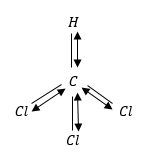
$CHC{l_3}$ has maximum dipole moment because in tetrahedral structure all Cl-atoms will be at bottom and add to individual dipoles.
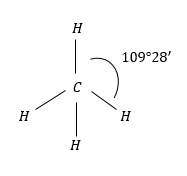
(2) $C{H_4}$: $C{H_4}$ molecules have regular tetrahedral geometry due H-atoms present and regular tetrahedron structure.
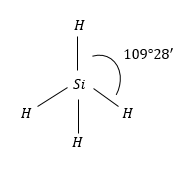
$Si{H_4}$: Molecular geometry of this molecule is also regular tetrahedral. Because it is surrounded by the same atoms i.e., H-atoms.
Therefore, the same symmetric charge distribution around $Si$atom and molecule is non-polar.
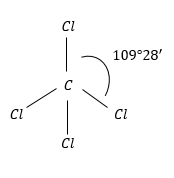
$CC{l_4}$: This has regular geometry because of the same atoms surrounding the C-atom.
Therefore, the dipole moment of the molecule is zero.
Therefore, from the above explanation the correct option is (D) $CHC{l_3}.$
Note:
Molecules show regular tetrahedral geometry when the central atom is surrounded by the same atoms. The resulting dipole moment becomes zero.
But when central atoms surrounded by different atoms [differ in their electronegativity] have dipole moment and therefore their geometry is distorted.
This is due to repulsion between the bond pair and lone pair of electron.
Complete step by step answer:
Let us discuss the geometry of each molecule one by one.
(1) $CHC{l_3}$ chloroform: The molecular shape of $CHC{l_3}$ is tetrahedral. It means that H-atoms and three Cl-atoms. The vertices of a triangular based pyramid around the central C-atom.
This is because polar covalent bonds are asymmetrically arranged around the central atom of a molecule.
The geometry of molecules is not regular because the dipole moment of $CHC{l_3}$ is not zero.
$CHC{l_3}$ has maximum dipole moment because in tetrahedral structure all Cl-atoms will be at bottom and add to individual dipoles.
(2) $C{H_4}$: $C{H_4}$ molecules have regular tetrahedral geometry due H-atoms present and regular tetrahedron structure.
$Si{H_4}$: Molecular geometry of this molecule is also regular tetrahedral. Because it is surrounded by the same atoms i.e., H-atoms.
Therefore, the same symmetric charge distribution around $Si$atom and molecule is non-polar.
$CC{l_4}$: This has regular geometry because of the same atoms surrounding the C-atom.
Therefore, the dipole moment of the molecule is zero.
Therefore, from the above explanation the correct option is (D) $CHC{l_3}.$
Note:
Molecules show regular tetrahedral geometry when the central atom is surrounded by the same atoms. The resulting dipole moment becomes zero.
But when central atoms surrounded by different atoms [differ in their electronegativity] have dipole moment and therefore their geometry is distorted.
Recently Updated Pages
Master Class 11 English: Engaging Questions & Answers for Success

Master Class 11 Social Science: Engaging Questions & Answers for Success
Master Class 11 Maths: Engaging Questions & Answers for Success
Master Class 11 Biology: Engaging Questions & Answers for Success
Master Class 11 Physics: Engaging Questions & Answers for Success
Master Class 11 Chemistry: Engaging Questions & Answers for Success
Trending doubts
One Metric ton is equal to kg A 10000 B 1000 C 100 class 11 physics CBSE
Difference Between Prokaryotic Cells and Eukaryotic Cells
Find the value of the expression given below sin 30circ class 11 maths CBSE
Difference between physical and chemical change class 11 chemistry CBSE
Two of the body parts which do not appear in MRI are class 11 biology CBSE
Draw a diagram of a plant cell and label at least eight class 11 biology CBSE