




Which of the following has all the properties of a parallelogram and also that of a kite?
A.Square
B.Rhombus
C.Rectangle
D.None of these
Answer
 Verified
492.6k+ views
Hint: In the above question we have been given different types of quadrilateral but we have to choose the one of them that has the property of a parallelogram and also has the property of a kite. So we will first try to understand the properties of parallelogram and kite and then after that, we will choose our answer.
Complete answer:
Let us try to understand the parallelogram first:
As we know that a parallelogram is a quadrilateral with two pairs of parallel sides. The diagrammatic representation of parallelogram is as follows:
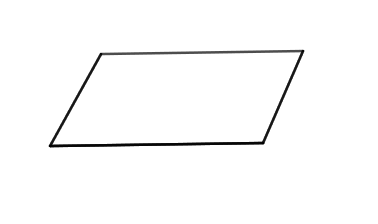
We know that the properties of a parallelogram are that two opposite sides are parallel and equal and the opposite angles are also equal in a parallelogram.
Now we will try to understand the definition of the kite and its properties:
A kite is a quadrilateral that has $2$ pairs of equal-length sides and these sides are adjacent to each other.
We can represent the kite from the figure as below:
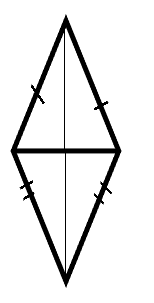
The properties of a kite are as follows:
We know that the diagonals of a kite meet at a right angle i.e. $90^\circ $ .
We should also know that one of the diagonal bisects the other diagonal i.e. it cuts in equal half.
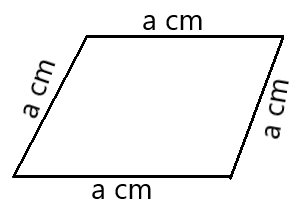
Now we know that from the above-given options, an only rhombus has the properties of a parallelogram and that of a kite. The diagonals of the rhombus bisect each other at a right angle and their opposite sides are parallel and equal.
Hence the correct option is (B) Rhombus
Note:
We should note that in a square all the sides are equal, so it does not fill the properties of a parallelogram , while in a triangle the diagonals do not bisect each other at $90^\circ $, so these two options are incorrect.
We can draw the image of the rhombus which is as follows:
Complete answer:
Let us try to understand the parallelogram first:
As we know that a parallelogram is a quadrilateral with two pairs of parallel sides. The diagrammatic representation of parallelogram is as follows:
We know that the properties of a parallelogram are that two opposite sides are parallel and equal and the opposite angles are also equal in a parallelogram.
Now we will try to understand the definition of the kite and its properties:
A kite is a quadrilateral that has $2$ pairs of equal-length sides and these sides are adjacent to each other.
We can represent the kite from the figure as below:
The properties of a kite are as follows:
We know that the diagonals of a kite meet at a right angle i.e. $90^\circ $ .
We should also know that one of the diagonal bisects the other diagonal i.e. it cuts in equal half.
Now we know that from the above-given options, an only rhombus has the properties of a parallelogram and that of a kite. The diagonals of the rhombus bisect each other at a right angle and their opposite sides are parallel and equal.
Hence the correct option is (B) Rhombus
Note:
We should note that in a square all the sides are equal, so it does not fill the properties of a parallelogram , while in a triangle the diagonals do not bisect each other at $90^\circ $, so these two options are incorrect.
We can draw the image of the rhombus which is as follows:
Recently Updated Pages
Master Class 10 Social Science: Engaging Questions & Answers for Success

Master Class 10 Science: Engaging Questions & Answers for Success
Master Class 10 Maths: Engaging Questions & Answers for Success
Master Class 10 General Knowledge: Engaging Questions & Answers for Success
Master Class 10 Computer Science: Engaging Questions & Answers for Success
Class 10 Question and Answer - Your Ultimate Solutions Guide
Trending doubts
What is the full form of PNG A Petrol Natural Gas B class 10 chemistry CBSE
Explain the Treaty of Vienna of 1815 class 10 social science CBSE
In cricket, how many legal balls are there in a standard over?
Why is there a time difference of about 5 hours between class 10 social science CBSE
Who Won 36 Oscar Awards? Record Holder Revealed
What is the median of the first 10 natural numbers class 10 maths CBSE