




Which of the following has a non-zero dipole moment?
(a)- $PC{{l}_{5}}$
(b)- $Cl{{F}_{3}}$
(c)- $Xe{{F}_{4}}$
(d)- ${{C}_{2}}{{H}_{5}}C\equiv C{{C}_{2}}{{H}_{5}}$
Answer
 Verified
575.1k+ views
Hint: Dipole moment tells the charge separation between two atoms and if the structure is symmetrical structure then the dipole moment will be zero because all the dipole moments are canceled out. For the compound to have a non-zero dipole moment then the compound must have an asymmetrical structure.
Complete step by step answer:
Dipole moment tells the charge separation between two atoms and if the structure is a symmetrical structure then the dipole moment will be zero because all the dipole moments are canceled out. Let us see the structures of all the compounds one by one:
(a)- $PC{{l}_{5}}$: This compound is phosphorus pentachloride. The structure of this compound is trigonal bipyramidal and this is a symmetrical structure, so the net dipole moment will be zero. The structure is given below:

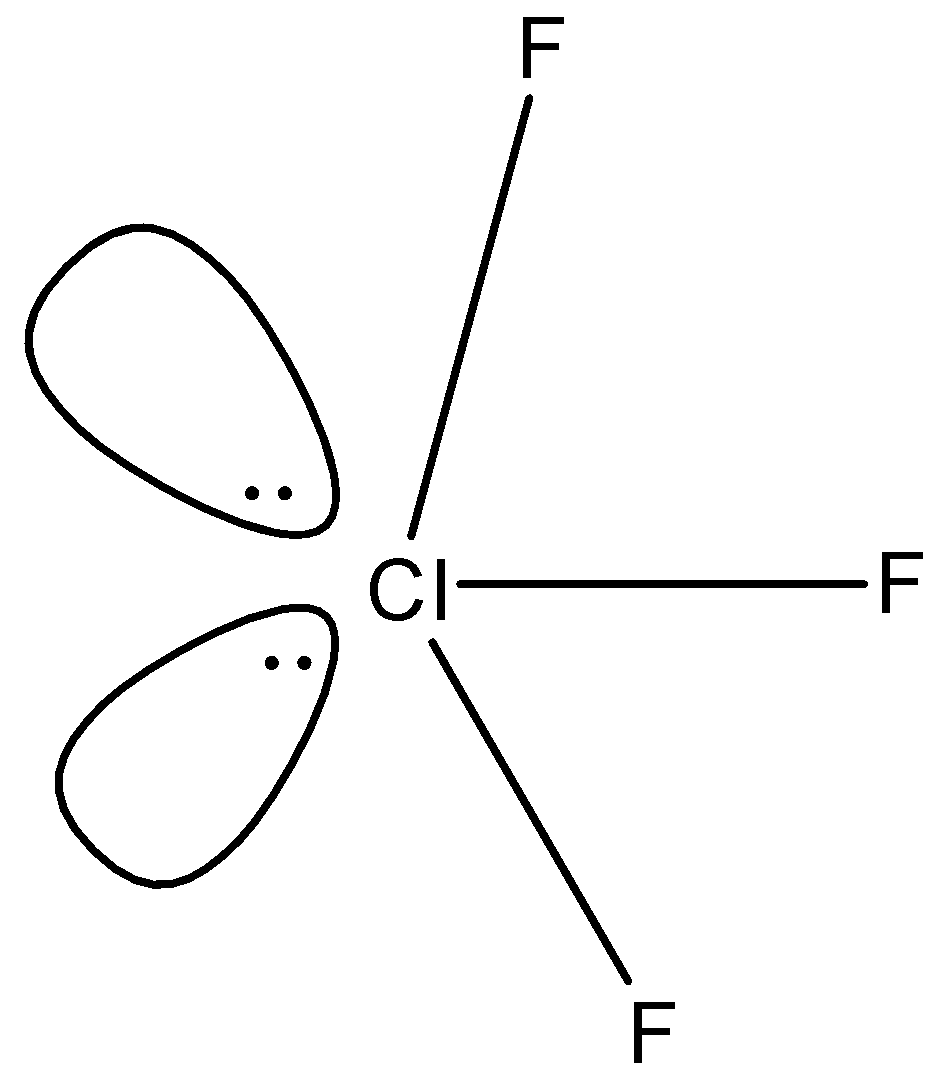
(b)- $Cl{{F}_{3}}$ : This compound is chlorine trifluoride. There are three fluorine atoms attached with the chlorine and there are two lone pairs on the chlorine atom due to which the shape becomes distorted and the net-dipole is non-zero. The structure is given below:
(c)- $Xe{{F}_{4}}$: This compound is xenon tetrafluoride. The structure of this compound is square planar and this is a symmetrical structure. So, the net dipole is zero. The structure is given below:

(d)- ${{C}_{2}}{{H}_{5}}C\equiv C{{C}_{2}}{{H}_{5}}$: This compound is hexan-3-yne. The structure of the compound is linear and the linear structure is a symmetrical structure. The dipole will be zero.
${{C}_{2}}{{H}_{5}}-C\equiv C-{{C}_{2}}{{H}_{5}}$ The correct option is option “D” .
Note: All the compounds having a linear structure will always have zero dipole moment. The dipole moment is denoted by the symbol $\mu $ and pronounced as meu. The unit is debye and written as D.
Complete step by step answer:
Dipole moment tells the charge separation between two atoms and if the structure is a symmetrical structure then the dipole moment will be zero because all the dipole moments are canceled out. Let us see the structures of all the compounds one by one:
(a)- $PC{{l}_{5}}$: This compound is phosphorus pentachloride. The structure of this compound is trigonal bipyramidal and this is a symmetrical structure, so the net dipole moment will be zero. The structure is given below:
(b)- $Cl{{F}_{3}}$ : This compound is chlorine trifluoride. There are three fluorine atoms attached with the chlorine and there are two lone pairs on the chlorine atom due to which the shape becomes distorted and the net-dipole is non-zero. The structure is given below:
(c)- $Xe{{F}_{4}}$: This compound is xenon tetrafluoride. The structure of this compound is square planar and this is a symmetrical structure. So, the net dipole is zero. The structure is given below:
(d)- ${{C}_{2}}{{H}_{5}}C\equiv C{{C}_{2}}{{H}_{5}}$: This compound is hexan-3-yne. The structure of the compound is linear and the linear structure is a symmetrical structure. The dipole will be zero.
${{C}_{2}}{{H}_{5}}-C\equiv C-{{C}_{2}}{{H}_{5}}$ The correct option is option “D” .
Note: All the compounds having a linear structure will always have zero dipole moment. The dipole moment is denoted by the symbol $\mu $ and pronounced as meu. The unit is debye and written as D.
Recently Updated Pages
Master Class 11 Social Science: Engaging Questions & Answers for Success

Master Class 11 Physics: Engaging Questions & Answers for Success
Master Class 11 Maths: Engaging Questions & Answers for Success
Master Class 11 Economics: Engaging Questions & Answers for Success
Master Class 11 Computer Science: Engaging Questions & Answers for Success
Master Class 11 Chemistry: Engaging Questions & Answers for Success
Trending doubts
One Metric ton is equal to kg A 10000 B 1000 C 100 class 11 physics CBSE
There are 720 permutations of the digits 1 2 3 4 5 class 11 maths CBSE
1 Quintal is equal to a 110 kg b 10 kg c 100kg d 1000 class 11 physics CBSE
State and prove Bernoullis theorem class 11 physics CBSE
Difference Between Prokaryotic Cells and Eukaryotic Cells
Discuss the various forms of bacteria class 11 biology CBSE